Posted on | June 4, 2026 | No Comments
The Unitarian Universalists (“UUs”) exist as the consequence of a heresy — the rejection of the Trinity — that originated in Eastern Europe and eventually found a permanent home in New England, where Henry Ware made it the quasi-official religion at Harvard in the early 1800s. Many years ago, one of my neo-Confederate friends cited the conversion of Harvard to Unitarianism as the actual cause of the Civil War, and I haven’t researched the issue enough to confirm that theory, but the general apostasy of New England is remarkable enough, even without that connection to world-historic events. When the Pilgrims landed at Plymouth Rock, they were the most militant Christians on the planet, adherents of the teaching of John Calvin, seeking to escape religious corruption and oppression (as they viewed it) in the England of James I.
The Mayflower Compact‘s description of their purpose as “the Glory of God, and Advancement of the Christian Faith,” and John Winthrop’s subsequent conception of New England as a “city upon a hill,” are sufficient testimony to the profound religious belief that inspired those early settlers. This was not some generic Christianity, but a very specific Calvinist faith, and these settlers were in the vanguard of its most sincere adherents. When, after more than a century in New England, it seemed that the colonial faithful had lapsed from the zeal of their forefathers, Jonathan Edwards inspired a revival with his famous 1741 sermon “Sinners in the Hands of an Angry God,” which I would recommend to the reading of anyone who desires a true understanding of the Gospel.
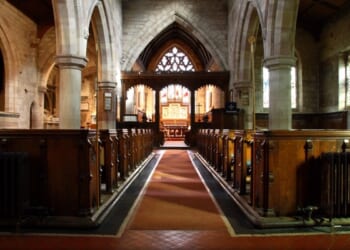
From the faith of the Pilgrims emerged what came to be known as the Congregational denomination. The Second Congregational Meeting House Society of Nantucket dates to 1809 — the “South Church,” to distinguish it from the First Congregational “North Church.” In 1837, the South Church congregation adopted Unitarianism in the form of the Harvard Covenant, and in 1961, the Unitarians merged with the Universalists to form the UUs, who are so far away from the Calvinism of John Winthrop and Jonathan Edwards that they’re practically in a separate universe. The South Church has made news:
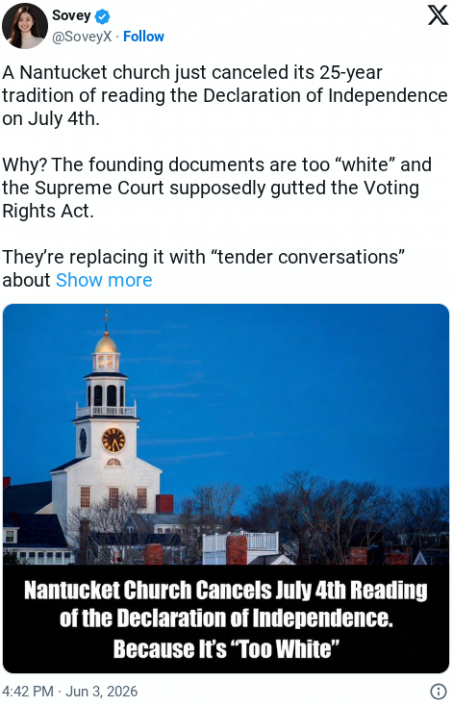
A liberal church on swanky vacation island Nantucket nixed its Fourth of July readings for the first time in 25 years in “political protest” over the Supreme Court’s voting rights ruling — and its congregants’ “whiteness.”
The Nantucket Unitarian Universalists has read the Declaration of Independence and Bill of Rights inside its church every Fourth of July for the last 25 years.
This year, the church’s board of trustees and presiding Rev. Erin Splaine published a letter announcing the cancelation of the readings just one month before America’s 250th birthday.
The church blamed the revision on the Supreme Court’s “gutting” of the 1965 Voting Rights Act and “an on-going process within the congregation to better understand our own whiteness,” according to the letter.
The self-proclaimed “liberal and free faith” leaders claimed that white people know the rights laid out in the America’s foundational texts “have, for centuries, been tragically, often violently, and unequally applied” against non-white citizens.
(Hat-tip: Ed Driscoll at Instapundit.)

The Rev. Splaine and her wife, Michelle
What would Jonathan Edwards have to say to the Rev. Erin Splaine? “Erin, her wife, Michelle and their very cute dog Charlie are thrilled to be part of the Nantucket UU and larger community,” we are informed, and I’m pretty sure the Pilgrims would not approve. The assertion that the Supreme Court’s decision in Callais amounted to “gutting” the Voting Rights Act was repudiated by Justice Clarence Thomas:
This Court should never have interpreted [Section 2] of the Voting Rights Act of 1965 to effectively give racial groups “an entitlement to roughly proportional representation.” … By doing so, the Court led legislatures and courts to “systematically divid[e] the country into electoral districts along racial lines.” Holder v. Hall, 512 U. S. 874, 905 (1994) (THOMAS, J., concurring in judgment). “Blacks [we]re drawn into ‘black districts’ and given ‘black representatives’; Hispanics [were] drawn into Hispanic districts and given ‘Hispanic representatives’; and so on.” Ibid. That interpretation rendered [Section 2] “repugnant to any nation that strives for the ideal of a color-blind Constitution.” Id., at 905–906. Today’s decision should largely put an end to this “disastrous misadventure” in voting-rights jurisprudence. Id., at 893.
As I explained more than 30 years ago, I would go further and hold that [Section 2] of the Voting Rights Act does not regulate districting at all. See id., at 922–923. The relevant text prohibits States from imposing or applying a “voting qualification,” “prerequisite to voting,” or “standard, practice, or procedure,” in a manner that results in a denial or abridgement of the right to vote based on race. … How States draw district lines does not fall within any of those three categories. Holder, 512 U. S., at 922–923 (opinion of THOMAS, J.); Allen v. Milligan, 599 U. S. 1, 46 (2023) (THOMAS, J., dissenting). The words in [Section 2] instead “reach only ‘enactments that regulate citizens’ access to the ballot or the processes for counting a ballot’; they ‘do not include a State’s . . . choice of one districting scheme over another.’” Ibid. (quoting Holder, 512 U. S., at 945 (opinion of THOMAS, J.)). Therefore, no [Section 2] challenge to districting should ever succeed.
Isn’t Justice Thomas more qualified to interpret the law and the Constitution than Rev. Splaine and her “very cute dog Charlie”?
Justice Thomas has talked about how, after a racial protest in Boston that turned violent in 1970, he went to the chapel at Holy Cross University and prayed: “I just asked God to take hate out of my heart, and I just vowed that if he did I would never hate again.” He has been commendably faithful to his vow, and I wonder what the Rev. Splaine thinks she will accomplish by her political stunt in a Nantucket church that long ago abandoned its claim to Christianity?
Shelby Steele’s 2006 book White Guilt analyzes the pathology expressed by the Rev. Splaine’s self-flagellating call to “better understand our own whiteness.” White guilt has become a religion for liberals, and they don’t understand why the rest of us aren’t heeding the altar call.