On the 29th of July 1909, as darkness fell over the Turó del Carmel hillside, Antoni Gaudí climbed onto the roof of his Parc Güell home. He was 57 years old. Across the city, columns of smoke rose from firelit streets. Barcelona’s churches and convents were burning. Earlier that day, Ramón Clemente García—a young, mentally ill man—had danced along the Ramblas with the corpse of a Hieronymite nun. Crowds had cheered. From a nearby convent, more corpses had been disinterred and dragged to the gates of the wealthy elite. What had started as a general strike against conscription for Spain’s war in Morocco had erupted into open rebellion.
From his rooftop, Gaudí would have been able to identify the burning buildings. I can see his bearded figure standing in the humid darkness, arms by his side, picturing loud flames rushing through the city’s sacred spaces. He would have thought of the mob, their astonished faces in the firelight. He would have hoped their rage would not bring them to the building site of his beloved church at the city’s edge.
For seven days and nights, violence and chaos carried away the city’s working classes. The anti-clerical incendiarism was down to provocative rhetoric from the Anarchist Party and Alejandro Lerroux, leader of the Radical Republican Party: “Enter and sack the decadent and miserable civilization of this unfortunate land: destroy its temples, throw over its Gods.”
Barcelona was changing. Against the great hum of an industrializing Catalonia, ancient belief systems had broken down. The city’s urban poor had turned on the Church and placed their faith in the political ideologies of anarchism, socialism, communism. By week’s end, Ramón Clemente García would lie dead—executed alongside five others. At least 112 lives would be lost. Twelve churches and 40 other religious buildings would be gutted, burned out, destroyed.
The week’s events came to be known as La Setmana Tràgica (The Tragic Week). They would haunt Gaudí for the rest of his life. He once said, “The man without religion is a man spiritually ruined, a mutilated man.” The city he had come to as a wide-eyed youth in the autumn of 1868 now found itself mutilated, polarized. Sides had been taken. The disharmony only served to radicalize Gaudí’s vision for his church. By 1914 he had renounced all other projects. The construction of La Basílica i Temple Expiatori de la Sagrada Família (The Expiatory Basilica and Temple of the Holy Family) would become the living embodiment of his ambition and spirituality, a building so remarkable it would expiate the sins of a fallen city.
The city could no longer grow within its walls. Between 1800 and 1909, Barcelona’s population had risen from 85,000 to 581,000. The rate of growth—27.4%—was three times the Spanish national average. Catalonia’s textile industry had become the fourth largest in the world. New wealth brought by industrialization drew workers from across the Iberian Peninsula to the city’s gates. But there was fear in Madrid. The central government wanted to shackle Barcelona’s transition from medieval town to metropolis. From behind their heavy desks, lawmakers refused the city’s expansion. The city walls would keep people in, not out.
The already low living standards inside the city were worsening. Ill health, low wages, and exploitative factory owners meant a chasm had opened between a new class of Catalan merchants and the urban poor. In 1854, when cases of cholera broke out and spread through the city, the walls were blamed. Civil disobedience escalated. It was the people themselves who began to pull down the walls.
Madrid’s authorities gave in. They granted the city the right to expand. A plan proposed by the civil engineer Ildefons Cerdà would be the blueprint. Cerdà’s plan set out streets in the shape of a grid, linking Barcelona’s old town with the villages of Gràcia and Sarrià. Each block would be octagonal, opening onto garden squares and parks. Light and air would pass through long straight roads. This was urban planning that considered the health and well-being of citizens. And rising from its gridded heart would be the spires of Gaudí’s Sagrada Familia.
At the time of La Setmana Tràgica, the site of the church was still on the city’s edge. Stonemasons worked where farmers had once grown crops. In Gaudí: A Biography, the art historian Gijs van Hensbergen describes children playing there, flying kites that would become tangled in scaffolding that surrounded the church’s facade. As Cerdà’s expansion grew block by block, Gaudí’s church continued to climb. But progress was erratic. Construction depended on alms: This was a church built by the people, for the people. When funds dried up, construction stalled.
Gaudí was appointed the church’s chief architect in 1883. At just 31, the boy born into a family of coppersmiths would now be spoken of among the city’s most renowned architects. The project was not new; construction on an unremarkable neo-Gothic church had started a year earlier, conceived of by the eccentric bookdealer José María Bocabella. Bocabella, troubled by the social and political turmoil of the 19th century, sought to build a church that would draw the city closer to God. But quarrels between the church council and the project’s original architect, Francisco de Paula del Villar, had led to Villar’s resignation. The project was rudderless. Bocabella despaired. He would later tell people he was visited in his dreams by an architect with piercing blue eyes. Several days later, he found himself face to face with the blue eyes of Antoni Gaudí.
Gaudí had arrived in Barcelona from the province of Tarragona in 1868. He settled quickly into the city’s social scene. He dressed well, holding a particular preference for black silk top hats and kid leather gloves. He frequented cafés. He attended artistic and literary events. But by the time of his appointment as La Sagrada Familia’s chief architect, a shift in his spiritual life began to alter his relationship with the world around him. He no longer spent free time socializing. Neglectful of his appearance, his clothes became increasingly disheveled. Slowly he withdrew from public life. Fasting became commonplace, to the point that he imperiled his life with a Lenten fast in 1894. As the city moved into an age of materialism, Gaudí retreated inward, embracing a persona of devout piety as his mind worked tirelessly to figure out a church interwoven with God.
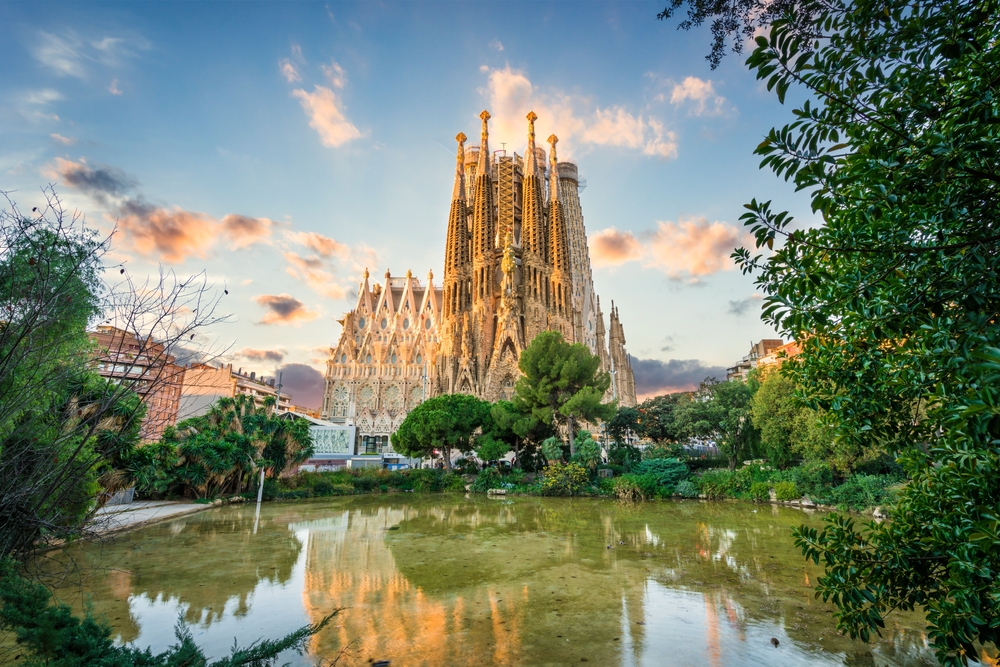
After 1909, Gaudí worked exclusively on his church. Without the distraction of secular commissions, he set his mind to solving the problems posed by such a huge building. Principal to the building’s design was its verticality: This was a church that would link heaven and earth. Eighteen towers with lipped openings would represent Jesus, Mary, the four evangelists, and the 12 disciples. Three portals would commemorate the life, death, and resurrection of Christ. Inside, a dreamlike world would reveal itself, showering worshipers in multicolored light as perforated towers harvested wind. Helicoidal staircases would allow the towers to act as echo chambers, funneling the sound of a natural chorus down to the church floor. The building itself was a musical instrument, a looking glass, a kaleidoscopic space that belonged more to an imagined future than to the early 20th century. Gaudí said, “Hearing is the sense of Faith and seeing is the sense of Glory, because Glory is the vision of God. Seeing is the sense of light, of space, of plasticity, vision is the immensity of space; it sees what there is and what there is not.” Here was a building that put a distance between people and the eroding norms of society. It was a sacred space of parabolic shapes, blurring the threshold between nature and man.
Of course, Gaudí knew his church would not be finished in his lifetime. Whenever asked about its completion—a common question considering the slow progress—he would respond, “My client is in no hurry.” At the time of his untimely death, just a single bell tower dedicated to the apostle Barnabus stood complete. Now, a century on, La Sagrada Familia is the tallest church in the world. It is still unfinished. I find it hard to imagine gazing up at a version where men in hard hats do not walk the scaffolding, where cranes do not guide sheets of glass through air. Part of me wishes to see the church’s completion. A greater part hopes they go on building it for ever.
By 1926 Gaudí had moved from Parc Güell to his workshop at La Sagrada Familia. His world continued to close in around him. He was cut off, detached. He let his white beard grow long and regularly shaved his head. Although his personality had changed, he was still known for the strictness with which he kept to his routine; you could set your clock by the old man. His working day began with a 5 a.m. walk to Barcelona Cathedral for morning prayers. It ended in the old town with confession at the Oratori de Sant Felip Neri. Those ancient patterns of ritual, so tightly spun over generations, having been renounced by so much of society, had not loosened their hold over Gaudí.
It was on the evening of June 7, 1926, walking southward through Cerdà’s Eixample, on his daily pilgrimage to Sant Felip Neri, that Antoni Gaudí stepped from the pavement and into the path of an oncoming tram. He was knocked unconscious. As the tram trundled away through the city—the driver mistook him for a drunken vagrant—two passers-by crouched beside the disheveled stranger. Blood was running from his right ear. In his pockets they found only almonds, raisins, and rosary beads. He was not wearing socks. Neither could have suspected this man of being the architect of so many of the city’s wonders. Three taxis would ignore their calls for help. A member of the Guardia Civil had to force a fourth taxi driver to bring Gaudí to the dispensary on the Ronda de Sant Pere. Once there, with his identity still unknown, doctors decided to send him to Hospital Clínic, the most advanced in the city. But the ambulance drivers placed little value on the life of a man they thought a tramp, opting to take him to the closer Hospital de la Santa Creu. He was placed in bed number 19 on a public ward. There he lay, slipping in and out of consciousness.
When friends found him the following day, in a brief window of lucidity, he declined the offer of a transfer to a private clinic. On Thursday the 10th of June, Antoni Gaudí died. Two days later, the city’s inhabitants tied black ribbons to their balconies. Thousands lined the streets as his coffin made its way to La Sagrada Familia.
Gaudí’s work goes on. Construction of La Sagrada Familia has endured in fits and starts through civil war, two dictatorships, two world wars, and a global pandemic. A building once paid for by the people is now paid for by tourists: 4.8 million people passed through La Sagrada Familia’s turnstiles in 2025 (almost three times the city’s population). The city’s streets are no longer laced with the smoke of burning churches, and the social complexities of industrialization no longer threaten open rebellion, but a lack of affordable housing, overcrowding, and a local economy dependent on the hospitality industry means tourism is where the city’s inhabitants now direct their ire. I wonder: Would Gaudí be perturbed by the magnetism with which people from across the world are drawn toward his church? Or would a quiet satisfaction be taken? So many souls passing through the multicolored light of his finest creation.
One hundred years after his death, the man who never left Catalonia is responsible for its most prominent global symbol. I can see him now, white-bearded and shabbily dressed, no socks inside his shoes, walking quietly through the glow of a Barcelona evening, almonds in his pockets, his head full of his Sagrada Familia.