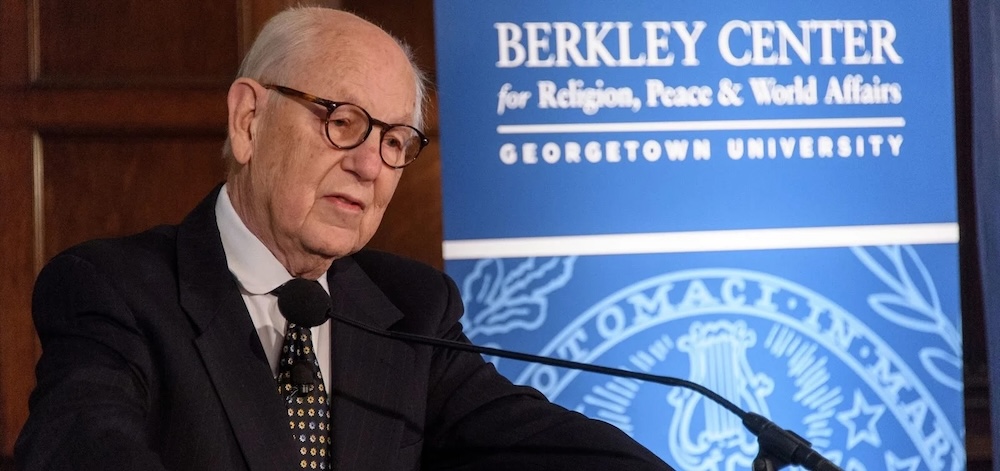
In my first year at the University of Virginia, I registered for a course on the history of Christianity from the birth of Christ to the conversion of Vladimir the Great of the Kievan Rus in 988. For an 18-year-old evangelical eager to understand the history of my faith, the name of the instructor meant nothing to me. Even when I received my grade at the end of the semester, I had no idea that I was learning from one of the preeminent global authorities on the history of the early church and a leader in the conservative movement to preserve religion’s role in the public square. That man was Robert Louis Wilken, who died on June 6 at the age of 89.
Professor Wilken, practically old enough to be my grandfather, presented as an imposing force, a no-nonsense, old-school academic. He told students on that first beautiful September day of class that he expected every student ready at their desk promptly at 9 a.m. He bemoaned the quality of writing he often encountered from undergraduates and said he would hold us to strict standards for our papers and exams. All this was delivered in an accent I could not place but that remotely sounded similar to my Brooklyn-born, Queens-raised grandfather. (In fact, Wilken was from New Orleans, but as I learned from him, the city’s port identity fostered, among many, an oddly “Yankee” or “Yat” accent.)
As a low-church evangelical, my exposure to the writings of the post-biblical early church was close to nothing, so Wilken assigning St. Justin Martyr, St. Athanasius, and St. John of Damascus, among others, was an arresting introduction to a seemingly foreign Christian faith and practice. Nevertheless, Wilken was an excellent instructor, and I decided to introduce myself to him during his office hours. He was quite welcoming and friendly, and asked me about my own religious tradition. I told him that I was “nondenominational,” thinking myself clever for belonging to a contemporary evangelical movement that, we thought, transcended denominational parochialism—we just believed in Jesus. He didn’t respond to me, at least not verbally. Instead, he gave me a disconcerted, haunting glance that seemed to communicate that I had said something demonstrably stupid. (Now I know I had.)
One morning before Wilken’s class, I saw one of my friends chatting outside with a cute girl. Both handsome and a flirt, I worried for him. Sure enough, a few minutes after Wilken started his lecture, my friend tried to enter the classroom. “Oh no you don’t,” Wilken declared, and attempted to shut the door in his face. My friend tried to push on the door and come in, which only further emboldened our professor to block him out (and lock the door!). Afterward, my friend waited outside to express his contrition. Yet Wilken seemed almost apologetic for his behavior, as if he had hoped his bark would preclude any such bites.
Though intimated, I found Wilken precisely the kind of professor from whom I wanted to learn, and I did well in the course. He would often make life recommendations, such as his maxim that anytime we make a significant choice in life, we often inevitably close off some opportunities. He told students that if they were to read any novel, they should read Fyodor Dostoyevsky’s The Brothers Karamazov. Like many, I was overwhelmed by the story and its deep spiritual meaning, encapsulated by Dostoyevsky’s citation of John 12:24: “Truly, truly, I say to you, unless a grain of wheat falls into the earth and dies, it remains alone; but if it dies, it bears much fruit.”
During my second year at UVA, my (Catholic) grandfather bought me a student subscription to the magazine First Things, which I soon discovered was led by an editorial board that included Wilken. That magazine came at an opportune moment in my intellectual and spiritual life. Continuing to take religious studies courses that often called into question historical Christian dogmas, and surrounded by a largely secular student body that was indifferent if not hostile to my religious faith, I found the articles therein a welcome salve, proof that Christians could be intellectually rigorous and defend themselves against skeptics and other religions. With First Things in my hand, my faith could hold its own in the public square, and I became capable of thoughtful debate with my fellow students. I shot off an email to Wilken expressing my gratitude for the magazine, which he forwarded to its founder and editor, Richard John Neuhaus.
When I decided to pursue a religious studies minor, I asked Wilken to be my adviser. During our conversation, I asked him what UVA courses he would recommend for someone like me, planning as I was to apply to a Protestant (Calvinist) seminary after graduation. His response surprised me: He told me to take a course on Islam. “You’ll take nothing but Christianity courses in seminary,” he said. “So take courses here on other religious traditions, so you understand them.” I regret I didn’t take his advice, especially ironic given that my first book is an account of my experiences advocating for persecuted Christian minorities in Muslim countries.
I returned regularly to Wilken’s books while I was in seminary. His The Spirit of Early Christian Thought—widely recognized after its publication as a masterpiece for its poignant analysis of the spiritual and intellectual currents of the early church—was assigned for one of my seminary courses. The Christians as the Romans Saw Them, a survey of early non-Christian sources and their discussion of Christians, has since proved far more useful to me than I would ever have anticipated, given the importance of understanding not only what a religious tradition says about itself but what others say about it.
Not long after I converted to the Catholic faith, Wilken published The First Thousand Years: A Global History of Christianity. In some respects, it was an extension of the very same college course of his I had taken a decade earlier. Yet it, too, has proved remarkably durable and valuable, perhaps one of the best single-volume treatments of early Christian history ever to be published, respected by Catholics and Protestants alike. And it truly is global, studying not only the Mediterranean and European world in which Christianity flourished and perpetuated Western civilization, but also sub-Saharan Africa (Ethiopia), Persia, and China.
For all this, Wilken will surely be read and remembered long after his death. But he also deserves a place of honor for his role in helping preserve religion’s role in American public life. His position at First Things, for example, had much to do with his long friendship with Neuhaus, with whom he had attended Lutheran seminary in St. Louis (both, of course, would in time become Catholics). Wilken’s articles for the magazine were usually on a historical topic, such as patristics or the relationship between Christianity and Islam, rather than on contemporary political debates that made First Things nationally relevant during the George W. Bush administration, in which Neuhaus served as an informal adviser.
Wilken’s last book, Liberty in the Things of God: The Christian Origins of Religious Freedom, is a full-throated argument that religious freedom and liberty of conscience owe their beginnings not to the political writings of the Enlightenment but to the early church. “Coercion has no place in religious devotion,” a quote from third-century church father Tertullian of Carthage, was in fact celebrated by the famous religious skeptic Thomas Jefferson, who copied it into his personal copy of his Notes on the State of Virginia. Wilken saw Jefferson’s marginalia as emblematic of how Christian ideas of religious liberty had been circulating, sometimes imperceptibly, for many centuries before the Enlightenment. In chapters covering the early church as well as the Reformation and its aftermath in Germany, Switzerland, France, the Netherlands, and England, Wilken demonstrated that far from being a secular concept, religious liberty has been central to Christian self-understanding since its beginning.
I published reviews of both The First Thousand Years and Liberty in the Things of God and emailed Wilken links to both. He replied with gratitude, though I wondered if he remembered who I was. So, almost four years ago, I contacted him and asked if I might see him in person. He graciously agreed and welcomed me to his and his wife Carol’s rowhouse in a historic neighborhood in Washington, D.C. Shortly after arriving, Wilken, much to my amusement, asked: “So, tell me again how it is that you know me?” (I had heard from a mutual friend that he was in declining health, so this comment did not offend me in the slightest.)
That afternoon, Wilken and I talked about all manner of subjects and persons (“To a great conversationalist,” he signed my copy of one of his books). I gave him a copy of my first book, and he promised to introduce me to First Thingssenior editor Rusty Reno. Then in my late-30s and with five children, I was no longer a naive, intimidated undergrad, though I still felt a deep sense of awe in Wilken’s presence. He in turn did everything to make me feel like his equal, something his friend David Bentley Hart noted in his own recent reflection on Wilken.
Afterward, I worried that might be the last time I would see Professor Wilken. I emailed him this past December and queried his availability; sadly, he never responded. The cancer, I presume, was too advanced for social calls.
Wilken was a rare breed, a man of impressive and diverse scholarly acumen, an influential player in a turn-of-the-century intellectual movement that has had a profound influence on conservative politics, and a deeply personable Christian who mentored scores if not hundreds of students. Like the church fathers he so carefully studied, he was a scholarly saint. I have no doubt his books will be read and discussed for many years to come—“unless a grain of wheat falls into the earth and dies, it remains alone; but if it dies, it bears much fruit.”


![Hegseth Demands Fitness Requirements, Says 'Fat Troops' 'Not Who We Are' [WATCH]](https://teamredvictory.com/wp-content/uploads/2025/09/Hegseth-Demands-Fitness-Requirements-Says-Fat-Troops-Not-Who-We-350x250.jpg)