“Education is useless without the Bible,” stated Noah Webster (1758-1843), known as the “Father of American Scholarship and Education.”
“The Bible was America’s basic textbook in all fields,” he continued. “God’s Word, contained in the Bible, has furnished all necessary rules to direct our conduct.”
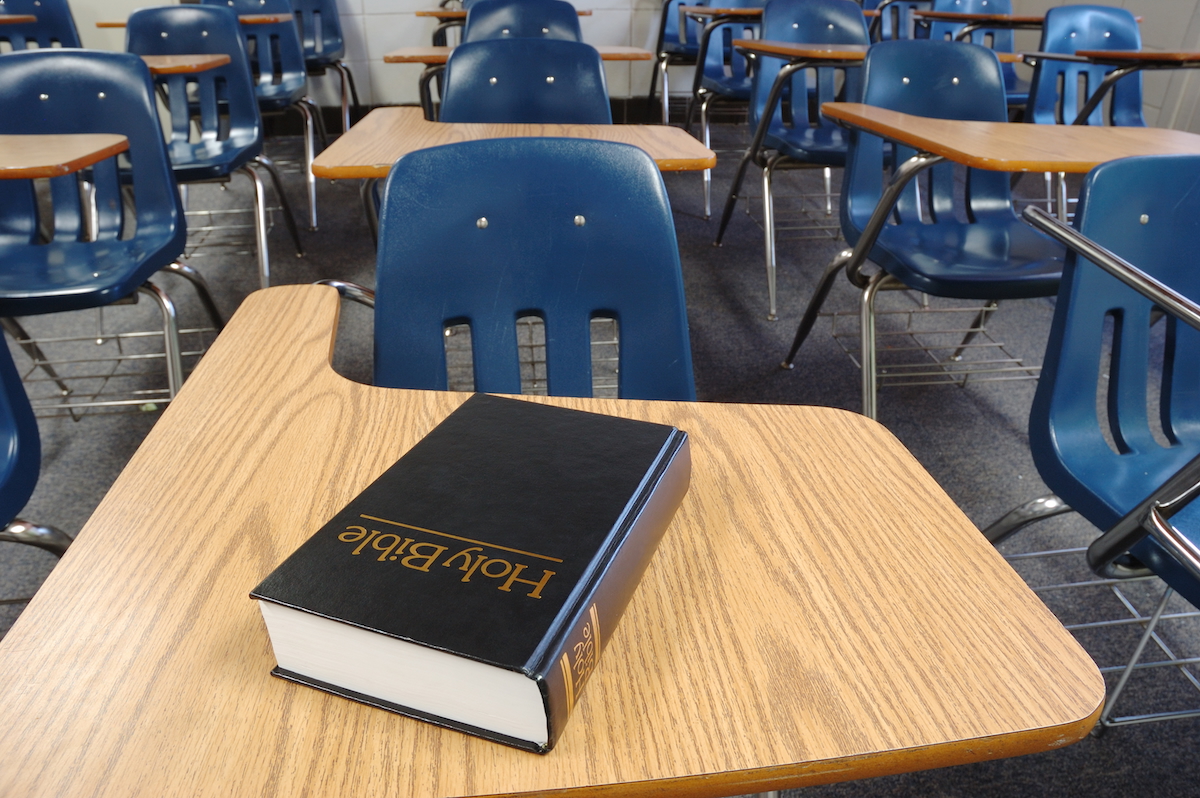
Texas is now taking this to heart. In fact, it has just approved a plan to require its five million-plus government school students to study Bible stories. This has, not surprisingly, inspired controversy. Among the criticisms, too, are claims — by figures such as Senate candidate James Talarico (D-Tex.) — that the proposal is “un-American.” This is an interesting response. After all, Webster perfectly reflected his time, as Bible teaching was essentially the norm in Colonial and early American education. And it remained a foundational element well into the 19th century.
Now, were all the Founders and the generations that created America un-American?
Reporting Friday on the Texas happenings, Reuters writes:
The Texas Board of Education on Friday approved mandated reading lists for public school children that include passages from the Bible…
The Republican-dominated board, in a 9-5 vote with one member absent and not voting, approved the reading lists for over 5 million public school students…
Texas had already mandated that the Bible’s Ten Commandments be displayed in all public schools, a decision that was upheld by a federal appeals court earlier this year, following on the heels of other Republican-led states seeking to infuse public education with Christian teachings.
Regarding specifics on what will be taught, the Washington Examiner informs:
The reading list won’t take effect until 2030 for elementary school students, with the higher grades to follow.
Younger elementary students will learn about classic children’s Bible stories, such as David vs. Goliath, while fourth-graders will start reading passages about Jesus in the New Testament.
By middle school, students will be expected to take on more passages about Jesus, including the Sermon on the Mount. After entering high school, students will read specific Bible passages alongside literary works by renowned authors such as Charles Dickens and Jane Austen.
The Examiner then continues, however:
Critics of the proposal argue that reading the Bible in school blurs the separation between church and state, whereas proponents believe that the public school curriculum should include an understanding of the Bible because of its influence on American society.
The issue: While the latter part of the above is accurate, the first part reflects a fallacy and a falsehood.
Biblical Software in America’s Hardware
As to biblical influence, an MSN commenter expressed the following in response to the Texas story:
The Bible is the single most influential book in western civilization, and no one is educated who is ignorant of it.
Is this mere sectarian bias? Well, consider research on works that influenced America’s Founders. As the Oxford University Press (OUP) related in 2016:
Following an extensive survey of American political literature from 1760 to 1805, political scientist Donald S. Lutz reported that the Bible was cited [in the Founding era] more frequently than any European writer or even any European school of thought, such as Enlightenment liberalism or republicanism. The Bible, he reported, accounted for approximately one-third of the citations in the literature he surveyed.
Now, given the above, how can we understand the Founders or our founding if ignorant of the Bible?
Of course, though, such ignorance will suit you just fine if you don’t want people to understand the Founders or founding.
Much more could be said, too, than space allows here, and the whole OUP essay is worth reading. But here’s one more telling passage:
Many founders also saw in the Bible political and legal models — such as republicanism, separation of powers, federalism, and due process of law — they believed enjoyed divine favor and were worthy of emulation in their polities.
In other words, Christianity is the software in the American republic’s hardware.
In fact, even a wiser, patriotic atheist should encourage biblical teaching. Why? Well, how can you recreate a delectable dish if you forget the recipe?
Consider: I quite dislike ginger. I won’t drink ginger soda or eat ginger candy. Nonetheless, when I’d make Indian food years ago, I’d include ginger when the recipe prescribed it. The reason is that I understand it may be a prerequisite for the finished product. Working in concert with the other spices, it may create a culinary wonder.
So it can be with someone who’s indifferent to Christianity or who even views it negatively. He could grasp that removing an ingredient he dislikes from the American recipe could yield an outcome he dislikes far more.
First Amendment Violation?
What, though, of constitutional imperatives? Does in-government-school biblical teaching violate the First Amendment? Anyone saying yes must believe the Founders were ignorant of what they meant when writing that amendment. After all, intra-school biblical instruction was the norm in their era — and they never complained about it.
This isn’t to say the “separation of church and state” isn’t a constitutional principle. It is.
It’s in the 1936 Soviet Constitution.
Our Constitution is a different story. It merely states that “Congress shall make no law respecting the establishment of religion or prohibiting the free exercise thereof.” (Note: This simply means that the central government may not strong-arm people into membership in an established national church.) The Supreme Court never misinterpreted this to mean “separation,” either, not for the first 150-plus years of our history, anyway. That is, until 1947, when ex-Klansman Hugo Black wrote an opinion that was perhaps motivated by prejudice in this regard.
Oh, it’s true that Thomas Jefferson did use the phrase “wall of separation,” but this is also misunderstood. Jefferson’s usage was not in a government document, but in an 1802 letter to the Danbury Baptist Association. And the intent? It was merely to reassure the group that, under his presidency, religious beliefs would not be imposed upon them.
Put differently, Jefferson’s “wall” was a one-way filtration system. It kept government out of religion — not religion out of government.
In fact, the Founders infused religion into government. They opened the very first Congress, in 1789, with Christian prayers. This practice continued thenceforth, too — and to this day the prayers are still mainly Christian.
Imposition of Values?
Moving on from the legal realities, however, what of the moral/philosophical ones? “You’re imposing Christian values!” some will say. “This is indoctrination!” The proper response to this is:
So what?
The term “indoctrination” comes from the Latin indoctrinare (“to teach” or “instruct”); it’s derived from doctrina (“teaching” or “doctrine”). Originally, it simply meant systematic instruction in a body of knowledge or beliefs — similar to “education” or “inculcation.” Sure, it usually has a negative connotation today, but this misses the point. To wit:
“In truth, there are only two kinds of people,” noted philosopher G.K. Chesterton; “those who accept dogma and know it, and those who accept dogma and don’t know it.”
There is no such thing as “value-neutral” education. When schools teach about “LGBTQIA+,” climate change, or the “misdeeds of Western civilization,” does this not involve values?
“Ah, but we’re talking about ‘religious values’ here,” some may counter. Again, so what? Consider an argument I’ve posed:
If the religious ideas in question really have been handed down by God, Creator of the Universe and Inerrant Author of All, don’t we have a duty to infuse our public sphere with them? Is it not then an imperative that we immerse schoolchildren in this divine light? Of course, naysayers may now respond, “Not everyone worships sky fairies! These are just man-made beliefs.”
Alright, but if so, why say that the man-made beliefs we happen to call “secular” may be in the public square, but the man-made beliefs we happen to call “religious” may not be? If they’re all man-made, wherein lies the difference?
Conclusion: Either these beliefs are man-made, in which case they can share the table with other man-made ideas and may be in the public square.
Or they’re from God and must be there.
Not understanding the above has led to tragic discrimination — to “religious” ideas being relegated to the back of the bus. It has also led to ignorance. Just consider what a 15-year-old student said to me when I alluded to Scripture about 25 years ago.
“You mean that Bible book?” he replied casually, as if he’d just heard rumor of its existence.
If this isn’t an example of modern educational malpractice, what is?