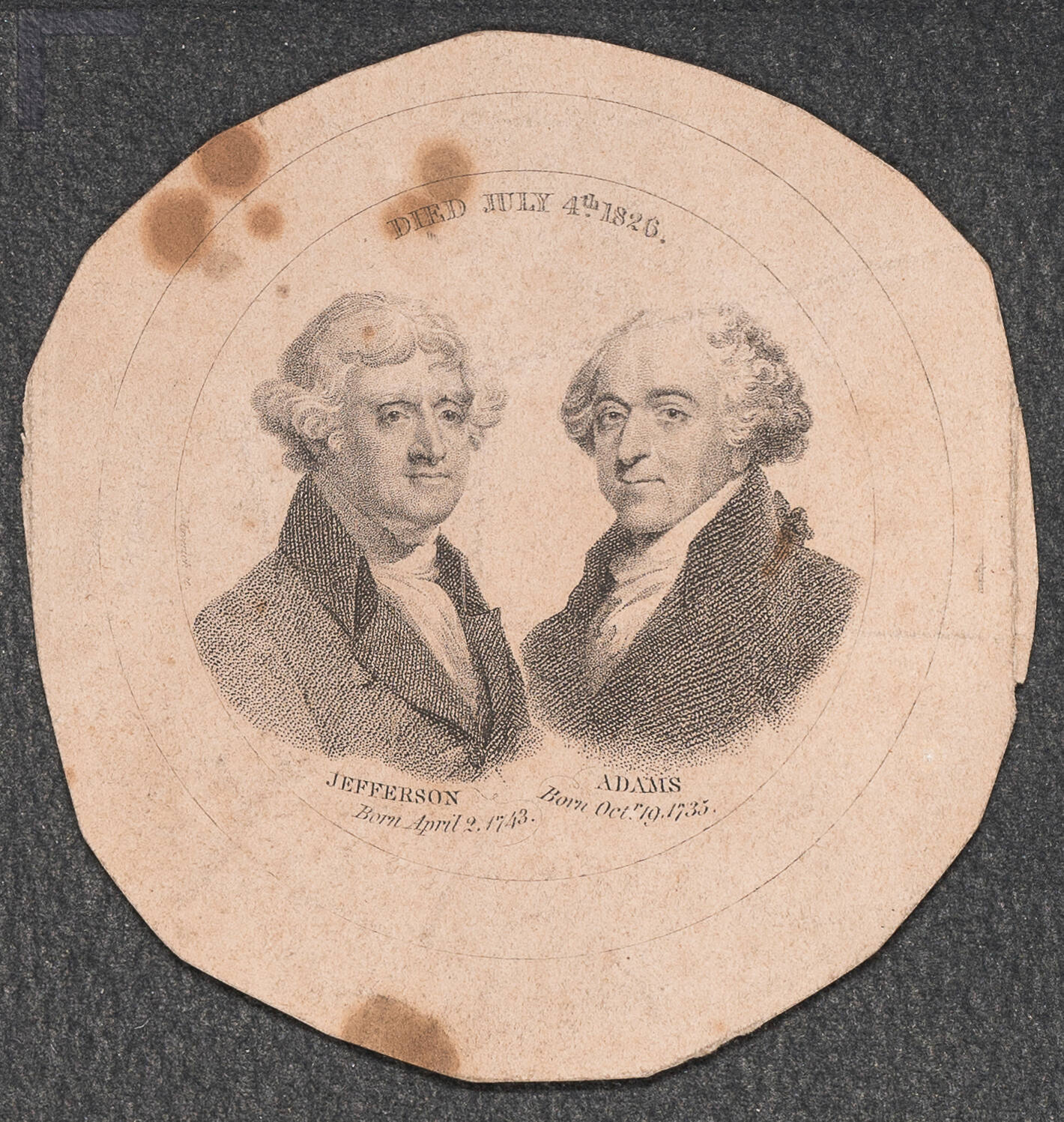
In the early days of July 1826, Thomas Jefferson “marshalled his will toward the realization of one last mission: He wanted to survive until the Fourth of July.” So writes Jon Meacham in his marvelous biography Thomas Jefferson: The Art of Power.
Jefferson did, repeatedly asking in his final agony in the evening hours of July 3: “This is the Fourth?” He finally heard the twelve chimes of midnight on his bedroom clock; he lingered, drifting out of consciousness, but knowing it was the Fourth. He died at ten minutes before one o’clock that afternoon.
Five hours after the third president died at Monticello, the second president, John Adams, died in Quincy, Massachusetts. His famous final words were false: “Thomas Jefferson survives.”
Both died on the fiftieth anniversary of the Declaration of Independence, two hundred years ago. (The fifth president, James Monroe, would die on the Fourth in 1831.) It’s the great anniversarial coincidence of the Founding Fathers. The reaction to the twin presidential deaths on the fiftieth anniversary of the first Fourth was that Providence was at work, not unlike how Catholics consider miracles in the causes of saints.
John Quincy Adams, president at the time of his father’s death, styled the coincidental deaths “visible and palpable marks of Divine Favor, for which I would humble myself in grateful and silent adoration before the Ruler of the Universe.”
The junior President Adams issued an executive order in memory of the senior Adams and Jefferson:
A coincidence of circumstances so wonderful gives confidence to the belief that the patriotic efforts of these illustrious men were Heaven directed, and furnishes a new seal to the hope that the prosperity of these States is under the special protection of a kind Providence.
In early August 1826, with President Adams present, Daniel Webster was more fulsome at Faneuil Hall in Boston:
Adams and Jefferson are no more. On our fiftieth anniversary, the great day of national jubilee, in the very hour of public rejoicing, in the midst of echoing and re-echoing voices of thanksgiving, while their own names were on all tongues, they took their flight together to the world of spirits.

Webster continued:
If we had the power, we could not wish to reverse this dispensation of the Divine Providence. . .[that] the heavens should open to receive them both at once. As their lives themselves were the gifts of Providence, who is not willing to recognize in their happy termination, as well as in their long continuance, proofs that our country and its benefactors are objects of His care?
The Declaration of Independence, signed fifty years before Adams and Jefferson died, professed a “firm reliance on the Protection of Divine Providence.” Now, it seemed to their contemporaries that Providence had vouchsafed a final protection, calling Jefferson and Adams home on the anniversary of their great work.
Meacham wrote that Webster “painted an indelible portrait of Jefferson’s and Adams’s ascent to the American pantheon.”
Catholics do not have a pantheon, but there are the saints. Catholic saint-making – or saint-recognizing, strictly speaking – has two broad parts. First there is the human judgment, after a painstaking examination, that the candidate lived a holy life, culminating in a declaration of “heroic virtues.” The second is the celestial confirmation, the requirement of a miracle, understood to be divine evidence, as it were, that the candidate is in heaven, interceding before God.
The Fourth in 1826 was something like a miracle for the secular canonization of the nation. What the founding generation of Americans knew by experience – and aspiration – had apparently been confirmed by Providence. They knew the heroic virtue of the young republic; now a divine benediction had been granted.
Organizers of the golden jubilee of the Declaration had greatly desired to have Jefferson in Washington, but he was too ill to travel. He wrote a letter for the occasion, noting the fittingness of observing the anniversary.
All eyes are opened, or are opening, to the rights of man. These are grounds of hope for others. For ourselves, let the annual return of this day forever refresh our recollections of these rights, and an undiminished devotion to them.
In all cultures, anniversaries – “the annual return of this day” – are markers of memory and occasions of gratitude and recommitment. Anniversaries bring to mind great moments from the past, most often beginnings, birthdays and weddings and ordinations, but also endings, including retirements and graduations (even if the latter are sometimes called commencements).
Biblical imagination makes something more of the anniversary, commanding that it be kept as a festive memorial down through the generations. (cf. Exodus 12:14) The Jewish intuition was that the anniversary memorial made the original moment present again. Those who were not present for the original covenant were thus able to join it.
By its fiftieth anniversary in 1826, the Fourth had already become an occasion for gratitude, celebration, and recommitment to original ideals. If, somehow, Jefferson and Adams had made it to Washington or Philadelphia for the jubilee celebrations, their presence would have elevated the occasion. Yet in death they sealed the Fourth as something sacred, watered not by the blood of fallen soldiers, but by an outpouring of grace – as only God sets the day and the hour.
Death anniversaries are usually kept with greater reserve, save for the saints, for whom they are literal feast days. The Fourth this year will be the first feast day for St. Pier Giorgio Frassati, a man bursting with life. The traditional term is dies natalis – death is birth to eternal life.
There are secular feast days – Presidents’ Day, Columbus Day – and every country has its national day. But the Fourth, due to its fiftieth, combines something of both, the secular and the sacred, enduring another two centuries to the semiquincentennial.

![Hegseth Demands Fitness Requirements, Says 'Fat Troops' 'Not Who We Are' [WATCH]](https://teamredvictory.com/wp-content/uploads/2025/09/Hegseth-Demands-Fitness-Requirements-Says-Fat-Troops-Not-Who-We-350x250.jpg)