
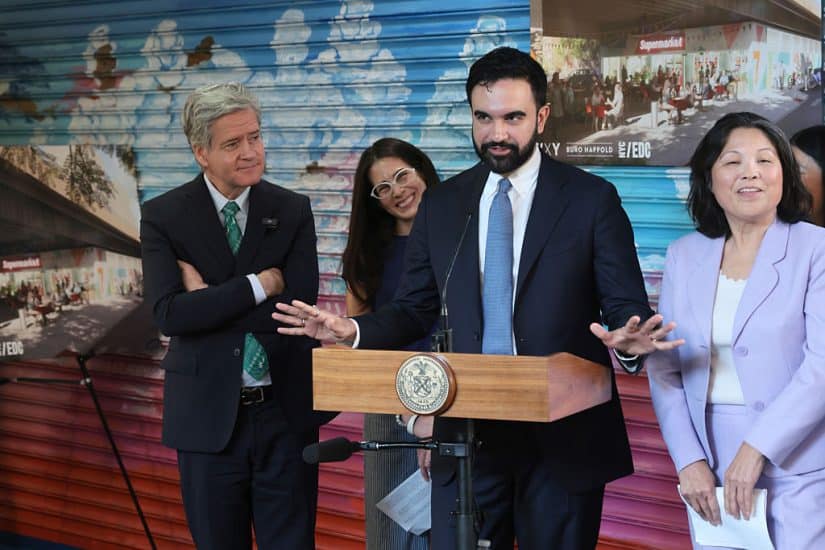
New York City bodega owners say they left a recent meeting with the Mamdani administration more worried than reassured after officials reportedly asked for sensitive business information while offering few details about the city’s controversial plan to launch government-run grocery stores.

Representatives from the city’s roughly 13,000 bodegas gathered at City Hall last week for what officials billed as a roundtable discussion on the proposal. Instead, attendees say they were met with probing questions about their businesses that only deepened concerns over the city’s intentions.
According to sources familiar with the meeting, Deputy Mayor for Economic Justice Julie Su distributed a questionnaire asking owners which products sell the most and where they earn their highest profit margins.
Don’t miss the stories that matter.
Get Sean’s breaking news alerts — free, direct to your inbox.
“They wanted us to share proprietary information with them, but they don’t answer our questions, and that’s why there is distrust,” one bodega representative told The New York Post.
The meeting comes months after Mayor Zohran Mamdani unveiled plans to establish city-owned supermarkets, beginning with a taxpayer-funded location in Hunts Point next year. Another proposed public grocery store at La Marqueta in East Harlem carries an estimated $30 million price tag and has drawn criticism from nearby merchants who fear government-backed competition.
City officials insist the publicly subsidized stores are intended to improve food access—not drive neighborhood businesses out of operation.
“We met with bodega owners so they could help us plan and ensure that we take into account their challenges and their role as a part of the food ecosystem,” Su said in a statement.
“One of the questions we wanted to understand is whether there are key products bodegas sell and rely on that we should not sell. That’s how serious we are about not undercutting them.”
Many small business owners remain unconvinced.
Independent grocers argue they already operate on razor-thin profit margins—often between 2% and 3%—while absorbing higher costs for fuel, property taxes, labor, and inventory. They warn that government-owned stores backed by taxpayer subsidies could offer prices private businesses simply cannot match.
As the administration searches for ways to soften opposition, officials are reportedly considering excluding deli counters from the public markets. Under one proposal, the stores would not sell made-to-order sandwiches, sliced meats and cheeses, chicken cutlets, or prepared salads—items that generate significant revenue for neighborhood bodegas.
“That’s a plan on the table,” Cathy Nonas, executive director of Meals for Good and a former senior food policy adviser for the city’s Department of Health, told The Post. She said city leaders “want to make sure that those who have served the community are still thriving after the public markets open.”
For many bodega owners, however, the latest meeting did little to restore confidence that the city can both operate taxpayer-funded supermarkets and avoid disrupting the small businesses that have long anchored New York’s neighborhoods.
More over at The New York Post:
Mamdani officials scramble to ease concerns about public supermarkets – but local business leaders aren’t buying it https://t.co/zmSqCSSHX2 pic.twitter.com/LcN9Jgl5lp
— New York Post (@nypost) July 6, 2026






![WHAT POLICY? Crockett Trips Through MS NOW Softball Question on Her Agenda if Elected to Senate [WATCH]](https://teamredvictory.com/wp-content/uploads/2025/12/WHAT-POLICY-Crockett-Trips-Through-MS-NOW-Softball-Question-on-350x250.png)