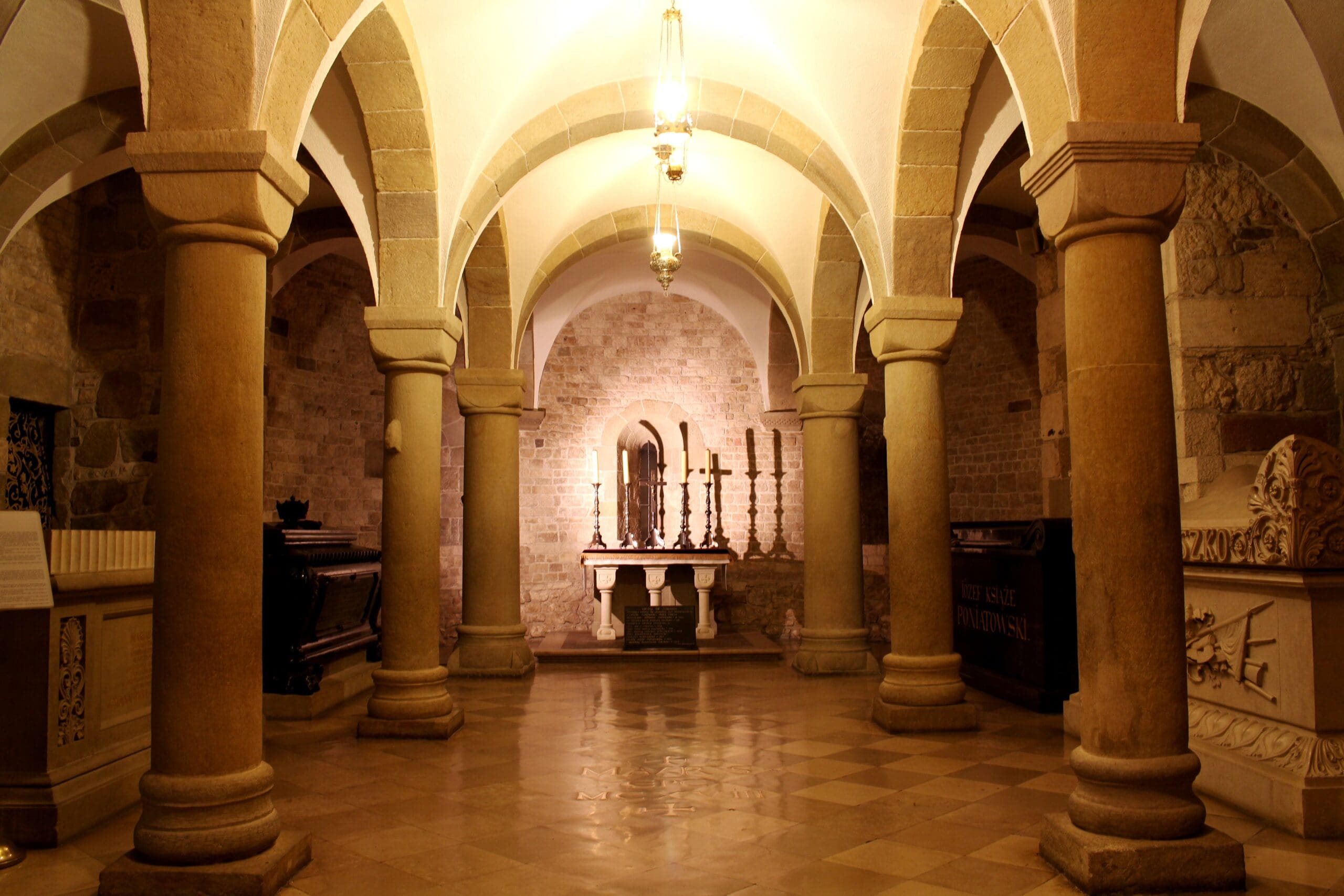
I am in Poland, as I am every July, for the Tertio Millennio Seminar, a three-week meeting on Catholic social teaching and the thought of John Paul II. As we often do, we began our seminar with Mass in the St. Leonard’s chapel. It was there that a newly ordained Karol Wojtyla offered his first Mass on November 2, 1946.
The chapel dates from the 11th century. Built in the Romanesque style, it has little decoration beyond the arches and columns. It does, however, contain the mortal remains of some of Poland’s great heroes, and their sarcophagi provide all the ornament the chapel requires.
King Jan III Sobieski, who saved Europe by defeating the Ottoman Turks at the Battle of Vienna (1683), is buried there alongside his wife. Sobieski’s predecessor, King Michał, lies nearby.
The other three tombs in the chapel are the tombs of men who fought, unsuccessfully in each case, for Polish independence.
General Władysław Sikorski, the Prime Minister of the Polish government-in-exile and commander-in-chief of the Polish Army during World War II, is also buried there. Sikorski died tragically in a plane crash during the war. He was buried in England, and his remains were only permitted to return to Wawel in 1993 after the fall of Communism.
When Poland ratified the first modern constitution in Europe (the second in the world after the United States Constitution) in 1791, the Russians invaded to put a stop to it. Józef Poniatowski led Polish forces in defense of the new Constitution, an effort which ultimately failed and resulted, eventually, in the first partition of Poland.
Beside the tomb of Poniatowski lies Tadeusz Kościuszko, who crossed the Atlantic in 1776 to join the American army. He designed the fortifications at West Point and played a decisive role in the American victory at Saratoga. He was a lifelong champion of Polish independence, a dream he never realized, and long after his death became the namesake of the RAF’s Polish Squadron during the Battle of Britain in World War II.
In life, Kościuszko was known for his unimpeachable character. He was a true devotee of human freedom, wherever it was threatened. One example: Kościuszko made his friend, Thomas Jefferson, the executor of his will, which ordered that his not insignificant American assets be used to purchase American slaves, free them, and set up schools for their education. (For complicated reasons, including legal challenges that ended up before the Supreme Court, Kościuszko’s will was never carried out.)
Young Father Wojtyła chose to offer his first Mass among the tombs of these Polish heroes, not from some misguided sense of nationalism, nor because they were successful in preserving or achieving Polish independence (most weren’t). Nor was the future pope under any illusion that these heroes were great exemplars of the Catholic faith; not all heroes are saints.

Nevertheless, these men were true heroes. And while they may not have been heroic examples of faith, hope, and charity, they possessed real virtues: justice and fortitude, to be sure, but also loyalty and a willingness to sacrifice for the common good. These heroes used those virtues in the service of their people and their beloved nation. And so while most of these “secular” heroes never lived to see Poland free, and are not counted as saints, their memory and example were precious – indeed, formative – to a young Karol Wojtyła who did become a saint.
Moreover, John Paul II understood, from both Polish history and his own experience of Nazism and Communism, just how precious and fragile freedom can be. This shaped his view of freedom in the modern age, and in particular, his admiration for (and occasional critiques of) our own experiment in ordered liberty here in the United States.
Politics requires virtue. This is true always and everywhere, but it is particularly true in a democracy (or if you prefer, a republic) like our own. People who cannot govern themselves cannot be expected to govern others wisely or well. The flourishing of our societies requires that we, the people, be people of a certain character, people possessed of certain virtues. No human government, no economic system, no culture, can long serve truly human ends without virtue.
In this regard, the Church plays an indispensable role in the life of society. The Church primarily serves supernatural ends, of course, but it contributes significantly to our natural, worldly good as well, not least through her innumerable charitable works: hospitals, schools, feeding the hungry, assisting refugees and the like.
Moreover, the Church insists that politics is not the highest end, and in so doing, recognizes a necessary limit on our politics. This is a boon to political freedom and, accordingly, totalitarian regimes tend to hate this about the Church more than anything else.
The Church also forms the moral character of citizens, instilling in them those virtues which are necessary for the Christian life – and which happen to serve the good of society as well. The highest of these virtues are faith, hope, and love. And the greatest exemplars of these virtues are the saints; men and women of heroic virtue who serve both as intercessors on our behalf and also as models of virtue from whom we can learn.
Nothing serves a republic so well as saintly citizens.
But there are natural virtues as well, beginning with the cardinal virtues, as men like Tadeusz Kościuszko demonstrated. Such virtues can be found in men and women whom we would never presume to call saints, but whose lives and character are worth study and emulation, nonetheless. Young Fr. Wojtyła understood that examples of virtue are precious, wherever they may be found, and worth celebrating.
To disregard real virtues when they are found in those who fall somewhat short of sainthood is cynical and foolhardy. When it comes to examples of virtue, we need all the help we can get. And so does our republic.


![Hegseth Demands Fitness Requirements, Says 'Fat Troops' 'Not Who We Are' [WATCH]](https://teamredvictory.com/wp-content/uploads/2025/09/Hegseth-Demands-Fitness-Requirements-Says-Fat-Troops-Not-Who-We-350x250.jpg)