In the interest of diplomacy and personal relations, it’s normally a good idea to follow the adage, “If you can’t say anything nice about someone, don’t say anything at all.” But when it comes to assessing challenging and complex situations, this advice should be flipped: “If you can’t say anything critical or incisive or even just useful, don’t say anything at all.” All too often, good-hearted people will smother a truthful analysis with platitudes that obscure issues and prevent potential solutions.
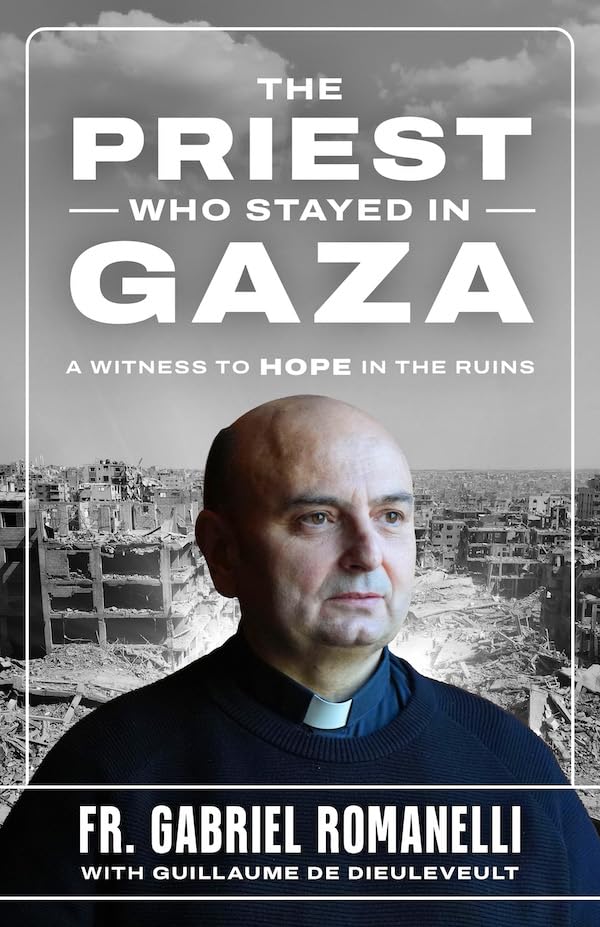
Such, alas, is the case with the well-meaning but ultimately counterproductive book, The Priest Who Stayed in Gaza: A Witness to Hope in the Ruins by Fr. Gabriel Romanelli, an Argentinian priest who has ministered to the dwindling Christian community in Gaza for the past few years. Already run down and desperately poor, the Gaza Strip became an active war zone after the Israeli military responded to the horrific terrorist attacks on October 7, 2023, looking to recover hostages and remove Hamas from power.
True to the book’s title, Romanelli refused to leave the area. Amidst the bombs and fighting, he continued to run the Holy Family Church, directing instruction for the children; managing the living conditions for homeless families; overseeing medical care for the sick and wounded; and celebrating the Mass for the few Christians still coming to church.
Unfortunately, the qualities that would make Romanelli an ideal observer prove to be his undoing. He is too close to the action to offer an objective perspective that would do the hard work of identifying causes and evaluating paths forward. He is too busy mediating conflicts between refugees, rationing food and water supplies, and entertaining the children to take a larger view of what is happening.
Another problem is Romanelli’s commitment to “avoid judgements, condemnations, denunciations, and other expressions belonging to the legal domain.” He thinks doing this will help him “clarify [his] point, reflect the atmosphere of the moment, or explain a particular situation,” as well as heal the many wounds inflicted by this conflict.
But this approach usually leads to precisely the opposite. Everything he describes happens with hardly any explanation: bombs fall, refugees arrive, the IDF imposes blockades, humanitarian convoys are looted, hostages are taken and tortured, ceasefires are made and broken, reconstruction is prohibited – all for apparently unknown reasons.
Although Romanelli thinks that this kind of indiscriminate reporting from an insider will encourage his audience to rise above blaming one side or the other, it mostly causes the reader to blame everyone for the seemingly senseless chaos. Despite their misery and the suffering it brings, the Gazans largely support Hamas and do little to create a workable society. Despite the heavy casualties and violent reprisals, the Israelis keep up their siege of Gaza and turn the area into an open-air prison.

Perhaps worst of all is Romanelli himself, who, despite his endless trials in Gaza, never really explains why he is there or what he wants. In broad terms, he is a Catholic missionary preaching the Christian Gospel and overseeing a local parish. But in his book, he primarily preaches a generic secular humanism (summed up in a repeated line, “Primum vivere: one must live above all”) and leads a refugee camp that primarily serves Muslims.
Ironically, he becomes indignant when journalists portray him as a “man who works for a humanitarian NGO.” He insists that he is “here for Christ – that is the truth.” Meanwhile, the number of Christians under his care declined rapidly, and his pastoral duties mainly pertained to housing refugees and providing them free childcare and healthcare. In his defense, this is all he can do because of the radical Islamist rule in Gaza: “speaking was not possible: but giving a sign of charity, yes.”
Yet surely if speaking in Gaza was impossible, his writing to the rest of the world should comment on that very fact.
Perhaps Romanelli believes his testimony will convert readers outside of the Holy Land. They might be inspired by his unflinching willingness to endure the hardships of Gaza for the good of his community, see God’s loving presence at work, heed his call for peace, let go of prejudices, and work towards a more tolerant, harmonious world.
But as several decades of the Church’s decline in the Middle East demonstrate, this kind of quiet evangelism has done little to bring about peace, much less convert people to the Catholic faith. Instead, it seems to perpetuate and even enable injustice and heresy by asking nothing of the people being helped.
It is more likely that Hamas sees Fr. Romanelli’s Holy Family Church as a convenient social service institution and an ideal hiding spot for its operatives, not an influential religious center run by saintly holy men and women.
There is a reason why Christ tells his disciples, “Do not give to dogs what is sacred; do not throw your pearls before swine. If you do, they may trample them under their feet, and turn and tear you to pieces.”
Simply offering Christian charity to everyone in the hope that this will win them over usually ends up backfiring. In Gaza and much of the Muslim world, Muslims will often take the aid and sympathy of Christians and use it to empower their own corrupt leadership, who will in turn bully and terrorize non-Muslims.
For Western Christians living in pluralistic liberal societies, this is a hard truth to accept. Not only are we reluctant to think of others as proverbial “dogs” and “swine,” but we have ceased to appreciate the Christian Gospel as “sacred” and as valuable as “pearls.”
What results is the tragic futility of Fr. Romanelli’s mission in Gaza, which produces no converts and effects no peace. Even though we can and should admire Fr. Romanelli’s steadfast courage, faith, and selflessness, we should also see The Priest Who Stayed in Gaza as a cautionary tale of what comes of nonjudgmental Christian charity in a hostile land.


![Hegseth Demands Fitness Requirements, Says 'Fat Troops' 'Not Who We Are' [WATCH]](https://teamredvictory.com/wp-content/uploads/2025/09/Hegseth-Demands-Fitness-Requirements-Says-Fat-Troops-Not-Who-We-350x250.jpg)