I’m old enough now to be the sort of person who will occasionally observe, in all apparent earnestness, that being around young people makes me feel young at heart. This is a concession to the realities of middle age which I am loath to make, but here we are.
I have just returned from two weeks lecturing on Catholic social teaching in Poland with some three dozen young people, mostly in their early to mid-20s. By any measure, this group was exceptional relative to their peers: they were academically excellent, religiously serious (mostly devout Catholics), vocationally minded, and incredibly diverse (we had students from both Peoria and Papua New Guinea).
Yet for all this, they were consistent in their evaluation of their own generation: anxious, fearful, and generally unsettled. More than the normal uncertainties of youth, this generation seems unsure of who they are, who they are supposed to be, and whom they might look to for answers. In short, they have inherited a profound doubt about even the possibility of hope.
The horizon against which they are taught to understand themselves seems to be shrinking. Young people feel the longing for greatness but increasingly seem to fear that such longings are illusory, that the call to greatness is unanswerable.
They are taught to strive for passing things – money, status, academic excellence – not because these passing things will satisfy, but because these things are all there is. It is a miserable lesson taught by a frustrated and cynical age that, having lost its own confidence in human possibilities, has inoculated a younger generation against hope.
My students are more immune to all this than most, but they see it all around them and cannot help but be touched by it. And that should unsettle all of us.
Youth, we older folks sometimes like to tell ourselves, is wasted on the young. I suspect this is mostly sour grapes on the part of people who are surprised to find it difficult to touch their own toes. The physical advantages of youth are obvious. But there are disadvantages, too.
Ronald Reagan – then 73 years old and seeking reelection against the 56-year-old Walter Mondale – famously joked in a debate: “I am not going to exploit, for political purposes, my opponent’s youth and inexperience.” The joke is, if anything, even funnier after four decades.
Youth (and its necessary companion, inexperience) is not, it turns out, much of a qualification for anything. Surely physical health and beauty, which come more easily to the young, are good things, but they are not reliable indicators of character or virtue. The measure of man is to be found elsewhere.
Young people, moreover, seem to know this. They understand, with all the hope and anxiety that comes with it, that they are not yet the men or women they will become. That space – the space between the person one is and the person one is becoming – is where the ultimate drama of every human life plays out.

This knowledge ought to be a source of wonder and of hope, for both the young and not-so-young alike. But it can only be that when human life is set against its proper horizon.
Christian faith broadens those horizons – far beyond the temporal and material – to their uttermost limit. In the light of the Incarnation, we perceive the fullest possible reach of human aspiration: perfect union with God himself.
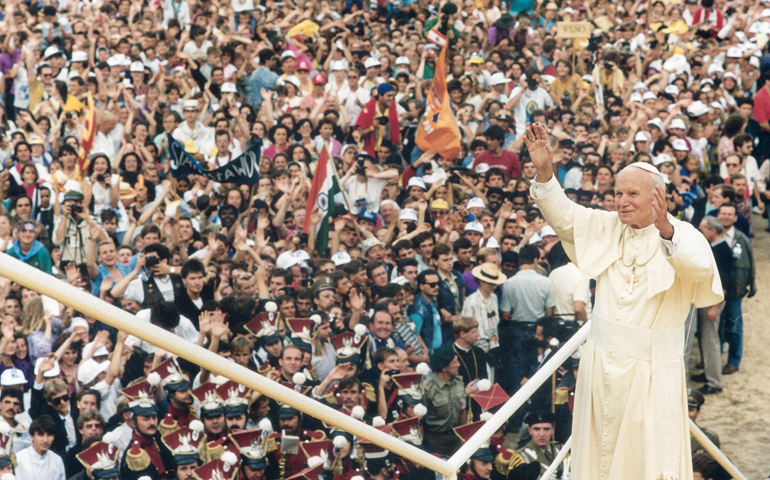
This union is not an obliteration of self but a fulfillment. As Pope John Paul II observed in his first Urbi et orbi: “For God and before God, the human being is always unique and unrepeatable, somebody thought of and chosen from eternity, some called and identified by his own name.” To be holy is to become conformed to God and, in so doing, to become truly, perfectly oneself.
I said that being around young people has a way of making me feel young at heart. What I mean is that young people tend to perceive more easily the drama into which we are all summoned. If the young are less calloused by the inevitable costs of life in this valley of tears, they feel the promise and potential of vocation that much more acutely. And that is contagious.
To feel young at heart is to be renewed in hope which comes from knowing the heights to which we are called and from knowing the One who calls us by name.
Which brings us back to the question of young people today. The danger for young people today is less that they are searching for God in all the wrong places but that they have been sold on the notion that the search itself is dangerous and quite probably not worth the risk. The highest aspirations of the human heart have been cowed with fear, anxiety, and doubt.
That is not good enough. Human beings were made for greatness. We all fall short, but we have a savior who lifts us up. Young people, of all people, need to be reminded of this. They need examples of this. Young people today need to hear the words so associated with Pope John Paul II, but which are first and last words of the Gospel:
“Be not afraid.” Christ knows “what is in man.” He alone knows it. So often today man does not know what is within him, in the depths of his mind and heart. So often he is uncertain about the meaning of his life on this earth. He is assailed by doubt, a doubt which turns into despair. We ask you therefore, we beg you with humility and trust, let Christ speak to man. He alone has words of life, yes, of eternal life.
Such words are liable to make anyone feel young at heart, because they inspire in us the daring to hope. These words transformed a generation. And they can do it again. If only we have the courage to proclaim them.