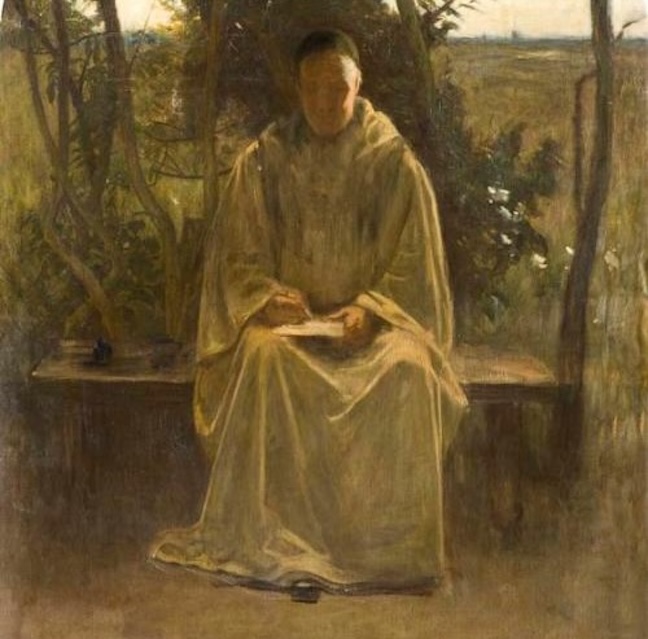
I wonder if a certain greater sobriety is not asked of us as regards our use of social media. And if so, who is going to tell us so? So much that is stern and chastising has been removed from the public acceptance of our faith today. This is strange when, never before, it seems, has such chastisement been so very badly needed.
To see what I mean, open the pages of the spiritual classic, The Imitation of Christ, by Thomas à Kempis. St. Thérèse of Lisieux memorized entire chapters of this book. Pope Benedict called it “that golden text of spirituality.” St. Theresa of Ávila directed that a copy should be placed in every convent that she founded.
In his chapter on love of solitude and silence, Thomas writes:
Very many great saints avoided the company of men wherever possible and chose to serve God in retirement. “As often as I have been among men,” said one writer, “I have returned less a man.” We often find this to be true when we take part in long conversations. It is easier to be silent altogether than not to speak too much. To stay at home is easier than to be sufficiently on guard while away. Anyone, then, who aims to live the inner and spiritual life must go apart, with Jesus, from the crowd. . . .No man appears in safety before the public eye unless he first relishes obscurity. No man is safe in speaking unless he loves to be silent.
Let me “operationalize” this teaching, as a modern social scientist might say. Should we say that no one should spend more minutes on social media during the day than he has already spent in prayer? Or consider prayer as like revenue, and you are not permitted to spend any time in speaking, except what you have earned in praying. “Raise your eyes to God in Heaven and pray because of your sins and shortcomings,” Thomas says at the end of the chapter.
Then we seem to have forgotten the traditional warnings against idleness. Idleness is definitely not the condition of having nothing to do on the Internet. St. Jerome says, “Always be doing something, so that the devil may find you always occupied.”
But are you “doing something” in his sense when you are reading posts or posting yourself? Suppose there is only one chore or task or duty which remains to be done, as you are aware. Doing which of these – that chore or that post – would be “doing something”? If reading to your child, improving yourself in some definite discipline, fixing something, calling a relative or friend – if any of these remains undone, then Internet activity which produces nothing of worth meets the definition of “idleness.”

St. Thomas Aquinas and other great spiritual writers teach that idleness involves not simply being “unoccupied,” but also turning away from a known good.
Newman spoke sternly about something he called “viewiness” in the Preface to his Idea of a University. We repeat, perhaps too easily, the sense of his opening lines there, about how a university exists mainly to form students, not to advance knowledge. But do we read on and see how he would be horrified if a university’s formation led to what he disparaged as “viewiness” in the students?
Yet what else could it lead to, if every view gets affirmed with an “A,” and if it’s presumed that every student in every submitted essay might reasonably have something “original” to say?
An intellectual man, as the world now conceives of him, is one who is full of “views” on all subjects of philosophy, on all matters of the day. It is almost thought a disgrace not to have a view at a moment’s notice on any question from the Personal Advent to the Cholera or Mesmerism. This is owing in great measure to the necessities of periodical literature, now so much in request.
Sound familiar? There’s more:
Every quarter of a year, every month, every day, there must be a supply, for the gratification of the public, of new and luminous theories on the subjects of religion, foreign politics, home politics, civil economy, finance, trade, agriculture, emigration, and the colonies. Slavery, the gold fields, German philosophy, the French Empire, Wellington, Peel, Ireland, must all be practiced on, day after day, by what are called original thinkers. As the great man’s guest must produce his good stories or songs at the evening banquet, as the platform orator exhibits his telling facts at mid-day, so the journalist lies under the stern obligation of extemporizing his lucid views, leading ideas, and nutshell truths for the breakfast table.
For us, the algorithm has replaced the newspaper on the breakfast table as the thing demanding a fresh hot take on schedule.
Newman’s antidote was what he called “critical scholarship,” which he conceived of as the product of a serious course of study, a sequence of demanding disciplines, under the eye of a strict tutor: grammar, mathematics, chronology, geography, and “metrical composition.”
Which of these are you practiced in, at even an elementary level?
And we haven’t even dealt with discourse that fosters envy, anger, or malice. Or sins of injustice committed in speech, such as backbiting, tale-bearing, or derision. Or sins against truth, such as boasting, hypocrisy, and flattery. And just maybe serious attention to all of these typically lesser sins would have served as a hedge and safeguard for someone now caught up in truly demonic enslavements such as pornography.
The old-time religion asked us to be strict about seeking silence and prayer, whom we kept company with, what good we were accomplishing, and what sort of person we were becoming. The Internet has made all of these concerns even more pressing. Who will tell us so?
“But I say unto you, that every idle word that men shall speak, they shall render an account for it in the day of judgment.” (Matthew 12:36)



![Hegseth Demands Fitness Requirements, Says 'Fat Troops' 'Not Who We Are' [WATCH]](https://teamredvictory.com/wp-content/uploads/2025/09/Hegseth-Demands-Fitness-Requirements-Says-Fat-Troops-Not-Who-We-350x250.jpg)