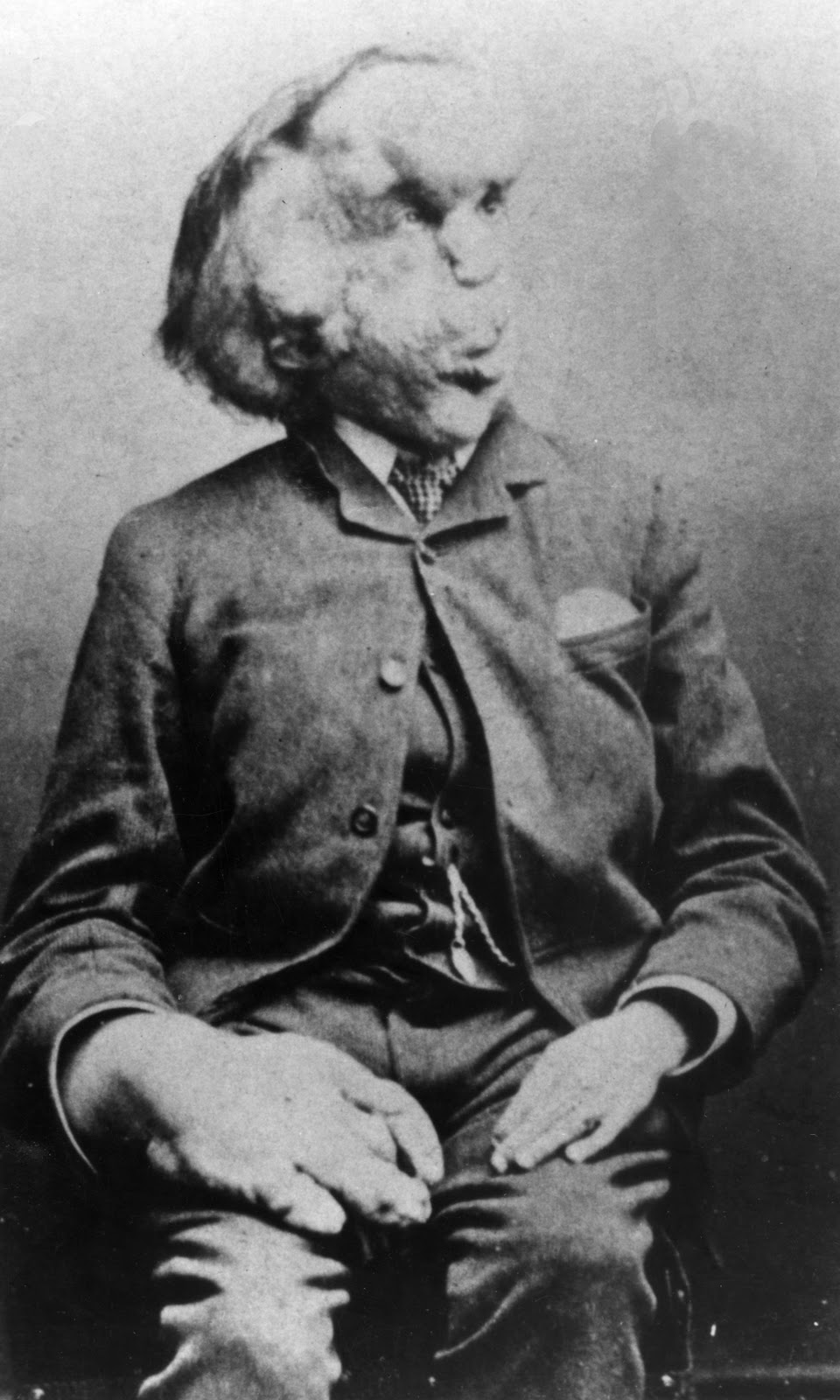
In the Mile End Road, opposite to the London Hospital, there was . . . a vacant greengrocer’s which was to let. The whole of the front of the shop, with the exception of the door, was hidden by a hanging sheet of canvas on which was the announcement that the Elephant Man was to be seen within . . . – from The Elephant Man and Other Reminiscences by Frederick Treves (1923)
I am not here concerned with moral matters, as in the beauty of the virtues – of love or of honor. This is about the human experience of physical objects and of sensory impressions – of faces and bodies; of art and music; and tastes and smells. And about the sensory differences between the beautiful and the ugly.
My first observation is that the perfect is the enemy of the good. That phrase was popularized by Voltaire, who got it from an earlier 17th-century Italian source, Il meglio è l’inimico del bene, which is the more plausible, “The best is the enemy of the good.” Better because perfection exists only in God.
Augustine saw beauty as the materialization of the good. On the sixth day of Creation, “God saw all the things that he had made, and they were very good.” Aquinas was of a mind with Augustine and, especially, with Aristotle in seeing beauty as integritas (wholeness), consonantia (harmony), claritas (radiance). For me, however, integritas, which is also understood as “perfection,” is problematic.
Many continue to accept that formula. I do not, but that’s not because I deny the classical conception. I think proportion, radiance, balance, etc.– all this passion for symmetry and order is fine, because when you see that in a face, for instance, you viscerally know beauty. Or ugly when the qualities are missing. I’ll make this personal.

This is true whether we’re looking at a beautiful human face (above) or an ugly skyscraper.
I live just north of New York City’s borough of Manhattan, which has been (and seems always to be) undergoing a construction boom, and some of the new buildings aren’t beautiful and suggest a revival of Brutalist architecture. Manhattan embraces ugly in part because buildings must be tall and straight to accommodate the millions of people who live and work there. Much of Washington, D.C. and Paris, France, remain lovely because laws protect their mostly horizontal skylines, the Washington Monument and the Eiffel Tower notwithstanding. And they are the only exceptions.
Speaking of tall and straight in New York City, consider 111 West 57th Street. It’s 300 feet shy of being as tall as One World Trade Center (1WTC) in Lower Manhattan, which is the tallest building in the Western Hemisphere. My friend George Marlin, former Executive Director of the Port Authority of New York and New Jersey some years before the 9/11 attacks, told me that in his office high in the North Tower, you could feel the building sway in strong winds.
Imagine what it’s like at 111 West 57th, where the width-to-height ratio is 1:24. The old North Tower was 1:6.5, and today’s 1WTC is 1:8.88. 111 West 57th is ugly and scary.

There’s a Japanese concept that’s interesting in this regard: Wabi-sabi. The etymology of Wabi is rooted in the rustic simplicity of a life lived close to nature, through the observation of simple things: of a smooth, time-worn stone, even if irregular in shape, shining in the rippling water of a stream. It’s “the quiet, understated beauty found in humble, irregular things.”
Sabi is “the beauty and serenity that comes with age, wear, and weathering,” as in the face of an older woman – whose white hair and facial lines make her all the more alluring, as in the photo below.

It must be noted that art need not be beautiful. As there is ugliness in the world, there will be ugliness in art, and that’s hardly a profound statement, just a simple fact.
Yes, but sin is ugly because it distorts beauty, and, therefore, ugliness is everywhere, which is why some modern art celebrates ugliness.
Classically, ugliness was also defined as the deprivation of beauty, but that seems to me shortsighted.
I began with the quotation from the Treves book about Joseph Carey Merrick, the “Elephant Man.” Mr. Merrick suffered principally from Proteus syndrome, a genetic disorder that left his head and body severely deformed. His story was heartbreakingly told in David Lynch’s 1980 film, with Anthony Hopkins as Dr. Treves and John Hurt as Mr. Merrick.
Is there beauty in heartbreak? Perhaps, because compassion is found there.

Mind you, I’m not among those who stubbornly insist that everybody’s beautiful. If everybody is beautiful, nobody is. And we humans have an innate revulsion to ugly: sights, sounds, and smells. I cannot resist in some situations averting my gaze, covering my ears, or holding my nose. Such reactions are organic, immediate, and universal. There’s even a science of ugly, and it has found that revulsion, such as one might feel in the presence of Mr. Merrick, isn’t necessarily a moral verdict you’re rendering when you turn away; it’s closer to a reflex like blinking. In essence, it’s a fear of contamination. The problem, which has played out horribly in recent history, comes when the reflex hijacks moral judgement, causing scapegoating.
Dr; Treves noted (and it’s visible in the photo of Merrick) that the Elephant Man’s left hand was well-formed. It was “a beautiful hand which any woman might have envied,” and Merrick was quite proud of it. Love reorders what the eye does with what it (love) sees, and it doesn’t require the eye to lie.
Near the end of his book, Treves writes:
[Merrick], no doubt, pictured himself the hero of many a passionate incident. His bodily deformity had left unmarred the instincts and feelings of his years. He was amorous. He would like to have been a lover, to have walked with the beloved object in the languorous shades of some beautiful garden and to have poured into her ear all the glowing utterances that he had rehearsed in his heart.
And there’s the beauty hidden in ugliness.