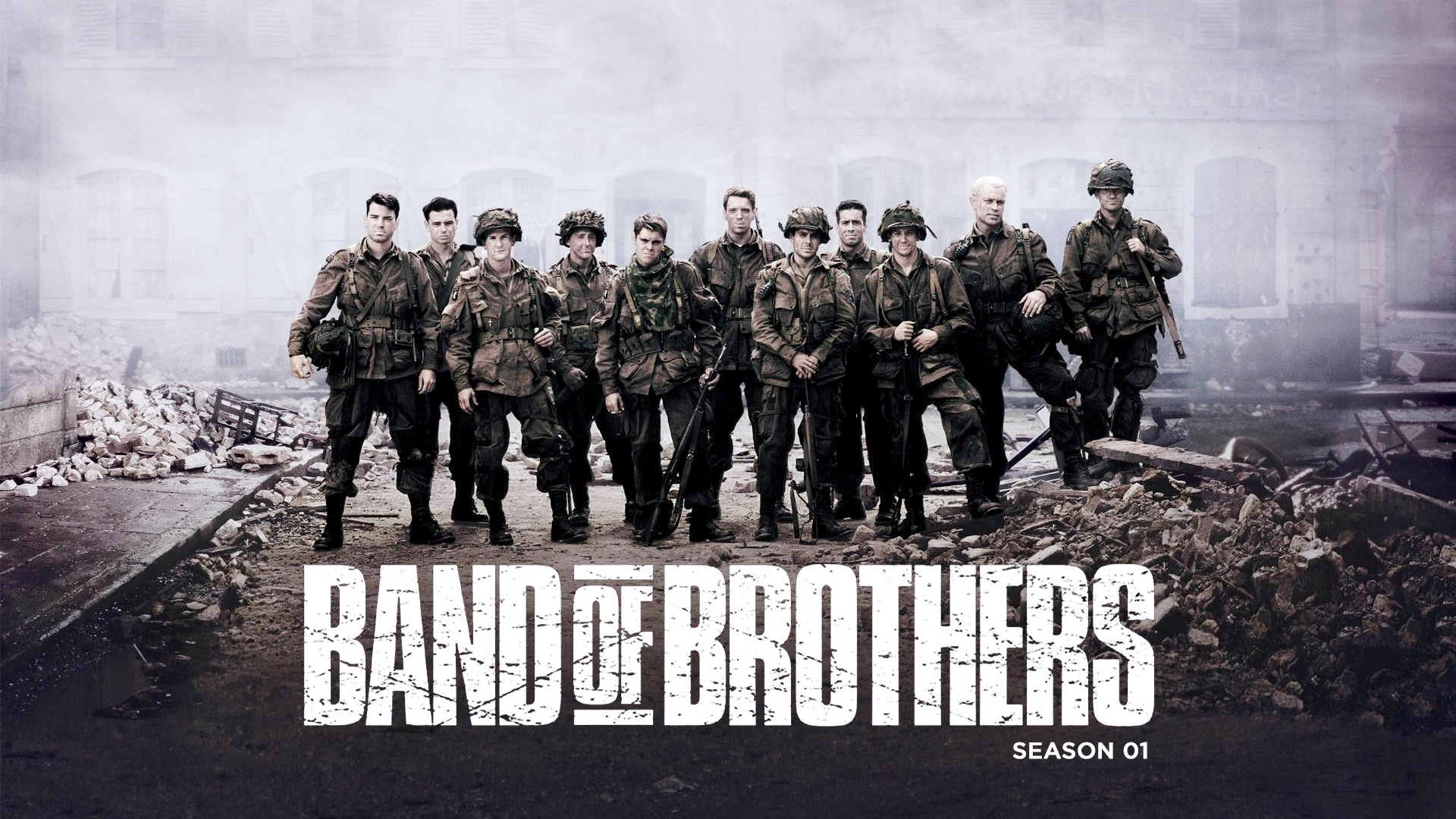
Two days before 9/11, Band of Brothers aired on HBO to an audience of 10 million viewers. America discovered the definitive statement of that period about “the Greatest Generation.” I want to make the case for viewing this show again, with new eyes—retaining and deepening the deep affection it stirred on release.
Of course, that was a very different time. Patriotism had come back into fashion after the miseries of anti-Vietnam college protests, not to mention the later anti-Reagan hysteria. The phrase itself was of the time, popularized by Tom Brokaw’s eponymous book of 1998—the year Spielberg gave America Saving Private Ryan.
This moment really started, however, at the end of the ’80s and became the background for national life in the ’90s. One wants to call the middle-aged men who read history the last embodiment of the silent majority. Historian Stephen Ambrose was one of their spokesmen. His book Band of Brothers, E Company, 506th Regiment, 101st Airborne: From Normandy to Hitler’s Eagle’s Nest (1992), the source of the miniseries, was an early sign of the return of patriotism. Yet it turned out to be only a prelude to his bestseller, D-Day, June 6, 1944: The Climactic Battle of World War II (1994), which was timed for the 50th anniversary of the invasion. And then there was its sequel, Citizen Soldiers: The U.S. Army from the Normandy Beaches to the Bulge to the Surrender of Germany (1997), which then led to other incredibly successful histories of the making of America. With millions of readers and many imitators, Ambrose took his place among the very popular historians of the time, like James McPherson and David McCullough. After winning an Emmy for helping produce the miniseries, Ambrose died in 2002, having changed popular history.
Band of Brothers may be the best thing TV produced in the 21st century, when TV turned out to be the last gasp of popular culture. It’s still incredibly popular and sitting near the top of the IMDb top 250 TV shows at #4. Why? Negatively, it’s surely because its mix of nostalgia and patriotism avoids almost all the pathologies of thought and sentiment that come out of universities. Patriotism is now the only power in the soul that allows us to look to the past with real interest. This innocence is combined with a willful rejection of modernism; the older America was healthier, though not perfect, and it therefore made it easier to think about what it means to be civilized. Nowadays, as in 2001, it is worse than illegal to be a man: It is unthinkable. Our universities as much as our pop culture proclaim this commandment or interdiction. But the past was different, and Americans used to believe that American men were admirable, that they had moral beauty.
Positively, Band of Brothers delivers portraits of manliness, from the demotic to the lofty, from the ostentatious to the secretive (if manliness can ever endure to be truly secret). Starting from boot camp, the story shows us the reorientation of American democracy to war, which tests the nation, first of all because the infantrymen who will do the fighting are all young. They are what America has to offer before anyone even thinks about some potential global catastrophe of civilization. By 1945, the average age of the American private was around 20 years. Experience and judgment aren’t going to help in that situation. Morality is what counts, which starts in childhood. But judgment certainly counts in those wiser, more political men whom we generally call leaders, be they officers, NCOs, or something else.
Accordingly, we get our protagonists, Dick Winters (Damian Lewis) and Lewis Nixon (Ron Livingston). We’re familiar with the types, the commanding and executive officers. They’re also remnants of an older America. Winters was a Dutch Reformed Christian believer from rural Pennsylvania who liked the farm life; Nixon a WASP who liked regattas, Europe, and whisky. Neither loved war, but both volunteered for service; in some secret way they did love honor or else they couldn’t have become lifelong friends. We cannot say more about this in a brief review—but the miniseries’ weakness is a pious unwillingness to look into the souls of men. War is as dangerous in thinking as in deed; moreover, everyone involved feels democracy itself would be in danger if we began to take excellence seriously. Contrariwise, the very democratic men who served under Winters looked to him precisely because they believed he could rule them and save their lives.
Patriotism must involve two forms of seriousness—the moral and the intellectual—which we see in the fighting men and their leaders. The lessons of the series are conveyed quietly, that is, by deed, which also means that they may not be easily summarized—you have to see, remember, reflect, and even discuss what goes into a successful action. That way, the dangers of war end up instructing the good practices of business organization and every other type of leadership. Everyone wants to survive, but when tested, life turns out to mean a distinctly American life, which requires a remarkable flexibility (small-unit tactics, for example) and endurance to make up for lack of martial discipline. Various interesting talents reveal themselves in surprising ways, too many to recount. It is some sign of American freedom that so many soldiers achieve some specific success that ends up being inscribed in the rolls of honor in medals and decorations—men really only learn who they are on such extreme occasions.
One more important note, to summarize the touch of greatness of the series: Very interesting things are hiding in plain sight. What does the name Band of Brothers mean? The Shakespearean quote is from a speech by the most Machiavellian of English kings, Henry V. That may disturb nice people; stranger still, the metaphor of brotherhood in the mouth of a prince in war points to nation and to honor—only because he is prince can he bestow something by way of brotherhood. Egalitarianism is in the speech, inequality in the speaker; properly put together, they make for civilization, as excellence and law together. This also tells us why we need TV miniseries or popular histories. The universities betrayed the cause of civilization; but in a way, decent people were negligent, too. They presumed so much on national character that they failed to learn lessons that would have required them to remember the names and honor the men to whom they owe so much—from privates first class all the way to demigods like MacArthur and Patton. Only in storytelling can this error be rectified; storytelling about war turns out to be a war in defense of American patriotism, against an anti-American culture. It’s worth wondering what leaders we have, since this culture war remains ongoing.
The Emmy Award–winning series is back in the news not only because it has turned 25 but also due to the release of an hour-long documentary, Band of Brothers: Legacy, a fascinating back-and-forth between the young actors who made their names working on that series and the old war heroes they portrayed, whose reputation was brought to national attention by it. No serious person believes in actors’ tears, but it is nevertheless remarkable to hear all these artists talk with affection and reverence for those men who lived and died the passions they imitate. It is remarkable because patriotism is not fashionable anymore. But it is also remarkable because it gives us evidence of the more severe, less public patriotism that still animates so many Americans, though it has been tried by the great changes of the 21st century. It would be wise to remember that we need it again, and we shall need it again in future generations.
The first use of “band of brothers” in the popular American context may have been in relation to the firemen who nobly served and sacrificed on 9/11. The Legacy documentary makes this point—American men are what they were, later generations served as the earlier ones had, in moments of crisis, though no one suspected they could love so fiercely as to die by their ordinary, civilian, commercial lives. And then young men, too, burning with love of honor, went to serve in the Middle Eastern wars: WWII veterans saw themselves reborn in the fresh-faced volunteers of the 21st century. They have no parades, no Band of Brothers, no national gratitude, yet they exemplified the strength and freedom that continues to forge American character as they proved themselves men.