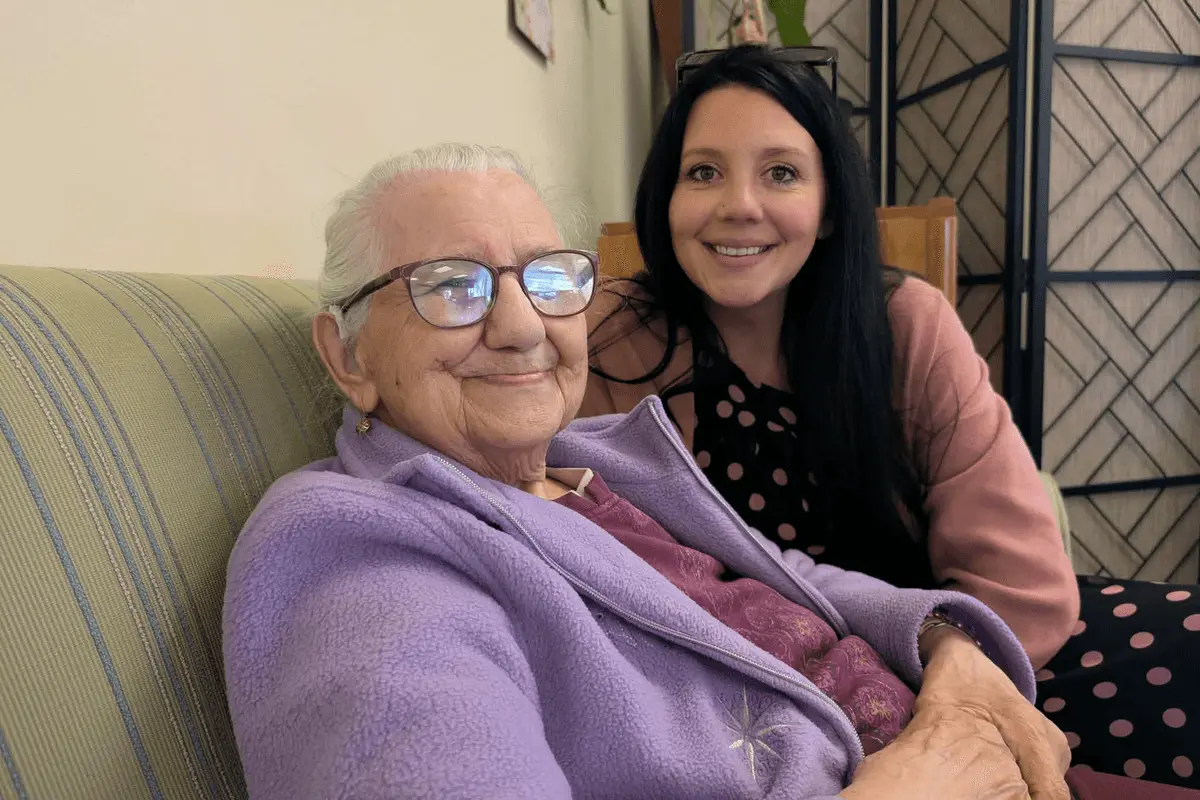
A Canadian grandmother died by “assisted suicide” in a scene that can only be described as a farce, based on the account published by her traumatized family. A botched IV insertion sequence left 83-year-old Brigitte Stegemann, or “GG” drenched in blood flowing from her arm.
The devout Christian, closed her eyes and folded her hands as the bedside pastor prayed, but she never gave final, verbal consent to Dr. Kate Koester’s offer to administer her “medicine,” the family alleges.
Upon receiving no response, Koester allegedly replied, “Okay, well, I’m just going to get started then.” Minutes later, Stegemann was dead.
“The family had been assured, strictly and explicitly … that GG would be required to give a final, explicit verbal confirmation immediately before the injection,” noted independent journalist Kelsi Sheren, the first to interview the family. “It is the reason, they say, that they did not attempt to physically halt the procedure that morning.” Worse, Brigitte and Robert Kranendonk (Brigitte was Stegemann’s granddaughter, namesake, and power of attorney for 12 years) were asked to hand the doctor implements, thus pressuring them into helping in a procedure they did not want.
Click here to sign up for pro-life news alerts from LifeNews.com
A year and a half earlier, Stegemann’s family made the decision to place her in assisted living at “The Pearl, formally EJ Mcquigge Lodge” in Belleville, Ontario. Stegemann was in a wheelchair, hard of hearing, and may have been cognitively impaired. Five months before her death on July 10, 2026, she was diagnosed with Stage Four stomach cancer.
As her grandmother’s power of attorney, Brigitte Kranendonk was involved almost daily in making decisions for Stegemann. In May, she discussed Canada’s Medical Assistance in Dying (MAiD) program with her grandmother, but she said her grandmother clearly objected to any such course, as it conflicted with her Christian faith. The question was settled — or so Kranendonk thought.
In the summer of 2026, the Kranendonks left on a 10-day vacation. Other relatives visited Stegemann in this period and noticed her condition noticeably worsen, although the facility still called Brigitte nearly daily to arrange details of her grandmother’s care. During this vacation, the family alleges, Canadian medical personnel held two meetings with the elderly, often confused Stegemann, behind Kranendonk’s back, which initiated the formal MAiD schedule that ended with her death.
The family learned only later that a formal MAiD meeting had been scheduled for July 6, to assess Stegemann’s mental capability to consent to the procedure. It was only at that meeting that the family learned about the two previous meetings.
On Monday, July 6, Stegemann appeared noticeably improved, appearing lighthearted and energetic rather than nearly unresponsive. Kranendonk requested her grandmother’s medication record and found no change in medication, nothing that would explain the short-lived improvement in her grandmother’s condition.
The physician never arrived, and the formal assessment was postponed to the next day, but the family described the Monday meeting devolving into a heated argument after Kranendonk asked why the MAiD conversation had been reopened at all, after the grandmother’s religious refusal. A nurse grew defensive, claimed that she was advocating from Stegemann, and accused Kranendonk of “attitude.”
“The family later learned from the home’s own manager that the nurse was barred from GG’s room immediately after the altercation,” writes Sheren, “which is to say, the administration itself judged her conduct indefensible, in the same week it relied on the process she had helped set in motion.”
On Tuesday, July 7, Dr. Koester administered a six-question cognitive test to Stegemann. According to the family, their beloved grandmother answered nearly every question incorrectly, even saying that all of her siblings had died, while two are still alive. Despite the wrong answers and over Kranendonk’s objection, the assessment continued to the end. Dr. Koester explained the euthanasia procedure as “receiving medication, feeling peace, falling asleep with the explicit promise that she ‘would not lose control of her bowels,’” Sheren records.
Dr. Koester then ordered all the family members out of the room — including Kranendonk, Stegemann’s legal power of attorney. After a private conversation with Stegemann, Koester concluded that Stegemann was “capable of making her own decisions” and announced that she had consented to the MAiD procedure, and that the death was scheduled for Friday, July 10. The family does not know what actually transpired in that conversation, but they fear their barely cogent grandmother did not fully understand what the doctor was saying.
According to Sheren, the justification for obtaining consent in private was “to rule out pressure or influence from the family.” The family complains that Dr. Koester dismissed concerns about pressure from the facility.
Under Canadian law, a determination that a patient is capable of speaking for herself overrides any standing power of attorney, Sheren explains. The MAiD protocol is also supposed to begin with a formal, signed, and witnessed request before anything is scheduled. In Stegemann’s case, the family alleges that health care staff manipulated consent, scheduled the procedure, and only backfilled the paperwork the next day.
The formal MAiD request was written not by Kranendonk but by the home manager. Canadian law allows any health care professional, including one employed at the same facility, to act as an independent witness to the signature. The family is fighting to obtain a copy of the document.
On Wednesday, July 8, the facility informed Kranendonk that her grandmother’s death had been rescheduled from Friday to Thursday, as the doctor had an opening. “Brigitte objected immediately and drove in,” Sheren relates. “In a meeting with the home manager, she laid out the family’s position staff [that] had gone around the advocate again, this time to change the date of a woman’s death for a doctor’s calendar, while the things GG had actually and consistently said mattered to her being surrounded by her family, having her pastor present were treated as secondary to scheduling.”
This appeal was the one point on which Kranendonk prevailed that week, and her grandmother was spared until Friday.
That same day, Kranendonk spoke with her grandmother. “I’m going to die on Friday,” Stegemann said. Kranendonk answered, “They are going to kill you on Friday.” The plain-spoken truth appeared to shock Stegemann, an indication that the euphemisms used by health care personnel had confused her.
“They’re going to kill me?” she asked, according to the family’s account. The family then states that Stegemann broke into sobs for 45 minutes, crying that she had made a terrible mistake.
The next day, the death took place at 11:00 a.m., as originally scheduled. There was perhaps more blood than anticipated. There was allegedly less consent than required. But it happened all the same.
Now, the family is demanding documents to determine just how Stegemann’s scheduled lethal injection came about, allegedly behind their backs, and whether it was even legal. They have filed a police report, an official complaint with Ontario’s Chief Coroner and are in the process of demanding other records and complaining to the College of Physicians and Surgeons of Ontario.
What is clear is that Canada leads the world in “Medical Assistance in Dying.” Health Canada legally euthanized 16,499 people, the highest (reported) number in the world and the second-highest per capita rate after The Netherlands.
Yet Canada’s MAiD program is riddled with errors and seems more concerned with putting people to death than doing it properly. According to a leaked document from the government of British Columbia, 51.9% of the state’s 2024 MAiD case outcomes required follow-up, including 2,807 errors, and 353 cases so problematic that the health care professionals involved were required to take training courses on MAiD’s standards and legal requirements. In 2023, British Columbia recorded 2,833 errors out of 3,808 MAiD cases.
Ontario physician Dr. Ramon Coelho, senior fellow at the Macdonald-Laurier Institute, criticizes the practice, arguing that “there should be an independent review before the death, rather than a paperwork review afterward.”
Despite the high rate of errors, a 2025 investigation found no record of disciplinary action related to MAiD in seven years of records. It also found only two cases referred to the police, neither of which resulted in publicly recorded charges.
A curious editor’s note appears above Fox News’s coverage of this episode, “This story discusses suicide.” As a matter of fact, their story does not. “Suicide” is when a person intentionally kills herself. “Assisted suicide” is the euphemism given to cases when medical professionals intentionally kill that person, ostensibly at that person’s request. But the modifier “assisted” turns “suicide” into “homicide,” even when it is not legally recognized as a crime.
Stegemann’s case adds yet another complication to the concept of “assisted suicide.” What should “assisted suicide” be called when a person neither kills herself nor wants to be killed?
Here is yet another case pointing out the inherent illogic of euthanasia. The practice of “good killing” can only be rationalized in a culture that has jettisoned all value of life as such and places all importance on consent. But without a moral framework based on life, even consent can sometimes be fudged for the sake of convenience.
“The events of GG’s final morning — being forced to assist with the medical preparation, witnessing a messy and bloody IV complication, and watching the procedure continue while GG sat silently in a prayer position — have left a lasting trauma on our family,” the family writes. “Grief does not erase these documented lapses in transparency, nor does it excuse a system that felt entirely rushed, defensive, and calculated. We will forever live with the painful uncertainty of how long GG might have lived comfortably had nature been allowed to take its course.”
LifeNews Note: Joshua Arnold is a staff writer at The Washington Stand, contributing both news and commentary from a biblical worldview. Originally published by The Washington Stand.