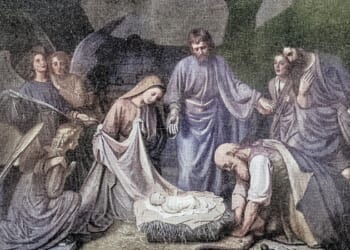
Jesus is asked by Jairus, an official of the Jerusalem Synagogue, to come to his house and heal his daughter who is gravely ill. As recounted in St. Mark’s Gospel, Jesus hurries to his house, but is told on the way that she has died. Arriving, the Lord, who sees what others cannot see, and knows that God’s glory will be revealed, tells them that the girl is not dead, only sleeping. They laugh at Him, as some translations say, “to scorn.”
The Lord enters the girl’s bedroom, holds her hand and, in Aramaic, says, “Talitha koumi – little girl, arise.” She wakes immediately and gets up.
Only Christ can bring the dead to life, or revive what seems to be dead.
For centuries, tyrants like Napoleon, Hitler, Stalin or the followers of Mohammed have claimed to have put the Church to death. But She has always arisen.
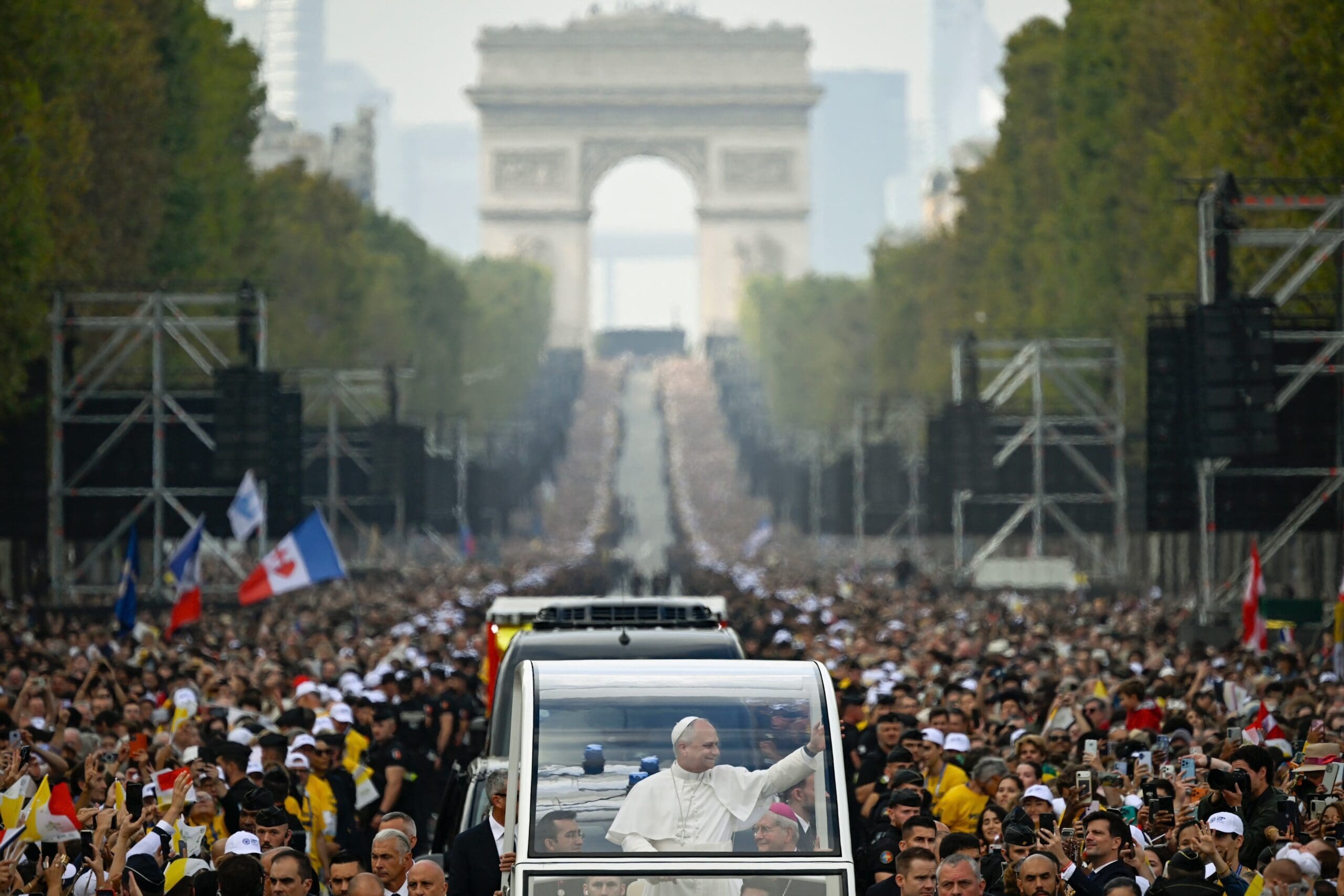
Viewing the scenes we saw in France this week during the visit of Pope Leo, it’s only natural to think both of those proud words of the tyrants and demagogues, and of the story of the daughter of Jairus.
France, for centuries called the “eldest daughter of the Church,” has been sleeping for a very long time. The horrors unleashed on that land with the regicide of the King and Queen, and the terror of the Revolution in 1789, seemed, in many ways, to have killed the little daughter of the Church. The further effects, we might say, of the revolution and the so-called Enlightenment have created a French society, as much of European society, that is, in Pope Leo’s words, “deeply secularized.”
Yet a million people lined the Champs Élysées in Paris to see the pope. Thousands of young people enthusiastically greeted him. And as we know, France is the very epicenter of what is called the “quiet revival” of Catholicism, though, in France last week it was rather loud.
A wise French commentator called it the “Advent of the Church” in France. Another friend, a journalist, said to me that a “page in history has been turned.”
Advent, of course, means the coming of the King, the awaited arrival. This is precisely why the season before Christmas bears that name; we celebrate His first coming in the Incarnation and await His Second Coming in glory when, in the words of the great Advent hymn, “Ev’ry eye shall now behold Him/Robed in dreadful majesty.”
The French commentator continued that the reawakened Church was rising to counter the deleterious and soul-quenching effects of secularism and nihilism. The militant atheists, the nihilists, the children of 1968 (the soixante-huitards as they are known in France), would laugh if they had been told that the little daughter would arise.
Leo XIV said in Paris that “people are rediscovering the Gospel and embracing the Faith,” precisely because of the emptiness and dissatisfaction that a Godless society produces. He called it the “small flame the Holy Spirit has kindled in the darkness of the night.”

Andrew Breitbart, it is said, coined the phrase that “politics is downstream from culture.” True, to a greater or lesser extent, depending on circumstances. But even more significantly, culture is, or should be, downstream from religion.
Leo remarked that France was not only a secular society, but a “deeply secular culture.” Abortion, now demonically enshrined in French Constitution, and a euthanasia law enthusiastically supported by the dollar-store Napoleon, Emmanuel Macron, were passed only weeks before the arrival of the pope.
Yet a culture once deeply formed by the Faith, imbued through the generations with the tradition of saints, artists, and scholars – so magnificently shown in the youth vigil with the pope at the Stade de France – can, even if its roots have been forgotten or deliberately obscured, be revived when its foundation is renewed.
In the last year, I have spent time with different groups of young, faithful French Catholics. Some are Latin Mass devotees; some are new converts to the Faith; some are from the charismatic or new communities; some are just ordinary, devout members of a parish.
They are all, invariably, joyful, filled not only with a joie de vivre, but a joie de l’esprit. What is significant is that they are surprisingly imbued with French culture in a way, sadly, not found in the United Kingdom, or the increasingly secular United States.
Although superficial matters of food and drink and the specific traditions of the different regions in France mark these young people, they also have a deep knowledge and respect for their common national history.
One young convert told me the story of his entrance to the Faith. His brother asked him to be the godfather of his child. He realized that he should take this seriously and sought Baptism.
When I asked him whether the brother was practicing, he replied that he was not, but that he was realizing that the entire foundation of France was Christian. (A reaction, perhaps, to the threats to France’s national identity by unchecked immigration and political radicalism in recent years.)
The young man described this as a “doorway to the Faith.” That humble story may be the central reason why French culture, revived and realized, is becoming a vehicle for the renewal of the Faith.
This is a moment of tremendous hope and inspiration for us all. Not only in France, but wherever this renewal is emerging, the Church must “recognize, welcome and protect” this small flame, as Leo XIV said.
What appears to be dead can awaken, if it is touched by the hand of Christ. The Goddess of Reason, once enthroned in Notre Dame de Paris by the followers of the atheistic Revolution, seems to have been definitively jettisoned. The Faith, as Hilaire Belloc once wrote, is the “only beacon in this night, if beacon there be.”
As we’re seeing, that’s true even for the long-lost “first daughter” of the Church.