Luke’s Gospel provides a rather detailed rendering of Jesus’ birth. Because Mary “kept all these things, pondering them in her heart,” she must have given her eyewitness account to Luke. Thus, the historicity of what is declared should not be challenged. Within Luke’s written words, we hear Mary’s spoken words.
So, Luke/Mary gives the historical setting of what would take place. Caesar Augustus decreed that a census should be taken throughout the Roman Empire. Everyone went to their home city to be enrolled. Thus, “Joseph also went up to Galilee, from the city of Nazareth, to Judea, to the city of David, which is called Bethlehem, because he was of the house and lineage of David, to be enrolled with Mary his betrothed, who was with child.”
Joseph’s lineage is theologically significant. He is from “the house of David,” and so he must register “in the city of David,” Bethlehem. It was here that David was born, and God told Samuel to anoint David king. “Samuel took the horn of oil, and anointed him in the midst of his brothers; and the Spirit of the Lord came mightily upon David from that day forward.” (1 Samuel 16:13)
Moreover, God later, speaking through Samuel, declared. “When your [David’s] days are fulfilled and you lie down with your fathers, I will raise up your offspring after you, who shall come forth from your body, and I will establish his kingdom. He will build a house for my name, and I will establish the throne of his kingdom forever.” (2 Samuel 7:12-13)
These prophetic promises are now being fulfilled as Joseph journeys to Bethlehem to be enrolled. The son to be born of Mary in the city of David is the Lord’s anointed, the one who is filled with the Holy Spirit, having been conceived by the overshadowing of the Holy Spirit. He is the king of the everlasting Davidic kingdom, and his throne will last forever.
All this is founded upon Joseph’s royal lineage, for he is of the house of David. Thus, Joseph is of foundational theological importance, for without him the child to be born of Mary would not be the fulfillment of God’s ancient prophesies. He would not be the king of God’s everlasting Davidic kingdom.
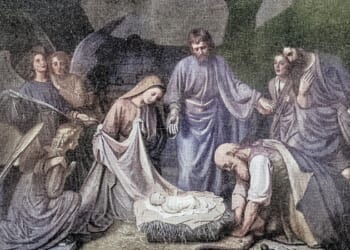
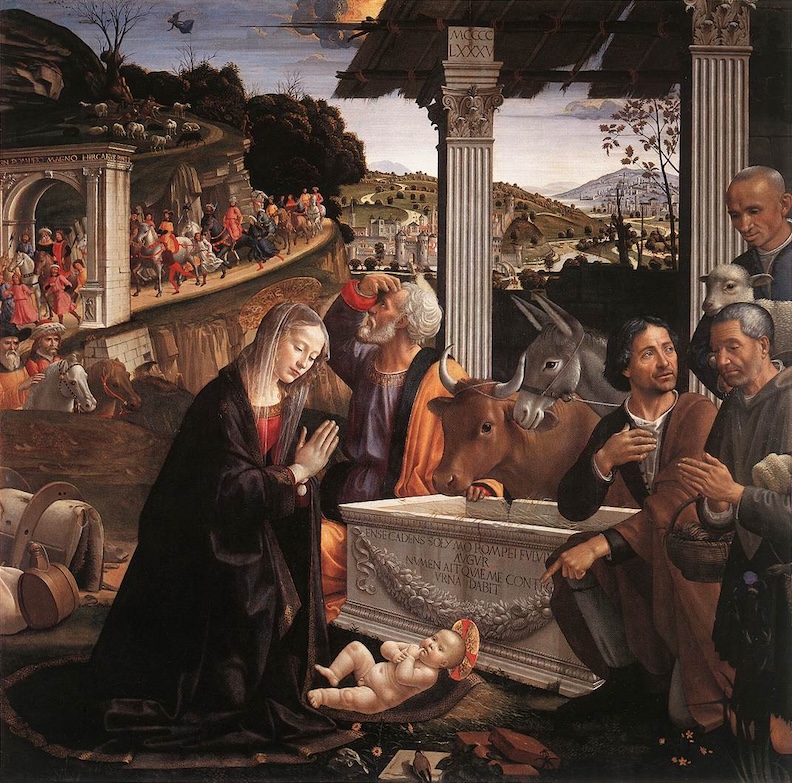
Now, while Joseph and Mary were in Bethlehem, “the time came for her to be delivered. And she gave birth to her first-born son and wrapped him in swaddling clothes, and laid him in a manger, because there was no place for them in the inn.” There was nothing miraculous in the manner of His birth. If such was the case, Mary would have informed Luke, and he would have stated what was the nature of the miracle.
What is unusual is that, finding no room in the inn, Mary gave birth to Jesus in a stable, and so she placed him in a manger. He who will sit upon the royal throne as the king of David’s everlasting kingdom is born in humble lowliness and unassuming poverty.
All of the above is implied within the context of Joseph’s lineage as being from the house of David. No one has yet declared his royalty or spoken of his identity. Everything up to this point in Luke’s narrative is simply normal – a baby was born of Mary in a stable in Bethlehem. However, in the midst of this normality, something will now be announced that is extraordinary.
“And in that region, there were shepherds out in the field keeping watch over their flock by night.” This too is normal. This is what shepherds do. However, “an angel of the Lord appeared to them, and the glory of the Lord shone around them, and they were filled with fear.”
What has taken place on earth may have appeared normal, but the heavenly realm knew otherwise. One of the Lord’s heavenly angels, engulfed in the Lord’s glory, appeared to the shepherds. Though the shepherds were afraid upon beholding such a spectacular sight, the angel said to them:
Do not be afraid; for behold, I bring you good news of great joy which will come to all people; for to you is born this day in the city of David a Savior, who is Christ the Lord.
Rather than being afraid, the shepherds are to behold the good news that the angel is bringing to them, news that will imbue within them great joy. That very night, in the city of David, a Savior is born, and he is the Spirit-anointed Christ, who is the divine Lord of Heaven and earth.
How will the shepherds know which child it is? “And this will be a sign for you; you will find a baby wrapped in swaddling cloths and lying in a manger.” Note again, the contrast. A Savior has been born, who is Christ the Lord, yet the shepherds will know him by humble signs – hardly what one would expect of one who is Christ the Lord.
With that, a host of heavenly angels sang out: “Glory to God in the highest, and on earth peace among men with whom he is pleased.” The transcendent God is to be glorified for such a wondrous event, for He is bringing peace to humankind with whom He is pleased.
So, the shepherds made their way in haste to Bethlehem. “And the shepherds returned, glorifying and praising God for all they had heard and seen, as it had been told them.”
This Christmas, all Christians are to echo the words of the angel and of the shepherds. We are to proclaim, to the glory of God, that the child born in Bethlehem so long ago is the Davidic king of God’s everlasting kingdom, for He is Christ the Lord, the Father’s incarnate Son.
The shepherds did not know His name. He was only given his name at His circumcision eight days later. We do know his name – Jesus, YHWH-Saves. It is He whom we profess, and it is he whom we proclaim this Christmas, for we are saved by no other name than by His alone.
This is the truth and the joy of Christmas!