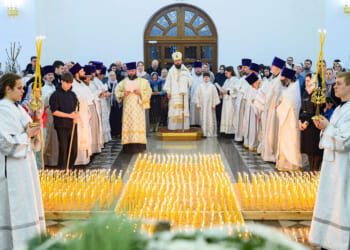
Let’s start with the “O Antiphons.” They began yesterday. There are seven of them, and they end on December 23. Then, with Christmas Eve and Christmas, they make nine – a novena – which is a period of expectation, the same in number as the months of pregnancy.
So, the lead up to Christmas is like a leading up to birth.
It’s fine and all to discourse about the O Antiphons, but to hear them in situ, it is necessary to go to Mass for those seven days, or to pray Vespers. If the first, and we receive Holy Communion, we repeatedly express our hope of receiving the Lord by, well, receiving the Lord.
If the second, we join Mary in celebrating the growing child within her, as she does in her Magnificat.
Moreover, since we are not Pelagians, and if we are sober and are convinced that through our own efforts we are incapable of giving rise to anything divine in us, we will also believe that the graces won from attending Mass those days, or praying Vespers, will change us, to make us more receptive to receiving the Child.
Then, everything about Christmas breaks down the barrier between born and unborn. Take the O Antiphons again. Famously, their first initials form an acrostic (Sapientia, Rex, etc.) which if taken backwards spell ero cras. You will hear it said that this means in Latin “tomorrow I will come,” as if, “I come into the world.”
Not so, it means “tomorrow I will be.”
But (you say) He already is: before Abraham was, He is. (John 8:58) Indeed, and therefore it must mean “be for you,” that is, become apparent to you, as for instance to the shepherds. Which is to say that in the womb he is saying that tomorrow you will see me, who now is unseen.
The statements about his life made by Zechariah in the “Benedictus,” perhaps even in the Lord’s presence (if Mary stayed for the circumcision) are all in the past tense – e.g. “he has visited his people.” True, this priest is using the so-called “prophetic past” – to refer to something so certain in the future that it must be expressed with the necessity of the past. But at the same time, he is referring to what that two-week-old embryo has already done.
And then, Catholics hold that Mary did not go through labor, and there was no disturbance of the birth canal or of her virginal integrity, so that the infant appeared to us by passing through her body as the Lord was later to pass through walls.
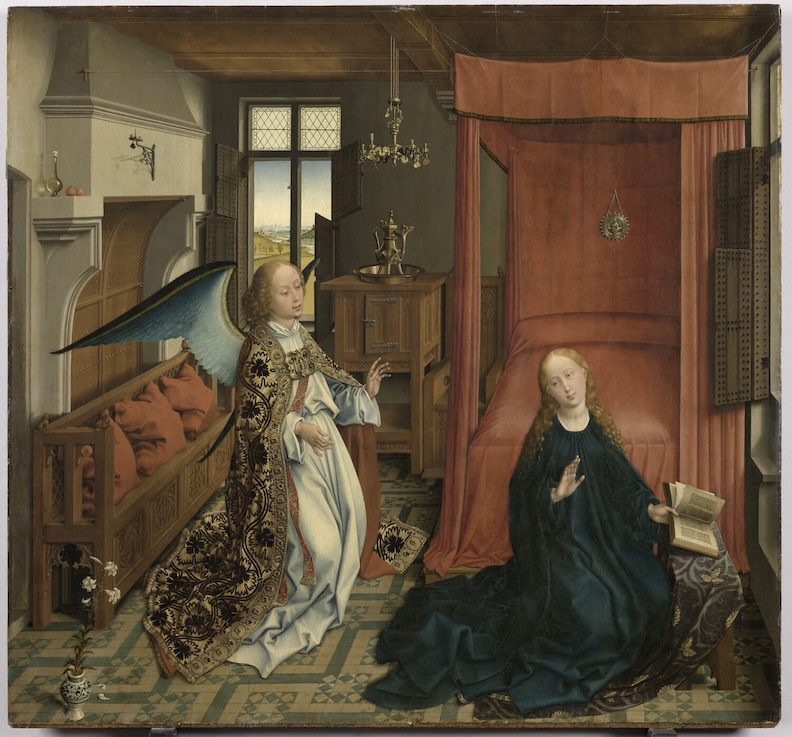
I don’t think that anyone ever claimed that someone changed from being a “clump of cells” to being human by walking into a room. Nothing could more clearly show the continuity and identity of born with unborn.
But Christmas tears down other justifications for abortion as well. “Every child a wanted child”? (Please take what I am about to write with appropriate reverence.) Jesus was not a “wanted child” by Mary. This is certain. She believed she would be a virgin. When the angel greeted her, she “was troubled at his saying, and thought with herself what manner of salutation this should be.” (Luke 1:29, Douay-Rheims).
She asks, famously, “How shall this be done?” She did not say, “I have been planning to have a child,” or “How providential that you arrive just when Joseph and I were thinking that we could afford a child!” But, yes, immediately the child becomes “wanted”: “Be it done to me according to thy word.” She denies any “autonomy” she might have claimed to have.
We often hear, “Who are you or I to say to a woman that she must accept all the burdens of raising a child?” What burdens here, in this case? Uprooting from Nazareth to Bethlehem. Uprooting from Bethlehem to Egypt. Uprooting again to return to Nazareth. Starting all over.
Later, wandering around Judea. Suffering the adulation of the crowd, then the hostility, in Jerusalem. Of course, the Cross. We dismiss most of these things – of course we do—just as any mother of a grown child dismisses all the sufferings she had to endure to raise him.
The most obvious fact about Christmas is that we are all receiving as our own a child who is not ours. I didn’t beget him. You didn’t bear him. Yet, if a Christ child in a crèche were miraculously to come to life and ask to be picked up – as has happened to saints – you and I wouldn’t hesitate to hold Him and cradle Him and even dance around the room with Him, just as those saints have done.
But then what does this mean? That each of us puts a crèche in his house, and yet if the Christ child Himself showed up, we wouldn’t receive Him, and even raise Him if we could? It would be our delight to spend so long with Him as to raise Him!
But then, think: that child conceived after that party when the mother and father, two college kids (the same age as Mary and Joseph) were plastered out of their minds? He’s the Christ child, shown up. Ero. That “mistake” of an adulterous affair? The Christ child. Ero. The mom whose boyfriend acted as if he was going to marry her but has deserted her? The Christ child, once again, saying “Ero.”
“But the child of that affair would obviously not be the husband’s because his skin is a different color!” Who ever walked away from a crèche in disgust because the infant’s skin did not match his own?
And then, as if a warning, and to teach us the meaning of our own actions in advance, Herod, out of rage against God’s sovereignty, slaughters the innocents.
Let’s therefore stop all the mere Christmas play-acting and receive, in truth, “the least of his brethren,” because what we do for the unborn child we do for the Christ child.