Isaiah stands as the great prophet of Advent: so powerfully does he foretell Christ’s coming (as well as his Passion and Death) that this book has been called the “fifth Gospel.” Later in Advent, we will hear his most direct prophecy: “the virgin shall conceive, and bear a son, and shall name him Emmanuel.” On this Second Sunday of Advent, though, Isaiah paints for us a vivid description of the Messianic age, one that reads like a pastoral ode: “the wolf shall be a guest of the lamb, and the leopard shall lie down with the kid.”
Here, all of nature rests in harmony and peace. It calls our mind back to Eden, free of violence and death. We glimpse the restoration of that fallen world in this vision of hope, from the prophet of hope.
But Isaiah is not the only prophet whom we encounter today. We also meet St. John the Baptist, the last and greatest in the long line of prophets. It is he whom Isaiah foresaw as “a voice crying out in the desert.” John’s message, though, appears quite different: “Repent!”
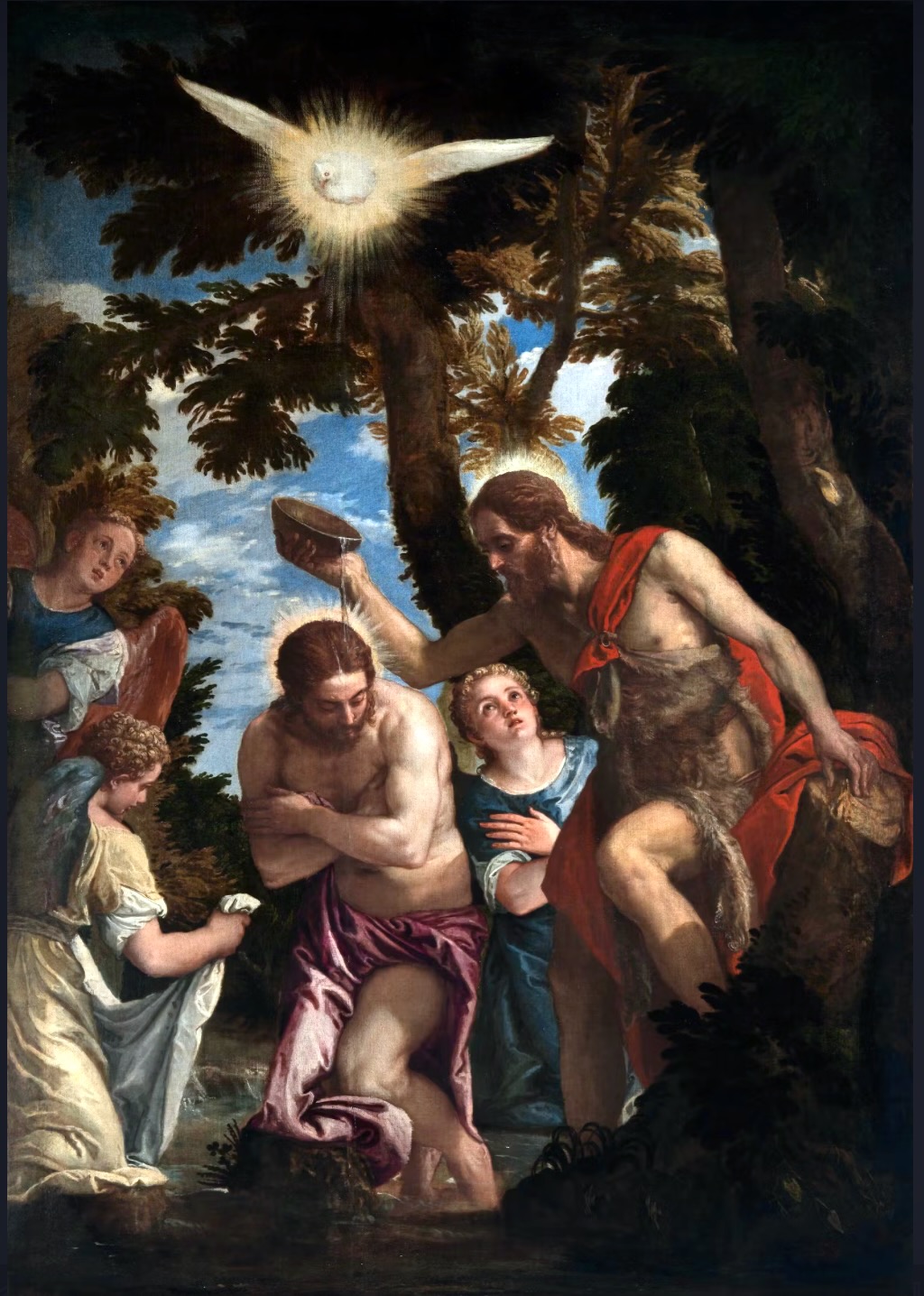
John knew that mankind left Eden a long time ago. That original harmony shattered when our first parents sinned against God, and we’ve all followed suit down the ages. That’s why John was baptizing in the Jordan River. His baptism was not a sacrament; it couldn’t take away any sins. But it was a way of expressing sorrow for sin as the washing prefigured the rebirth that baptism would bring. Each newly baptized person, however old, emerges from the waters a newborn child, reclaiming lost innocence.
That’s surely a reason why Almighty God, the creator of the universe, appeared on earth as a baby: to remind us of our need to be childlike, to mirror the humility and trust that characterize children. As Isaiah tells us, there will be “a little child to guide them.” Jesus wants to guide us to that innocence and joy, but we know that not everyone is willing to follow.
Certainly not everyone was willing to follow John. We see the Pharisees and Sadducees, so proud, so smug, so consumed with their own self-righteousness. John calls them out bluntly: “You brood of vipers!” Jesus himself will use the same language later on, both of them warning of what awaits those who persist in their sins.

They had to use such strong language: the Pharisees and Sadducees, blind in their arrogance, thought they had no need for John’s call to repentance. Because they were children of Abraham, they all thought they had it made. We see that same mindset among some fellow believers today: because I’m baptized, or a self-proclaimed good person, or because I’ve accepted Jesus Christ as my personal Lord and Savior, of course, I’m going to Heaven.
John holds up his hand and raises his voice to say: Not so fast. It’s the one who knows his sinfulness, his constant need for mercy, his own lowliness, who wins God’s favor. What’s lower than stones? Yet John tells us that God can make even these children of Abraham.
Isaiah speaks to that lowliness in his image of the root – buried in the ground, the short stump of Jesse. Through Jesse’s son, David, would come the promised Savior, as that root sprouted to become the wood of the Cross. It is the sprinkled blood from that Cross that makes us true children of Abraham, adopted into the bloodline of salvation.
And as newly adopted sons and daughters, we have a mother to whom we must turn. Mary offers the perfect model of trust and humility. As we celebrate her Immaculate Conception tomorrow, we recall how Mary remained entirely unstained by sin throughout her life. That purity in mind and body allowed her to be God’s honored vessel, magnifying him in her immaculate soul.
It’s no coincidence that in her many apparitions, Mary so often appears to children. Their docility, openness, and lack of ego enable Mary’s message, which is always Christ’s message, to be received and announced with unobstructed resonance.
God Himself came to Mary as a little child, and through Mary, He comes to us, at Christmas and always. The question is, will we receive Him as humbly as Mary did?
Isaiah and John present a stark contrast of the choice we face. We can accept Him and receive the joy of His peace, the beautiful harmony that Isaiah describes. To the one who rejects Him, refusing to humble himself, John minces no words: “he will burn with unquenchable fire.”
Two roads, leading to two very different places. But we do not walk alone. God knows that we, his sheep, can easily go astray, so he has sent a little child to guide us. If we follow Him, he will lead us not back to the ruined garden of Eden, but forward, to the eternal garden of Paradise.