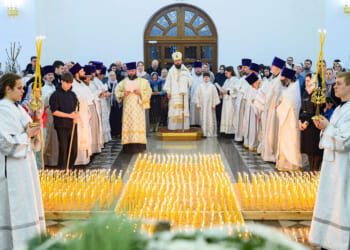
A few months ago, I was lucky enough to be in the capital city of Slovakia, Bratislava, formerly Pressburg, staying in the beautiful Old Town, to speak at a conference. To say it is charming makes it sound like a wedding-cake creation; it charms because it is intact and as it should be, not ersatz and artificial, a Catholic town, in creation and in fact.
Navigating its very walkable streets (a weekend break would be ideal to see all that is necessary), you see that multiple churches are open and in use, with, on a Sunday, many families with numerous children spilling out into the small squares. Unlike its Czech neighbor, in Slovakia the Faith appears healthy, a sign of encouragement for those who believe any revival of the Faith in Europe will come, in good part, from its Central and Eastern nations.
St. Martin’s Cathedral, in the very heart of the Old Town, is a small 15th-century Gothic jewel, simple and devout, dedicated to St. Martin of Tours, whom the populace claims as their own, which is technically correct, as parts of Slovakia were in what was called Pannonia.
This cathedral has seen kingdoms rise and fall – the kings of Hungary were crowned there. And there is a small shrine to the last Habsburg Emperor, Blessed Karl. In the lifetime of an elderly citizen, it also saw the horrors of the two most destructive atheistic ideologies ever known, Nazism and Communism. Both of those cruel systems attempted, as Herod tried and failed, to kill the rival to their earthly power, the true King, whose reign shall never cease.
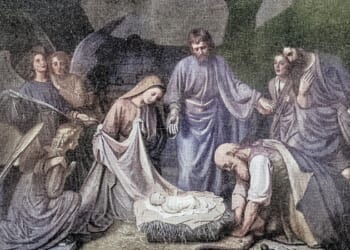
As the Gospel was about to be proclaimed that Sunday, the organ prelude thundered, an acclamation, in the true sense, for a person of great dignity, a royal person. It was a greeting for the Word, who would appear in Scripture and Sacrament, most truly in His Real Presence – the bread and wine transformed into His Body and Blood. It’s still as difficult to discern His divinity in those elements, just as it was a baby in a crib, except with the gift of faith, given to Shepherds and Magi.
The cathedral, as every church, humble chapel, or even, in necessity, table or Mass rock, is Bethlehem, the House of Bread, the royal palace of the hidden king.
There seemed to be something very appropriate about that triumphant organ. As Bishop Barron has written, during the reign of Caesar Augustus, trumpets and acclamations would greet the one perceived to be the King of the known world. Yet in silence, in “the fullness of time,” the true King appears, not acclaimed by trumpet and organ, unknown, but recognised and adored by rough shepherds and wise seekers from the East.
He has no earthly army, but something much greater, the army of the Heavenly Host. The great and the good, if they even hear of the event, laugh it to scorn, a very contemporary reaction to the Gospel. Yet the story, as Chesterton said, is “plain enough to be understood by the shepherds, and almost by the sheep.”
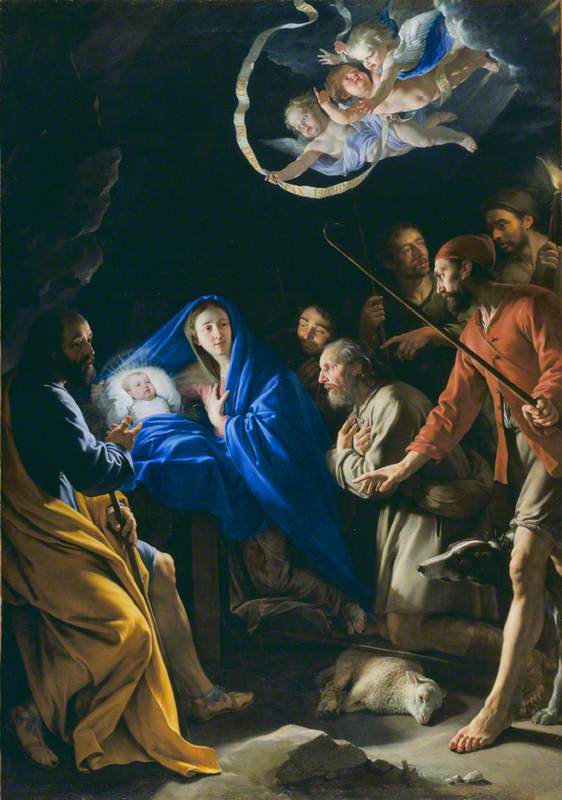
God confounds worldly wisdom with His hidden foolishness. “He came unto His own, and His own knew Him not.” Why did they not recognise Him, whom all the prophets had foretold?
It was partly the “mystery of iniquity,” of course, and the extraordinary simplicity of His birth. There is more, though: a God so close, so weak, so defenseless, is almost too much to accept, and therefore contradictory to the concept of divine omnipotence.
It is still the fashion, of those outdated critics of Christianity who have yet to realise their once fashionable views are now passé, to claim that, because pagan legends and myths included tales of a Virgin birth, or the appearance of a God in human form, this proves the Christmas tale to be just that: a tale like all the others. Hilaire Belloc, who punctured pomposity and intellectual cant with the weapon of his pen, quite accurately noted that “these are not pagan legends transformed. They are pagan foresights inherited.”
As St. Paul identified, in his evangelism at the Areopagus, the nearby Unknown God had been revealed in the person of Jesus Christ. Pagan legends, myths and fables had, for millennia, prepared the world for the reality of the Incarnation.
The Incarnation, as the German theologian Ida Görres wrote, had been a “thousandfold intuited, sensed, surmised,” by pagans and those who awaited the Messiah, but in His lowly habitation, perhaps even the reality exceeded expectation.
As with pagan images fashioned, St. Peter Chrysologus said, because “they wanted to see with their own eyes what they were worshipping,” the desire to know the Creator of the stars of night in the flesh, is part of the happy fault of Adam. Even today, we must not be too harsh with those who seek, albeit misguidedly, and often in the wrong place, for the One to touch and to hold.
The glorious tale to be told at the Masses of Christmas later this week, and the days that follow, a most necessary progression of feasting and celebration, is that the One intuited has, as Görres wrote, “stepped into the visible, to be heard with ears, to be touched with hands.”
This is the Good News, ever ancient and ever new, which must be proclaimed anew by the Church with passion and power, especially as we hear of new seekers after truth. God, beyond our wildest dreams, came to us, not in triumph, unapproachable, awesome and unreachable, but in the mewling of an infant in a crib.
He comes, once more, to be seen, touched, adored, and consumed, in the Holy Eucharist, the hidden King in his palace. As Benedict XVI said, “There can be no more luminous source of joy” – a joy intuited and so needed, the very essence of any New Evangelisation – “for human beings and the world, than the grace that has appeared in Christ.”