Posted on | March 28, 2026 | No Comments
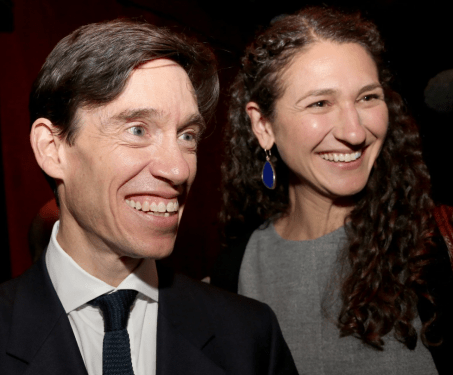
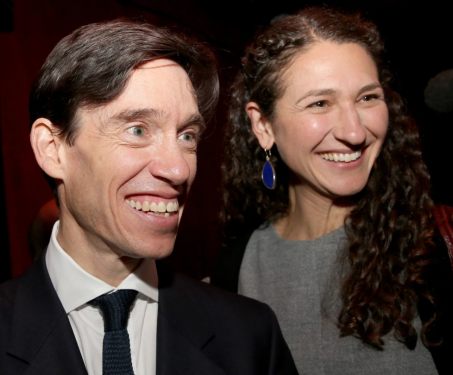
Rory Stewart and his wife Shoshana
The word “diplomat” is often a synonym for spy. The functions of diplomacy and espionage are so closely intertwined that if someone’s resumé includes a stint at the State Department, you are not wrong to suspect them of also being a CIA operative. Over the past decade, Americans have learned that our “intelligence community” does not merely spy on foreigners or seek to subvert hostile regimes overseas, but is also willing and able to foment “color revolutions” right here. But the subject at hand this morning is not Hillary Clinton and John Brennan. Rather I would call your attention to British politician Rory Stewart, currently on the faculty of Yale University:
Born in British Hong Kong, Stewart attended the Dragon School and Eton College. . . . Stewart studied philosophy, politics and economics (PPE) at Balliol College, Oxford. After graduating he joined the Foreign Office, holding diplomatic positions in Indonesia and Montenegro. . . . Following the 2003 invasion of Iraq, Stewart was involved in the Coalition Provisional Authority in the Maysan province. He founded and ran the Turquoise Mountain Foundation, an NGO focused on human development in Afghanistan, before becoming a professor at the Harvard Kennedy School. He joined the Conservative Party in 2009.
Stewart served as Member of Parliament (MP) for Penrith and The Border between 2010 and 2019, representing the Conservative Party. . . . He was a minister throughout Theresa May’s government: as Minister of State for International Development, Africa, and Prisons. He joined the Cabinet and National Security Council as Secretary of State for International Development. . . .
Stewart was born in 1973 in Hong Kong, then under British rule . . . Stewart’s father was a colonial official and diplomat who, in the 1970s, was reportedly a candidate to become the Chief of the UK’s Secret Intelligence Service or MI6.
If that’s not the biography of an intelligence operative, I don’t know what is. Rory Stewart was literally born into MI6, went straight from Oxford into the Foreign Office — hint, hint — and at age 30 turned up running the occupation government of Iraq, and went straight from there to Afghanistan where he founded an NGO — hint, hint — then returned to England where he joined the Tory party and magically got elected to Parliament. In all of this, he has been associated with failure, serving in the cabinet of the disastrous Theresa May ministry, unsuccessfully opposing Brexit, and ultimately quitting the Tories in a tantrum. His political career was bookended by Ivy League faculty sinecures:
In July 2008, Stewart was appointed to the faculty of the John F. Kennedy School of Government as Ryan Family Professor of Human Rights at Harvard University and director of the Carr Center for Human Rights Policy, having previously been a fellow at the Carr Center from 2004 to 2005. He left his position to campaign for Parliament. He returned to academia as a senior fellow at Yale University’s Jackson Institute in 2020.
He’s a “senior fellow,” you see! His wife Shoshana (née Clark) is an American, an alumna of swanky Williams College who joined Stewart’s Afghanistan “development” NGO as an intern and of course ended up married to the boss, who is 10 years her senior. This trans-Atlantic couple have obvious reasons to hate Donald Trump:
A charity run by Rory Stewart’s wife has lost $1 million of [USAID] funding as a result of Elon Musk’s foreign aid-slashing Doge reforms, the former minister revealed [in February 2025].
Mr Stewart said that the support for Turquoise Mountain, a charity that works in Afghanistan, Myanmar and the Middle East, had stopped abruptly, despite it having a contract.
The organisation is led by Shoshana Stewart, who has worked for the charity since 2006 when it was set up by the King, then the Prince of Wales.
According to its website, the organisation seeks to “revive historic areas and traditional crafts to provide jobs, skills and a renewed sense of pride” in the areas it works. . . .
Mr Stewart told The Rest Is Politics podcast, which he co-hosts with Alistair Campbell, on Wednesday: “It doesn’t matter you have a contract.
“Turquoise Mountain, which my wife Shoshana runs, had a contract (and) had another million dollars to go and the money just stops”.
Mr Musk, the tech billionaire and head of the new department of government efficiency (Doge), announced on Monday that [USAID] would be shut down.
[USAID] is the world’s largest single aid donor, distributing some $72 billion of assistance in 2023 to a range of causes, from natural disaster relief to access to clean water and HIV/Aids treatments.
Mr Stewart met his wife when he moved to Kabul in 2005 to help set up Turquoise Mountain. He was chief executive of the charity himself for two years before his wife took on the role. . . .
[The cutoff of funds from USAID] comes just weeks after the former Tory MP became embroiled in a social media spat with JD Vance, the US vice-president.
JD VANCE: There is a Christian concept that you love your family and then you love your neighbor, and then you love your community, and then you love your fellow citizens, and then after that, prioritize the rest of the world
A lot of the far left has completely inverted that pic.twitter.com/XkoTiKgq3g
— Jack Posobiec (@JackPosobiec) January 30, 2025
I’ve said before and I’ll say it again: the problem with Rory and people like him is that he has an IQ of 110 and thinks he has an IQ of 130. This false arrogance drives so much elite failure over the last 40 years.
— JD Vance (@JDVance) January 30, 2025
It was unkind, and arguably inaccurate, for our Vice President to suggest Stewart’s problem is a lack of intelligence. He is not stupid, but as Ronald Reagan famously quipped, “The trouble with our liberal friends is not that they’re ignorant; it’s just that they know so much that isn’t so.” The fact that Rory Stewart was once a member of Britain’s Conservative Party just goes to show the decadence of 21st-century Britain. Despite his quarrel with Vance, however, I had no idea who Rory Stewart was until someone called attention to his interview with a British journalist:
I asked @RoryStewartUK about the prevalence of anti-Muslim bigotry in modern politics and his reply stunned me.
What I wanted to talk about was the way ignorance and hatred (recent examples: describing Muslims praying in public as “an act of domination”, political parties trying… pic.twitter.com/asQPMlNX2L
— Oli Dugmore (@OliDugmore) March 27, 2026
What I wanted to talk about was the way ignorance and hatred (recent examples: describing Muslims praying in public as “an act of domination”, political parties trying to ban the burqa) was now not just harming British Muslims, but also the national interest.
How a lack of understanding about martyrdom or Persian nationalism connects to a war that might cause a global depression. I thought he might talk about Karbala, and we did eventually, but he began with a precise and confronting statement: much of what we’re dealing with is, quite simply, racism.
And not only that, but the weaponisation of that racism, and its political uses, which he described as “profoundly disturbing.”
He talked about arguing with Tommy Robinson. Speculated about possible endpoints for a politics that don’t incorporate dignity and love. And drew a parallel to anti-Semitism in the 1930s.
Translation: “Everyone I Don’t Like Is Hitler.”

Rather than risk the accusation of taking him out of context, let me quote Stewart at length from that interview:
Yeah. Well, I think I think we’ve got to be very clear that this is basically racism. I mean essentially the AFD in Germany uh or the far right in Britain or all those people on social media who are talking about Judeo-Christian values and saying “I’ve got nothing against people of color, I just don’t like Islam,” are basically racist. I mean essentially what they’re trying to do is drive hundreds of thousands — millions — of people out of their country. I mean, the AFD, some of their uh leadership are very clear about it. They talk about remigration. You’re a Muslim, you’re going to be shoved out of Germany. And it’s the most amazing nonsense. I mean this idea that somehow Islam itself is a kind of inherently bad religion and other religions are sort of inherently good is completely demented. . . .
It’s partly just pure ignorance . . . not very different from the kind of way that, well, our experience I suppose with other forms of racism that the kind of ways that people thought about black people when they hadn’t met any black people or the kind of ways that people thought about people who were gay until they actually had some gay friends. I mean it it a lot of it is simply that they just don’t know any Muslims, right? They don’t understand the lived experience of it.
Having been generous in providing the content of Stewart’s remarks, you see that I was merely giving him more rope with which to hang himself. The more he talks, the most insulting he becomes. If you don’t agree with him, you are ignorant, and your policy ideas are nonsense.
It is difficult not to laugh when Stewart speaks of racism as “the kind of ways that people thought about black people when they hadn’t met any black people,” as if, for example, Lester Maddox or George Wallace “hadn’t met any black people.” But then again, exactly what does Stewart mean by “racism” except disagreeing with me about immigration?
Here is where his invocation of “lived experience” boomerangs back to hit Stewart in the face: What about the “lived experience” of English working men whose communities are destabilized by the influx of foreigners? What about those girls in Rotherham and other towns whose “lived experience” is being raped by gangs of Muslim immigrants?
Oikophobia is a tendency to criticise or reject one’s own home or home society while praising others. It has been used in political contexts to refer critically to political ideologies that are held to repudiate one’s own culture.
Whose interests do our leaders serve? Isn’t the whole project of democracy — its very raison d’être — that leaders should represent the interests and opinions of the people who elect them? Here we are reminded of a famous quote by Bertolt Brecht. In 1953, workers in East Germany rebelled against the Communist government, which arrested hundreds, many of whom were executed, in a post-Stalin crackdown on opposition to the Soviet-controlled regime. Brecht wrote sarcastically:
“After the uprising of the 17th of June, the Secretary of the Writers’ Union had leaflets distributed . . . which stated that the people had squandered the confidence of the government And could only win it back by redoubled work. Would it not in that case be simpler for the government to dissolve the people and elect another?”
The idea of the government “electing another people,” which Brecht treated as an obvious absurdity, has in the 21st century become the policy of the political elite in nearly all Western democracies. Because their policy preferences are rejected by most of their own native populations, the leadership elite wish to import foreign migrants whom they expect to repay them in electoral support. This “Great Replacement,” as it has been called, is denounced as a racist conspiracy theory when any opponent of such a policy describes it as what it really is, despite the fact that many of those who favor a de facto open-borders policy have not always been secretive about their motives. Here we have Rory Stewart siding with Muslim invaders against British citizens, pretending that there is not reason that the natives should oppose a government policy of favoritism toward the foreigners and hostility to the interests of actual Britons.
No amount of evidence can ever persuade these elites of their error, as their antagonism to those they view as the ignorant “masses” is deeply rooted in their own personal interests, i.e., the maintenance and justification of what they consider their inherent right to exercise authority. This was where Sam Francis, a student of James Burnham, had the insight to interpret politics through the lens of The Managerial Revolution. Some speak of the “uniparty” in Washington, the tendency toward consensus among Republican and Democratic leaders, preventing any meaningful change in policy. The same people speak of the bureaucratic “Deep State” as similarly obstructing any real change. Both of these phenomena are expressions of the controlling power of what Burnham called “the managerial elite.” It’s a complex subject — Sam Francis had a Ph.D. and even he had difficulty getting others to understand the significance of Burnham’s work as it applies to contemporary politics — but my point is that people like Rory Stewart are incapable of changing their minds because to do so would require them to interrogate their own motives and confront their own selfishness.
Stewart’s career has been a long series of failures, and yet there he is, ensconced at Yale University, lecturing young people about international relations, while complaining on a podcast about how “racist” the English people are because they don’t want their country overrun by foreigners. And he’s angry because Trump took away the million dollars a year that U.S. taxpayers were sending to the Afghanistan NGO run by his wife.
You can’t understand his “lived experience,” you bigot.