The Bilderberg Group is meeting earlier than usual this year. The 72nd gathering of Western power brokers is taking place in Washington, D.C., from April 9 to 12. For decades, it was dismissed as a fringe conspiracy. But today, even its critics admit it is real, influential, and carefully shielded from public scrutiny.
According to the official release, discussion topics include:
- AI
- Arctic Security
- China
- Digital Finance
- Energy Diversification
- Europe
- Global Trade
- The Middle East
- Russia
- Trans-Atlantic Defence-Industrial Relationship
- Ukraine
- USA
- Future of Warfare
- The West
The list of participants, as always, reveals a dense concentration of political authority, financial power, and technological control. The composition is familiar, and so is the purpose. The event continues to function as a private coordination forum for a global order shaped by corporate, financial, and political elites moving in alignment.
U.S. Government
The U.S. delegation anchors the meeting. It spans government, finance, media, and Silicon Valley. The overlap is not accidental.
Among the current U.S. government officials on the list is Michael Kratsios, director of the White House Office of Science and Technology Policy. He also co-chairs the new President’s Council of Advisors on Science and Technology. A former chief technology officer at the Department of Defense (DOD), he helped lead the national push to expand 5G during the Covid era, and later joined Scale AI, a company embedded in defense and government AI infrastructure. His presence places the White House’s technology agenda in the same room as corporate and military power.
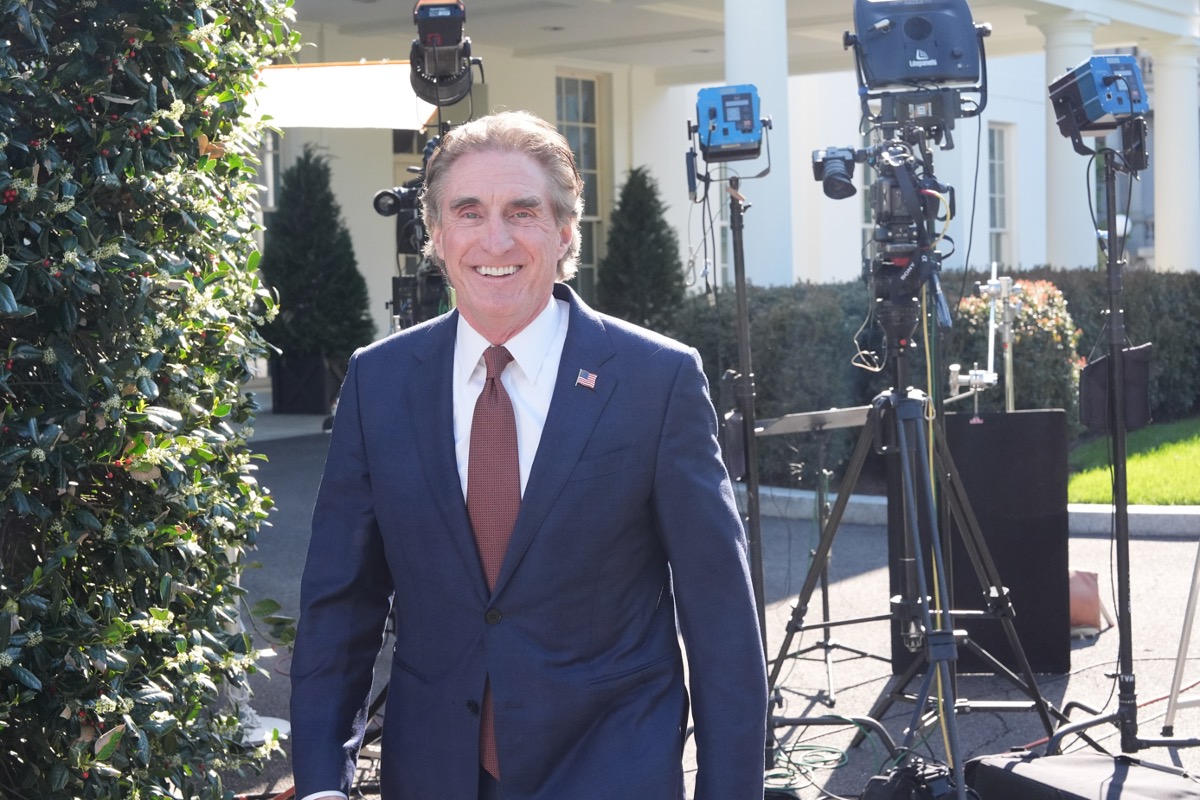
Another participant is Interior Secretary Douglas Burgum, who reflects a different pattern. The multimillionaire and former North Dakota governor had earlier built Great Plains Software and sold it to Microsoft, where he remained as a senior executive. He later co-founded Arthur Ventures, and served on or chaired boards at major technology companies. His career shows the revolving door between state authority, corporate leadership, venture capital, and strategic industry.
Jamieson Greer, the U.S. trade representative, brings the trade side.
Daniel Driscoll, secretary of the United States Army, represents the military establishment. Admiral Samuel Paparo, commander of the U.S. Indo-Pacific Command, adds the strategic and geopolitical dimension. They are joined by NATO leadership, including Secretary-General Mark Rutte, General Markus Laubenthal of Supreme Headquarters Allied Powers Europe, and Geoffrey van Leeuwen, chief of staff to the secretary-general, bringing both the alliance’s military and political command into the room.
The U.S. legislative branch is present as well, including Representatives Terri Sewell (D-Ala.) and Jason Smith (R-Mo.)
Tech
The tech list includes Alex Karp of Palantir Technologies, whose role in the U.S. Deep State is hard to overestimate. Seeded early by CIA-backed In-Q-Tel, Palantir helped pioneer the privatization of surveillance and intelligence functions once associated more directly with the state. It has since become a central public-private component of the national-security apparatus.
Today, Palantir operates deep inside defense, intelligence, and domestic enforcement systems. It holds major federal contracts across the Department of Defense (DOD), the Department of Health and Human Services (HHS), and the Department of Homeland Security (DHS), including Immigration and Customs Enforcement (ICE), among many others. It is also tied to the Trump administration’s Golden Dome project. Marketed as a missile deterrence shield, critics warn the system could evolve into an all-seeing network of satellites monitoring the homeland. Palantir’s co-founder Peter Thiel, a member of the Bilderberg Steering Committee, emerged as an early Trump ally and megadonor beginning in 2016, and also helped finance J.D. Vance’s political rise.
Brian Schimpf of Anduril Industries reinforces the defense technology dimension.
Eric Schmidt, former Google CEO and now executive chair of Relativity Space, adds another layer of influence. He previously chaired the Pentagon’s Defense Innovation Board and represents the flow of power between Big Tech, policy, and military planning.
Alexandr Wang, chief AI officer at Meta, brings one of the world’s most powerful data and AI platforms into the same orbit. His presence underscores how social platforms and AI systems are now integral to both governance and influence.
More Tech
Another attendee is Brad Smith, vice chair and president of Microsoft Corporation. Microsoft is no mere software company. A globalist heavyweight, it is a major contractor to the U.S. defense and intelligence apparatus and a key provider of cloud infrastructure to the Pentagon.
The list also includes Jack Clark, co-founder and head of policy at Anthropic. His presence highlights the overlap between frontier AI development and government systems.
Also attending is Mira Murati, CEO of Thinking Machines Lab and a key figure in advanced AI development. Demis Hassabis of Google DeepMind represents the frontier research sphere, while Arthur Mensch of Mistral AI reflects Europe’s effort to remain competitive.
Faryar Shirzad, chief policy officer of Coinbase, brings the digital asset industry into the same conversation. Crypto is no longer positioned outside the system — it is increasingly being absorbed into it.
Taken together, these names show that Bilderberg is not simply hosting tech executives. It is convening the architects of an AI-driven and digitally mediated order.
Narrative Control
Narrative influence is present here too. Power does not operate through policy, capital, and technology alone. It also operates through narrative control.
Among the attendees are Bloomberg editor-in-chief John Micklethwait, CNN host Fareed Zakaria, Financial Times commentator Gideon Rachman, and The Atlantic’s Anne Applebaum, among others. Their role is less direct, but still critical. They interpret events, define acceptable debate, and shape how elite priorities are presented to the public.
Also in attendance are figures from academia, think tanks, and media corporations. Representatives connected to institutions such as Stanford University, the University of Cambridge, Ghent University, Warner Bros. Discovery, and the Hudson Institute and Hoover Institution determine how ideas are framed, legitimized, and distributed across society.
Europe
European leadership forms another major pillar of the gathering. The list reads less like a roster of isolated national officials and more like a cross-section of Europe’s political machinery, spanning EU institutions, national governments, monarchy, and strategic ministries.
At the Continental level, the strongest institutional presence comes from Andrius Kubilius, the European commissioner for defense and space; and Nadia Calviño, president of the European Investment Bank.
National leaders and ministers are also well represented. Rob Jetten, prime minister of the Netherlands, appears on the list, as do foreign, defense, and finance figures from countries including Greece, Sweden, Finland, Poland, France, Ireland, Italy, and Turkey.
The king and queen of the Netherlands are joining the meeting. So are Parliament-linked and establishment figures such as Camilla Cavendish of the U.K. House of Lords and senior political actors tied to ruling or shadow parties across the Continent.
Finance and Capital
Global finance remains central to the gathering.
Peter Orszag of Lazard represents advisory power in global markets. He is joined by senior figures from Goldman Sachs International, Amundi, Deutsche Bank, Norges Bank Investment Management, Erste Group Bank, and CVC Capital Partners, underscoring how deeply banking, asset management, and institutional capital are embedded in the room.
The corporate presence is just as strong. Major firms in energy, industry, insurance, pharmaceuticals, and payments are represented, including TotalEnergies, Siemens, ENGIE, BMW, Royal Philips, Pfizer, and Stripe.
The institutional side completes the picture. With figures from the International Monetary Fund, the European Investment Bank, and the Bank of Spain also in attendance, the meeting again brings private capital and public financial governance into the same closed circle.
Bilderberg and the U.S.
The New American has long documented Bilderberg as a de facto global deep state — a private, highly secretive, and unaccountable coordinating forum where Western elites operate above and across national governments in service of a centralized world order.
Luckily, many Americans have come to see globalist agendas as harmful to the country. That helps explain the initial appeal of Donald Trump, who built much of his political brand by railing against globalism. Yet his representatives continue to appear in the room, seated alongside the same corporate, financial, military, and European institutional actors who have long defined the Bilderberg network and undermined America’s sovereignty and prosperity.
One would have to be naive to believe Trump’s representatives are coming to this notorious forum to change it from within. After all, actions speak louder than words. “You will know them by their fruits,” and those fruits are already plain to see. The alignment is translating into concrete policy across digital finance, AI acceleration, healthcare, education, defense, immigration enforcement, government operations and government identity systems.