On December 10, 1989, at the confluence of the Danube and Morava rivers under the shadow of Devin Castle, tens of thousands of Slovaks marched from Bratislava to Hainburg, Austria, piercing the Iron Curtain. Large crowds also assembled at the castle to protest peacefully under the slogan “Hello, Europe!” The protesters cut through the barbed wire separating Czechoslovakia from the Free World. The very next day, the communist government in Czechoslovakia began dismantling the barriers in this border zone, effectively bringing down the Iron Curtain in Central Europe.
These events were the culmination of the Velvet Revolution, the nationwide Czechoslovak protest movement that ended over forty years of communist rule, leading to the restoration of democracy and freedom there. Slovakia and the Czech Republic, now separate countries, both celebrate these miraculous events on November 17th, the day student protests were brutally disrupted in 1989, which became the catalyst for the chain of events leading to December 10th.
Astonishingly, this holiday, called the Struggle for Freedom and Democracy Day, was canceled this year by Slovakia’s Prime Minister Robert Fico. A former member of the Czech Communist Party who has served as prime minister since 2023, Fico cited austerity measures as justification. Instead, Fico’s ruling party marked the anniversary with a party congress, where one of his closest advisors greeted the participants with the Marxist greeting, “Honor to work, comrades.” To add insult to injury, Fico is on record averring that he does not celebrate November 17th because he does not consider it a fundamental turning point in the life of the country.
While Fico and his cronies in Slovakia attempt to memory-hole those brutalized by the ruling Communist Party during the Cold War and the bravery of those who defied it, Thomas Albert Howard admirably documents the widespread depravity visited upon Czechoslovakia and many other regions of the world over the course of the 20th century in his new book Broken Altars: Secularist Violence in Modern History.
Among the hundreds of atrocities documented in the book, two began in 1950, launched by Czechoslovakia’s Communist Party General.
Operation K (for klastery, the Czech word for monastery) utilized state security to round up the vast majority of religious orders throughout the country, focusing on Salesians, Jesuits, Redemptorists, Benedictines, and Franciscans.
Operation R (for the Slovak word for nun, rehol’nicka) decimated female religious houses and convents. Both operations resulted in “the sudden liquidation of religious institutions, some of which had existed for more than a thousand years.” Artwork, libraries, and other valuables were looted or destroyed while the religious were shipped to work camps, under prison-like conditions.
In spite of these and other persecutions that continued into the 1980s, as described in gripping detail in Broken Altars, a clandestine church flourished with bishops appointed secretly by the Vatican. This underground church “contributed through samizdat literature to currents of thought leading to the Velvet Revolution.”
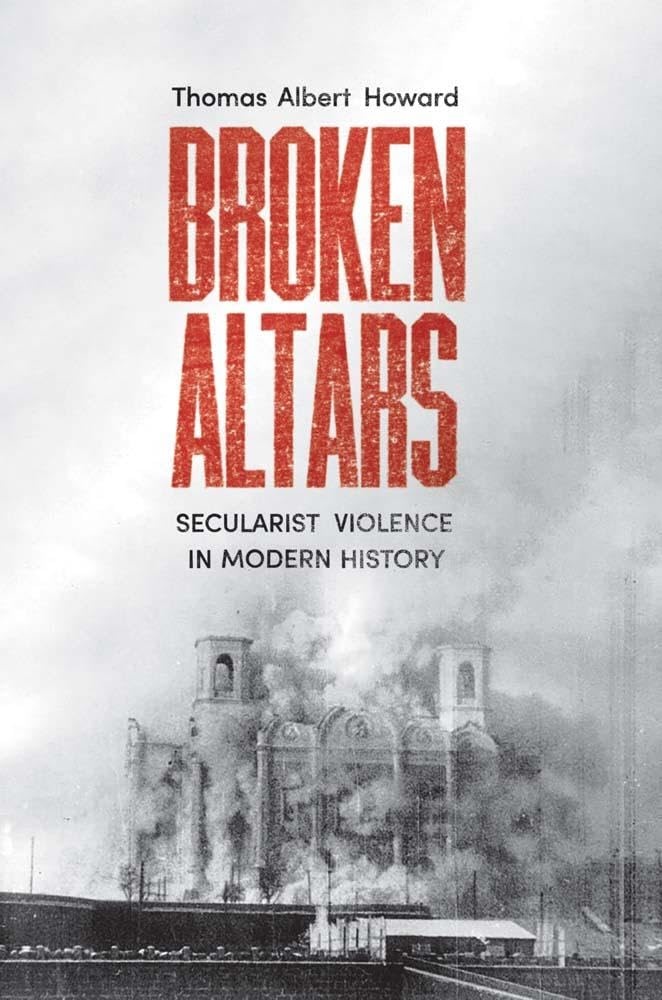
Broken Altars counters the popular Enlightenment cliché that violence is inherent to religious belief, while secularism is an intrinsic force for peace. While not denying or diminishing violence committed in the name of religion, Howard emphasizes the unfathomable human toll of secular violence in the 20th century, with estimates of 85 to 100 million deaths credited to communism alone.
Howard, a professor of humanities and history at Valparaiso University, groups secularism into three categories: passive, combative, and eliminationist secularism. Passive secularism “permits religious individuals and institutions wide berth in articulating and living out the convictions of their faith traditions within a democratic polity that neither endorses them nor seeks to advance its own religion.”
In contrast, combative secularism is an outgrowth of the “Jacobin stages of the French Revolution,” resulting in an often-violent anti-clericalism exemplified in Voltaire’s famous call to “ecrasez l’infame,” later somewhat tempered into France’s notion of laicité. Howard deftly traces their philosophical currents and resultant brutalities across Mexico, Spain, and Turkey.
The experience of religious orders in Czechoslovakia is an example of eliminationist secularism, developed by Europe’s far left philosophers such as Marx, Engels, Proudhon, and Bakunin. Comprehensively anti-religious, this ideology seeks the eradication of religion and the total politicization of institutions.
Howard’s tour d’horizon offers a sweeping, global view of these militant secular ideologies. While the main target was Christianity, specifically Catholicism, Howard records the effects on other religions such as Islam, Judaism, and even Buddhism, Taoist beliefs, and shamanism in the East.

In a thoughtful conclusion, he cautions that secularism alone does not exhaustively explain militant violence. It’s difficult to untangle the interplay between religion, ethnicity, political dissent, nationalism, and separatism. However, “secularist ideologies often supplied a modern, sophisticated-sounding ideological posture, appealing to ‘progress’ and ‘science’” such that “decline (and eventual extinction) of belief served as a bellwether of revolutionary progress.”
And although Howard doesn’t discuss it, today in the West a creeping combative secularism has emerged, requiring vigilance by the faithful. A report on discrimination against Christians in Europe has found “increasing restrictions on their religious freedom and, in some cases, even criminal prosecution for the peaceful expressions of their religious beliefs.” In the United States, a House Committee recently investigated the FBI’s categorization of Catholics as potential “domestic terrorists” in an internal memorandum portraying “‘radical traditionalist Catholics’ (RTCs) as violent extremists and proposed opportunities for the FBI to infiltrate Catholic Churches as a form of ‘threat mitigation.’”
Eliminationist secularism (communism) still exists prominently in North Korea, Cuba, and China. As Chinese President Xi Jinping told party members in 2022, Sinicization means recognizing a “Marxist view of religion.” Therefore “religion will disappear from human history” through “long-term asphyxiation.”
As in 1989, we owe these present-day victims of aggressive secularism our moral, political, and spiritual support so that they too may benefit from a Velvet Revolution of their own making.
Broken Altars is an important reminder of the unparalleled human suffering caused by secularist ideologies. Thankfully, many Slovaks have not forgotten the past. Tens of thousands attended the November 17 ‘They Will Not Take November from Us’ event in Bratislava’s Freedom Square to protest the cancellation of the national holiday by the Fico government. As one protester noted, “We value freedom and will not let it be taken away from us.”