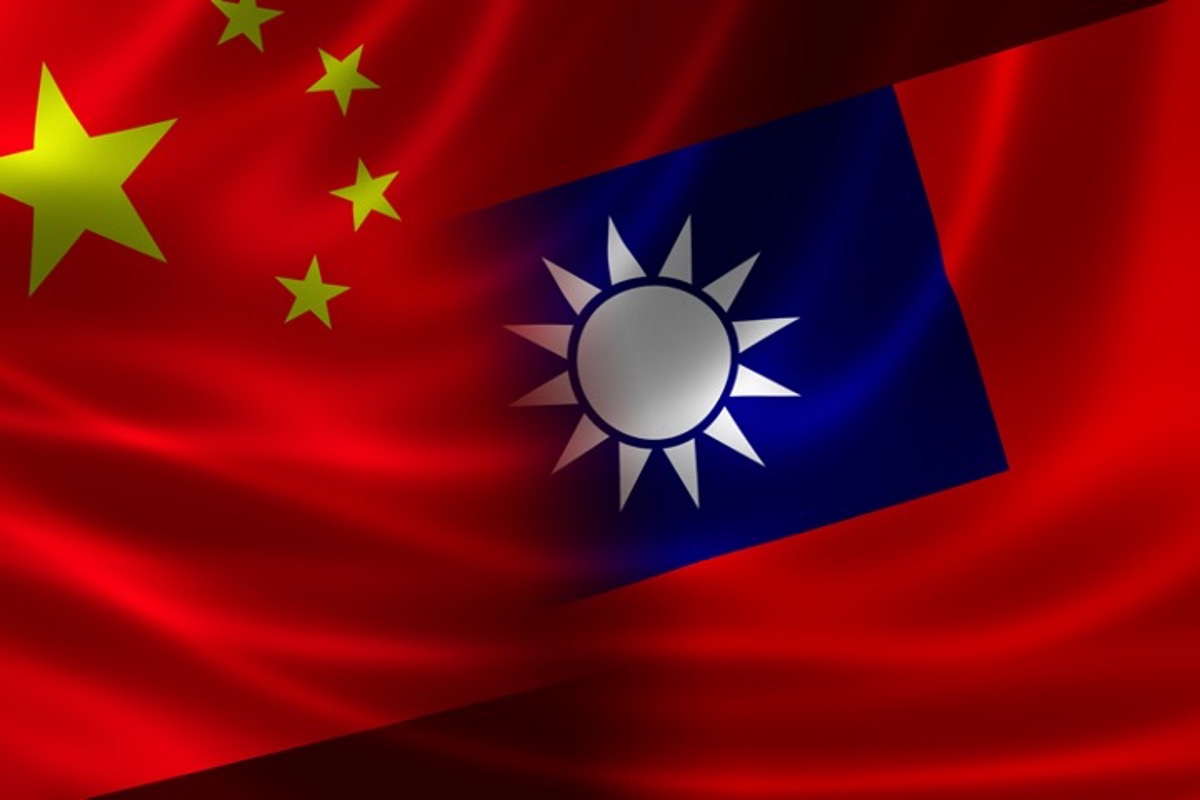
Donald Trump’s administration announced that it approved a weapons sale to Taiwan valued at more than $11 billion. Not surprisingly, China is not happy about this.
China’s foreign affairs spokesman, Guo Jiakun, said the move violates the understanding Washington has had with Beijing regarding Taiwan. He said it “seriously violates the one-China principle and the three China-US joint communiqués.” Accusing Washington of violating China’s sovereignty, security, and territorial integrity, he added that attempts to use Taiwan to contain China will not only fail, but possibly lead to war:
This cannot save the doomed fate of “Taiwan independence” but will only accelerate the push of the Taiwan Strait toward a dangerous situation of military confrontation and war. The U.S. support for “Taiwan Independence” through arms will only end up backfiring. Using Taiwan to contain China will not succeed.
Taiwan as a Buffer Helps America
Taiwan, on the other hand, was quite happy with the development. The Defense Ministry said the sale would help the island nation maintain “sufficient self-defense capabilities” while posing as a deterrent. Unlike China, Taiwan sees its arming as “the foundation” for peace in the region. Taiwan’s Foreign Minister Lin Chia-lung echoed the sentiment. He said America’s “long-term support for regional security and Taiwan’s self-defense capabilities” is key to preventing war.
President of the US-Taiwan Business Council Rupert Hammond-Chambers said the weapons will help not only Taiwan, but America as well. “This bundle of congressional notifications, a record in US security assistance for Taiwan, is a response to the threat from China and the demand from Mr Trump that partners and allies do more to secure their own defense,” he said.
The Trump administration announced the weapons sale on Wednesday. It includes high-mobility artillery rocket systems, anti-tank missiles, anti-armor missiles, loitering suicide drones, howitzers, military software, and parts for other equipment, according to reports. It is hailed as the largest-ever arms package for Taiwan. This is the second weapons deal with Taiwan the second Trump administration has made; a November deal includes $330 million for aircraft parts.
Partnership Between United States and Taiwan
The Pentagon believes the arms sale is good for America’s economic and security interests. The State Department said the sale serves “U.S. national, economic, and security interests by supporting the recipient’s continuing efforts to modernize its armed forces and to maintain a credible defensive capability,” reports say.
The sale aligns with the Pentagon’s request that Taiwan spend as much as 10 percent of its GDP on defense. The country is nowhere near that, but it did approve last year a defense budget for 2025 that comes to 2.45 percent of its GDP, a 7.7-percent increase. It has pledged to raise defense spending to 3.3 percent of GDP by next year, and to 5 percent by 2030.
The next step in the sale lies with Congress, which will have to approve the package. Be on the lookout for China sympathizers who might push back on the deal.
The relationship between the U.S., China, and Taiwan is complicated. While Washington acknowledges China’s claim that Taiwan is part of it, it doesn’t endorse it. And as far as China’s claim that the Western-friendly island belongs to it, history has a different view. As we reported in 2023:
Taiwan was not conquered by China but by the Manchu invaders, and was relinquished by treaty to Japan. It was then ceded to the Republic of China after World War II, also by treaty, and became the sole remaining bastion for that government when Mao’s bandit army took over the mainland, thanks to the U.S. government’s betrayal of Chiang Kai-shek and the Nationalist Chinese, and subjected it to decades of horrific despotism. China’s claim of sovereignty over Taiwan is largely bound up with a cultural obsession with saving face, coupled with a desire to crush once and for all a hated foe that has been showing the world for decades that, in fact, the Chinese are capable of sustaining a free government.
Nevertheless, the possibility of a Chinese invasion of Taiwan has been looming for years. Since at least 2017, Chinese dictator Xi Jinping has carried out numerous threatening military exercises in the waters and skies around Taiwan. If an attack happens, the vital question is: Will the U.S. jump to Taiwan’s defense?
The Taiwan Relations Act of 1979 is the closest thing we have to defining our relationship with the nation in the event of a Chinese attack. As per our previous report:
The United States will have no embassy or ambassador in Taiwan — but it does have the American Institute in Taiwan, which … is an embassy in everything but name. Taiwan no longer enjoys the protection of a defense treaty — but the act provides for making sure that Taiwan always has sufficient weapons to defend itself, and also directs the United States itself to “maintain the capacity … to resist any resort to force or other forms of coercion that would jeopardize the security, or the social or economic system, of the people on Taiwan.”
The treaty did not impose any actual obligation on the United States to defend Taiwan against China; hence the term “strategic ambiguity,” which for decades has defined the United States’ role in any potential conflict over Taiwan. The idea then was that such ambiguity would deter Chinese aggression while allowing the United States to have it both ways, enjoying the economic benefits of investment in both countries.