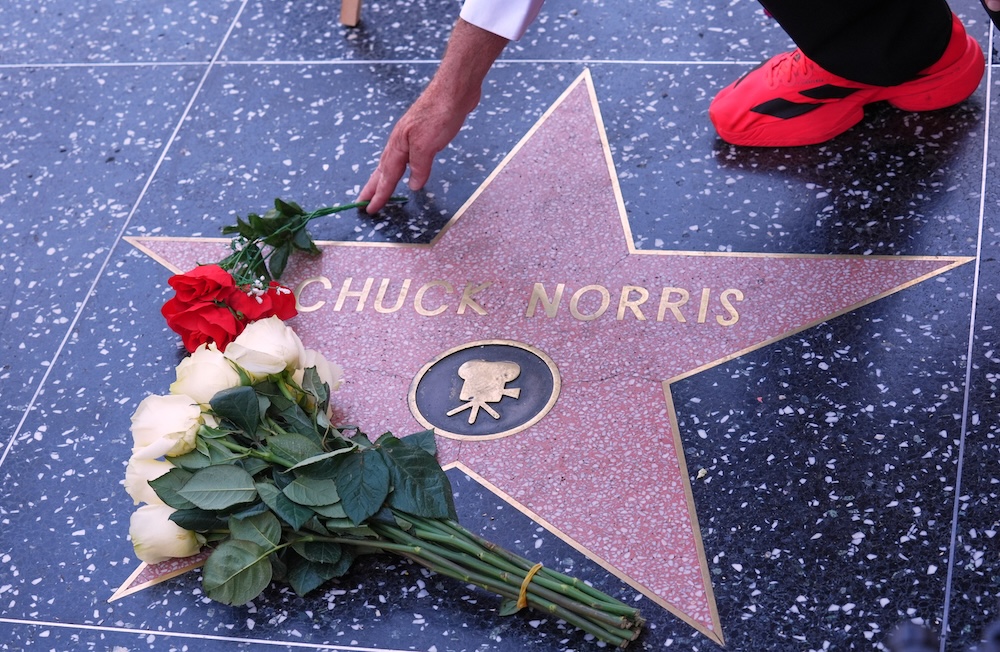
Chuck Norris has died at age 86, something considered impossible in the digital age, which includes “Chuck Norris Facts,” a litany of impossibilities that prove Norris is the greatest at almost everything. Accordingly, the world learned that Norris can divide by zero and that he’s so tough he can slam a revolving door. A comical exaggeration of his indestructibility and prowess was the last sight moviegoers got of him, in Sylvester Stallone’s The Expendables 2 (2012), after a career that spanned 50 years.
That career started in even more astounding fashion, as Bruce Lee’s preferred antagonist in The Way of the Dragon (1972), which Lee also directed. The climax of the movie is a duel to the death under the steps of the Colosseum in Rome. This may sound preposterous, but Bruce Lee was a remarkable entertainer, not just a fighter, and he knew what he was doing. The two had become friends as martial artists in the late 1960s in Los Angeles, trying to establish themselves. The other influence on Norris was one of his karate students, Steve McQueen, the coolest actor of the era, who encouraged him to make movies.
Norris was a very unlikely candidate for the movies or for celebrity. He had an unhappy upbringing and signed up for the Air Force after high school in 1958. He was stationed in Korea and learned martial arts there. After his discharge, in the 1960s, he started fighting and eventually winning in karate competitions, becoming a champion. He became a self-made man and a teacher, not just of martial arts but of self-help through strength and self-reliance, discipline and a disposition to be decent.
So as Norris became an entertainer, it was natural that he would turn to patriotism, too, against the cynicism of the ’70s. His first success, Good Guys Wear Black (1978), is about the aftermath of Vietnam. Here he plays a veteran who tried and failed to save MIAs and who next tries to save his own men from assassination. That became the theme of his three Missing in Action movies (1984, 1985, 1988), when he became a mainstream actor.
So also the two Delta Force films (1986, 1990) see Norris deal with Islamic terrorism and South American narco-terrorists. All these movies became staples of B cinema for their stories of the manly pursuit of justice, admiration for the U.S. military, and direct confrontation of the major problems facing America, which destroyed the confidence of national elites and ruined their credibility as Americans increasingly questioned why America can’t win wars or deal with Third World threats. Their fantastic or preposterous aspect was, in fact, a needed encouragement for millions of people.
Norris knew all this and said as much to the NY Times in his first interview in that prestigious venue, in 1985: “I am a conservative, a real flag waver, a big Ronald Reagan fan. I’m not so much a Republican or Democrat; I go more for the man himself. Ronald Reagan says what he thinks, he’s not afraid to speak his mind, even if he may be unpopular. I want a strong leader and he is a strong leader. And ever since he has been in office there has been a more positive, patriotic feeling in this country.”
Norris’s blue collar patriotism and rugged manliness come across best in Lone Wolf McQuade (1983), in which he plays a Texas Ranger: a gruff middle-aged man with a beard, a .44 Magnum, and a pet wolf. The American character established in the national genre, the Western, is resurrected in an opening scene in which McQuade faces off against cattle rustlers. He eventually faces a more modern threat, however: a criminal organization of arms runners led by a particularly cruel martial artist, Rawley Wilkes (played by David Carradine, of Kung Fu fame).
Norris later brought such a character to his very successful TV series Walker, Texas Ranger (1993–2002), within the restraints of television. Somewhat tamed by age and circumstances, Cordell Walker reminded viewers, over more than 200 episodes, about the duties of protection and self-government, their necessary relation to good character, and the inescapable need for men. This was moralizing storytelling, which is rather preferable to demoralizing storytelling.
In the end, Norris is probably going to be remembered for popularizing martial arts in America. He was an early practitioner of something that has become very important, with MMA and UFC now representing the most popular “identity” for men. The transformation of American society in the 20th century led to the rise, time after time, of fighting sports and eventually turned violence into entertainment. This strange development means that, on the one hand, the society is pacified or rendered helpless, relying ever more on impersonal, often distant institutions; but on the other, fantasy is out of control and takes over more and more of public and private life. Norris insisted on discipline in those times when it seemed America was going crazy, as in the ’70s, but also on individual initiative to safeguard American freedom. No wonder so many men came to rely on him for inspiration.
Perhaps most importantly, Norris had such a large number of fans because his movies were all about fighting for justice and people knew that he spoke up for them. Unlike the other action heroes of the ’80s, Norris didn’t joke around, avoided the one-liners, and was pretty much always earnest. He appealed primarily to the indignation with which many Americans looked at their society, which was riven by crime and drugs, and was becoming weak or contemptible, so that it was no longer easy to say whether people lacked principles or the will to act on them. It’s for this reason that his work was a public service.
The trouble with B movies is that there often isn’t enough talent behind the camera. Norris worked with a competent journeyman director only once, Andrew Davis of The Fugitive fame, on Code of Silence (1985). Norris is a Chicago PD sergeant who has to battle both drug lords and the “code of silence” about a wrongful police shooting within his precinct even as he tries to save an innocent young woman. It’s his most accomplished contribution to the ’80s action movie genre, which was one of the sources of hope in America in that decade and deserves its fans. It’s a great way to remember Norris—so watch it again!