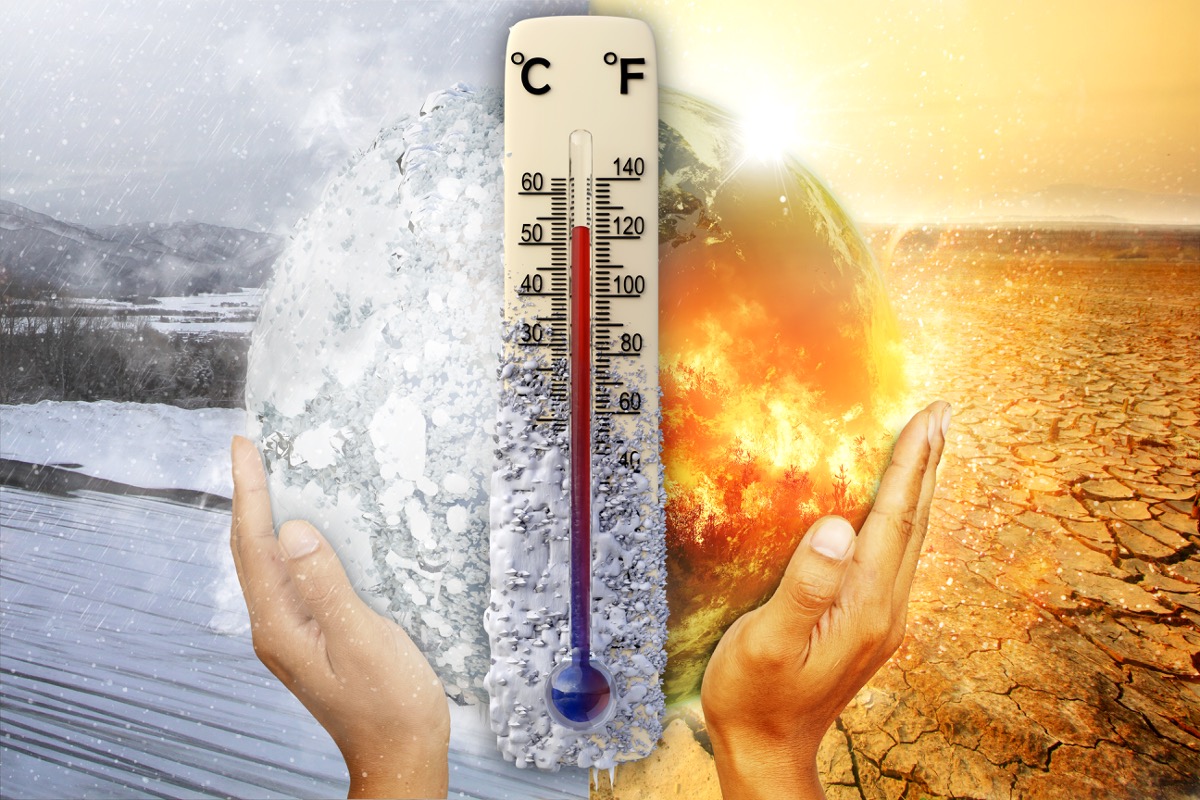
It’s always nice when your theory covers most every possible outcome. Just consider the matter of anthropogenic (man-caused) climate change. We have, of course, heard that if the weather warms, the thesis is correct. If the weather merely becomes more volatile, we’re told, it’s also correct, with the “excess” atmospheric CO2 causing climatic upheaval. Then, too, we’ve heard as well that the theory is correct if the weather cools.
(Not to mention that we’re never told what the Earth’s ideal average temperature would be. This precludes our knowing if any warming, whether naturally occurring or man-caused, is good or bad. For we then can’t know if it’s taking us closer to or farther from that ideal temperature.)
The latest warming-begets-cooling theory comes from scientists at the University of California — Riverside (UCR). Reported last week by ScienceDaily, the website’s article is actually titled, “Global warming could trigger the next ice age.”
Of course, Zen koan-like, this sounds like saying “Malignant cancer could trigger robust health” or “Impoverishment could trigger material abundance.” (The latter may be New York City Mayor-elect Zohran Mamdani’s thesis.)
Joking aside, though, some scientists have actually been predicting an impending ice age for decades now — due to natural cycles.
The Study
As to the recent study, what follows is a Grok AI summary of the ScienceDaily piece: UCR researchers claim to
have revealed a significant oversight in the longstanding scientific model of Earth’s climate regulation. For decades, experts viewed rock weathering as the primary stabilizing mechanism: rainfall absorbs atmospheric CO₂, reacts with silicate rocks like granite to break them down, and carries the dissolved carbon to oceans, where it forms calcium-based shells and limestone, sequestering CO₂ for millions of years. This process accelerates with warming, theoretically cooling the planet back to equilibrium.
However, geological records of ancient “snowball Earth” events — when ice covered nearly the entire planet — cannot be explained by this gentle feedback alone. The team identified an additional, amplifying process centered on ocean nutrient cycles.
As global warming increases rainfall, more phosphorus and other nutrients wash into seas, spurring explosive plankton growth. These organisms photosynthesize CO₂, and upon dying, sink to the seafloor, burying carbon. In warmer, low-oxygen conditions, decaying matter releases phosphorus back into the water, fueling further blooms in a runaway loop. This hyper-efficient carbon burial can overshoot, driving temperatures far lower and potentially triggering ice ages.
Computer models confirmed the mechanism’s potency in ancient low-oxygen atmospheres.
Laymen’s Explanation
Analogizing the researchers’ theory in simple terms, ScienceDaily writes:
Rather than gently stabilizing Earth’s temperature, this feedback [loop] can drive cooling well past its original starting point.
… [Geologist and study co-author Andy] Ridgwell likens the process to a household cooling system working too hard.
“In summer, you set your thermostat around 78°F. As the air temperature climbs outside during the day, the air conditioning removes the excess heat inside until the room temperature comes down to 78° and then it stops,” Ridgwell said.
Using this analogy, he explains that Earth’s climate control is not broken. Instead, it may respond unevenly, as if the thermostat were not positioned close to the air conditioner.
So as the theory goes, there should eventually be a cooling effect to counteract the supposed near-future global warming. But this should be less severe than what caused the ancient ice ages. This is because, states ScienceDaily, “higher oxygen levels reduce the strength of the nutrient feedback in the oceans.” It’s like, as Ridgwell puts it, “placing the thermostat closer to the AC unit.”
Nonetheless, the researcher claims that this feedback phenomenon could be enough to catalyze the next ice age. This won’t save us from man-caused global warming, though. For the cooling effect will likely occur too far in the future, Ridgwell claims. So are we going to be cooked and then frozen like excess Christmas dinner?
A Predilection for Prediction (and Fiction?)
Now, honest scientific inquiry is virtuous, of course; it’s about the discovery of Truth. The UCR findings are most interesting, too. Yet there may be a departure from true science when basing prognostications on findings.
As ancient Chinese sage Confucius once put it, “Wisdom is, when you know something, knowing that you know it. And when you do not know something, knowing that you do not know it.” The UCR scientists apparently have, as was claimed, “revealed a significant oversight.” Yet this raises a question:
What other climatic oversights remain unrevealed? We don’t know what we don’t know.
And if there are other relevant undiscovered phenomena, how do they affect climate?
What we do know is that man has always had, despite often scant knowledge, a predilection for prediction. In 1975, Newsweek famously proclaimed in its article “The Cooling World” that another ice age was nigh. This wasn’t just a media invention, either — even some climatologists issued such warnings.
This gave rise to sensational documentaries such as 1978’s “The Coming Ice age” (segment below).
(Unknown) Things to Come
To this day, too, certain experts warn of impending global cooling — naturally caused. One example is found in the 2015 New American article “Climate Change: Is a Deadly Ice Age on the Horizon?” And here are some points to ponder:
- There’s a multitude of naturally occurring cycles that influence temperature. Some are: Milankovitch cycles (orbital variations), glacial-interglacial cycles, Dansgaard-Oeschger events, solar cycles (sunspot cycles), grand solar minima, large igneous provinces, and volcanic aerosol cycles. All these phenomena affect temperature with or without man’s presence — sometimes profoundly.
- As even The New York Times admitted in 2016, cold weather is far deadlier than warming is. Warmth breeds life; this is why the tropics have 10 times as many species as does the Arctic.
- CO2 isn’t a pollutant but a “plant food” that augments foliage growth and increases crop yields. This is why botanists pump it into greenhouses.
- One analysis found that reducing the global temperature 3/10ths of one degree by the century’s end — meaning, postponing so-called “global warming” less than four years — would cost $100 trillion.
- Computer climate models have often been wrong, and measurements of Earth’s temperature may not even be accurate.
Conclusion
For a bit more perspective, we know that disaster does periodically befall man — and will again, eventually. But there’s one kind of disaster we probably needn’t worry about: the one most everyone else is worrying about.
How many people foresaw WWI, WWII, the Great Depression, the fall of Rome, or the Black Plague? Terrible disasters seem to come like a thief in the night, with only perhaps a few prescient souls sounding a usually ignored alarm. Conclusion?
No, we shouldn’t check our brains at the door and cease being vigilant. And legitimate research is wonderful. But we shouldn’t rejigger the entire world economy — and impoverish millions — based on the predictions of today’s fashionable doomsayers. Because a pretty safe prediction is this, in every time and place: The “consensus” doom-and-gloom prediction will almost always be wrong.