A good friend and long-time prominent Catholic commentator called me this week to ask my perspective on current American foreign policy. Not for the first time, I had nothing coherent to offer. This has been the situation for some 15 years now. A Cold War-trained American military and foreign policy functionary, I have found myself unable to adapt to the realities of the 21st century.
I realized around 2012 or 2015 that if you marched me into the Oval Office (whose decor was different then than in the Bush 43 Administration, but not yet gold gilt-saturated) and said, “OK, smarty-pants, tell the President what to do about [name your region or policy problem],” I would have had nothing to say. Same today.
In 2017, the French embassy in Washington awakened in early January to realize that after eight jolly years with the Obama crowd, they knew no one who was likely to be installed in the new Trump Administration. Those Rolodex entries had been thrown out in comfortable, even joyful anticipation of a permanently “transformed” America, to use Obama’s phrase. For the French, un problème sérieux.
The embassy apparently sent an emergency cable to Paris asking if anyone knew of Republicans from yesteryear who might be open to recultivating contact. In a clear signal of desperation, they invited me to an Inauguration party (I wasn’t actually a Republican, but you get the point). The star that night was Rudy Giuliani. I saw a few familiar faces as surprised as I was to be suddenly à la mode again.
I subsequently declined a very tentative inquiry about a possible Trump Administration position. No more invitations to the French embassy.
I declined not because I was a high-minded never-Trumper, but because in a rare moment of self-awareness, I knew that I no longer had anything to offer the Washington policy world.
In the Bush Administration, I had realized that my foremost contribution was to ask occasionally, “Remind me what we’re trying to do?” By 2017, even posing that question seemed out of reach.
I was by then well into my doctoral work in philosophy. My military and foreign policy jobs had, over the years, had the effect of sustaining my interest in fundamental questions about what unchanging truths might be had in this life.
That’s to say that my active life only intensified my desire for a contemplative life. And not just a retirement from gainful employment with material advantages, but retirement in the French sense of the verb retirer, to withdraw or pull away from the world.

So, halfway here through my TCT allocation of 1000 words, dear reader may well be asking: So, where does this Epiphany-season autobiographical reminiscence lead?
It leads to Socrates, Plato, Aristotle, St. Augustine, St. Thomas Aquinas, and the works of other philosophers about whom I like to scribble.
But perhaps a bit surprisingly, it leads also to Dante. At this point, our editor’s eyebrows may be raised, since he knows a good bit about Dante. So I’ll be careful.
My friend and CUA School of Philosophy mentor Dr. Kevin White has taught courses on Dante and philosophy, and I was fortunate to take one of those courses. A distinguished Thomist, he has taught at CUA for over three decades.
White (who, incidentally, owns a complete collection of the journal Idler, the great project edited by TCT contributor David Warren) encourages his students both to learn Italian and to read Dante daily. In this new year, I’m taking at least the second part of his advice.
I’m re-reading the Divine Comedy and am now a few cantos into the Inferno. I’m trying not to hurry, but also not to tarry because White also informs his students of the legendary dictum that where you stop reading the Comedy is where you go after you die. I need to get to Purgatorio quickly, and Paradiso promptly. You never know.
Besides, it’s a pleasure to read and re-read. And Dante knew his Thomist philosophy. He invokes a vast range of references, making notes essential for those of us less schooled in ancient literature and history.
The beautiful translation by Robert and Jean Hollander is my preferred version (the only volume of the translation by Dorothy L. Sayers that I’ve read, Purgatory, is also superb). Jean mostly did the language, and Robert did the notes.
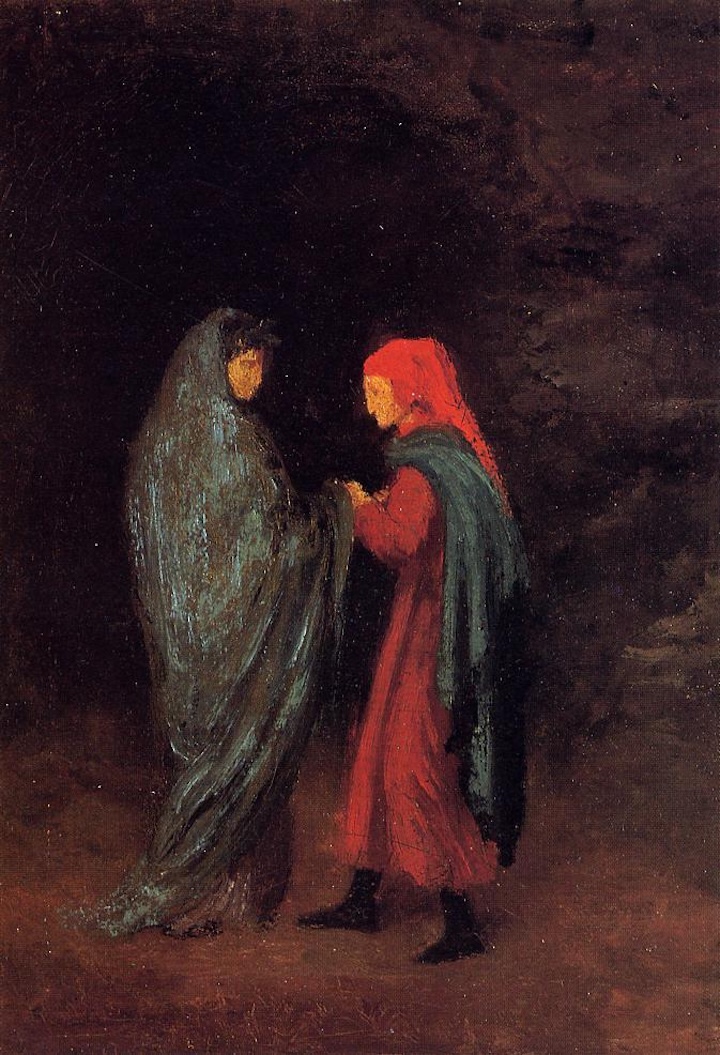
In the first circle of Hell, Limbo, Dante is led by his guide Virgil to encounter pagan poets and philosophers who lacked faith but died otherwise sinless. It’s not Paradise and the Beatific Vision, but it’s not nearly as bad as the lower circles will be.
There’s a “noble castle” within Limbo where 35 souls reside. Hollander notes that of these 35, in their earthly lives, three-fifths were contemplative and two-fifths were active.
So Dante acknowledges that among those without faith, the philosophical or contemplative life gives you an edge on eternity, but the active life also has its merits.
Aristotle thought the true telos of humans, the end for which we are built, is happiness as contemplation of the divine in the excellence of intellectual virtue, though he accepted the good of political life because most people can’t live that telos fully. Cicero saw the good in both the philosophical life and the active roles of political and military leadership, favoring the latter as more noble.
St. Augustine and St. Thomas Aquinas accepted the necessity of activity when faced with unavoidable duty. But they followed Christ’s admonition that Mary had chosen the better way over Martha (who was still in better shape in her activity than the sinless but faithless pagan contemplatives).
A very close friend who knows me well suggested that in the new year, I focus on writing things that will simply help people. Here’s a start on that: Read Dante. He fills his Comedy with examples of all kinds of life.
That’s something well worth keeping in mind for actives who find themselves perplexed by the headlines and circumstances of the moment.