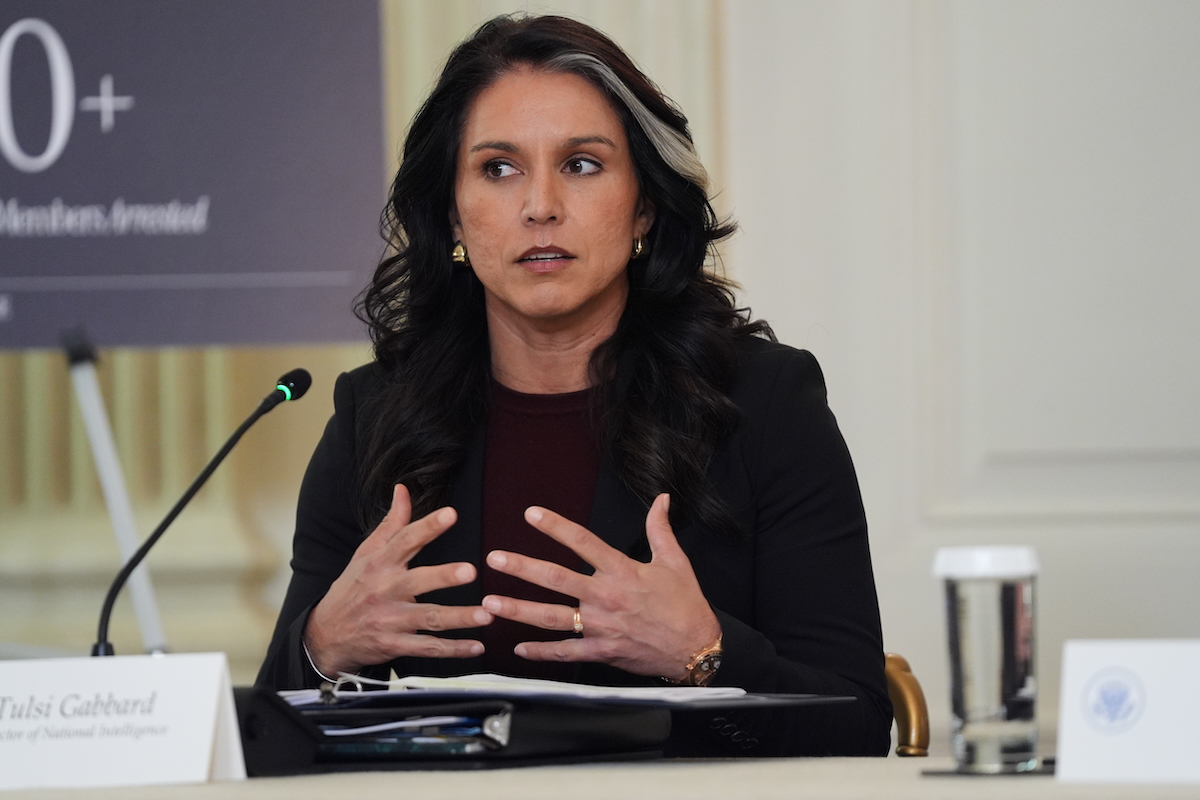
Three days after the Venezuela military raid, Director of National Intelligence (DNI) Tulsi Gabbard took to X to celebrate it. Once a staunch anti-interventionist, Gabbard thanked the military and the intelligence officers for “their flawless execution of President Trump’s order.”
Almost instantly, a wave of her earlier statements began circulating online, reminders of how radically different her foreign-policy rhetoric once was.
Still, Gabbard’s apparent absence from the planning and execution of the intervention, and her resurfacing only afterward, raised more than questions about hypocrisy. What role did America’s chief intelligence officer actually play in the most consequential military operation of Trump’s second term thus far, and what does that reveal about the current foreign-policy dynamic?
Operation Absolute Resolve
On Tuesday, Gabbard wrote on her official account:
President Trump promised the American people he would secure our borders, confront narcoterrorism, dangerous drug cartels, and drug traffickers. Kudos to our servicemen and women and intelligence operators for their flawless execution of President Trump’s order to deliver on his promise thru Operation Absolute Resolve.
Operation Absolute Resolve was carried out in the early hours of January 3. It was aimed at capturing President Nicolás Maduro and bringing him to the United States to face federal charges for narcotics and related offenses.
The mission unfolded in and around Caracas. It included elite Delta Force commandos, a covert CIA team on the ground, cyber operators, and more than 150 aircraft. They executed coordinated strikes on key infrastructure and Maduro’s residence. The Venezuelan military and allied Cuban personnel fought back, and casualties were significant. Dozens of Venezuelan and Cuban military personnel and civilians were killed, and seven U.S. service members were injured. Maduro and his wife, Cilia Flores, were taken into custody and transported to New York.
President Trump and his team described the operation as a demonstration of American resolve. They presented it as part law-enforcement action, part national-security imperative — necessary to disrupt drug flows and protect the U.S. homeland.
Gabbard’s post on X took that language wholesale, offering no context about the intelligence that justified launching a high-risk mission deep into a sovereign nation’s capital. There was also no acknowledgment of the political or, most importantly, legal debate swirling around the action.
What Intelligence?
The heart of the mission’s public justification has been its focus on drug trafficking and “narcoterrorism.” Trump officials have tied Venezuela’s state apparatus to global criminal networks, arguing that Maduro’s government facilitated the flow of drugs northward. But the public intelligence basis for these assertions remains thin and contested.
The U.S. Department of Justice’s (DOJ) own filings after the raid abandoned the claim that Maduro led a formal cartel such as the Cartel de los Soles. Instead, the revised indictment describes his role as part of a corrupt “patronage system” funded by trafficked drugs.
That distinction matters. The original narrative of a sprawling state-run drug cartel was powerful politically. But if the underlying evidence is legally weaker, it raises questions about the very rationale for military intervention.
The administration also tried to link Maduro to the Tren de Aragua gang. ODNI’s own assessments, published last April, contradicted that claim. Gabbard sidelined the assessment and fired the officials who produced them. The move drew criticism from some corners of the intelligence community as politicizing analysis.
What concrete intelligence justified the operation remains secret.
If the intelligence basis was less clear than public claims suggested, Gabbard’s unqualified praise of the mission — without explaining how her office assessed the threat — deepens debate over her role and understanding of the facts at issue.
CIA and the Cartel
There is an important detail Gabbard, as DNI, should have known, and inform the public of: The U.S. government once helped build the very network it later accused Nicolás Maduro of leading.
Investigative journalist Max Blumenthal reported in The Grayzone that the so-called cartel — or rather network of “corrupt rank-and-file civilian, military, and intelligence officials,” per the DOJ indictment — did not originate under Maduro at all. It was, reports Blumenthal, “established by the CIA under pro-U.S. Venezuelan governments during the 1980s and ’90s.” The history is not obscure:
Americans were introduced to this inconvenient truth not by some dissident muckraker, but by the New York Times, and by Mike Wallace in a 60 Minutes exposé broadcast in 1993.
The report further describes how in 1990, U.S. Customs intercepted 1,000 pounds of cocaine entering Miami from Venezuela. Officials soon learned the shipment had been allowed to proceed under a CIA operation intended to track traffickers. As the Times reported, the CIA’s plan was to let drugs “enter the United States without being seized, so as to allay all suspicion.”
To manage the flow, the CIA recruited officers from Venezuela’s U.S.-trained National Guard.
The network faded from headlines for years. It resurfaced when Washington began targeting former Venezuelan intelligence chief Hugo Carvajal — and later revived the “cartel” label against Maduro’s government. Even then, analysts remained cautious.
Blumenthal argues that discovery in Maduro’s case could expose more about historic CIA drug operations. That risk, he suggests, helps explain why the DOJ quietly softened its language, mentioning the “Cartel of the Suns” only twice — and recasting it as an informal network rather than a criminal organization with command structure.
Tulsi: From Warning Voice to Warning Sign
Almost as soon as Gabbard’s praise went up on X, critics resurrected her own warnings about Venezuela. In 2019 she argued that the United States should “stay out of Venezuela.”
At the time, she condemned the interventionist impulses of Trump’s first term, warning,
Military intervention in Venezuela will wreak death & destruction to Venezuelan people, and increase tensions that threaten our national security.
The stance largely defined her political identity. Just two months ago, she praised Trump for ending an “old Washington way” of “counterproductive and endless cycle of regime change or nation-building executing.”
And yet, when the administration launched the raid, Gabbard reportedly played “little role” in it. According to The Washington Post, the core national security team gathered with Trump at Mar-a-Lago as the operation began. Gabbard was neither present nor among the senior officials who later briefed lawmakers. Deciding on the matter were “Stephen Miller, the White House deputy chief of staff and homeland security adviser, Secretary of State Marco Rubio, Defense Secretary Pete Hegseth and CIA Director John Ratcliffe.” Meanwhile, two days before the raid, Gabbard’s personal feed featured tranquil beachside yoga shots.
But Gabbard’s arc is not just a story of inconsistency or even incompetence. It is a case study in how political calculation and institutional sidelining can convert once-independent voices into after-the-fact validators of policies they once condemned. At the same time, whether Gabbard’s anti-war image reflected conviction or a 2024 campaign posture aimed at pulling voters into Trump’s camp is unclear. What remains clear, however, is the broader pattern: In Washington, it is political will that leads. Objective assessments of risk and long-term strategy arrive later, if at all.
Seen this way, it is little surprise that Gabbard’s silence on how the intelligence she oversees connects to Trump’s widening threats toward Greenland, Cuba, Iran, and other countries is understandable — if not especially reassuring.