Dana Milbank was once one of the most insufferable of The Washington Post’s reporters and columnists. For decades, Milbank gained a reputation for serial exaggeration and distortion, such as misrepresenting his interview subjects. His partisan hackery was so egregious that Karl Rove specifically asked The Washington Post not to assign Milbank to cover White House news. In 2008, MSNBC’s Keith Olbermann, of all people, demanded the journalist submit “a correction or an explanation” for taking snippets of Barack Obama to misrepresent the then-presidential nominee, a practice journalist Mollie Hemingway labeled the “Milbank Rule.”
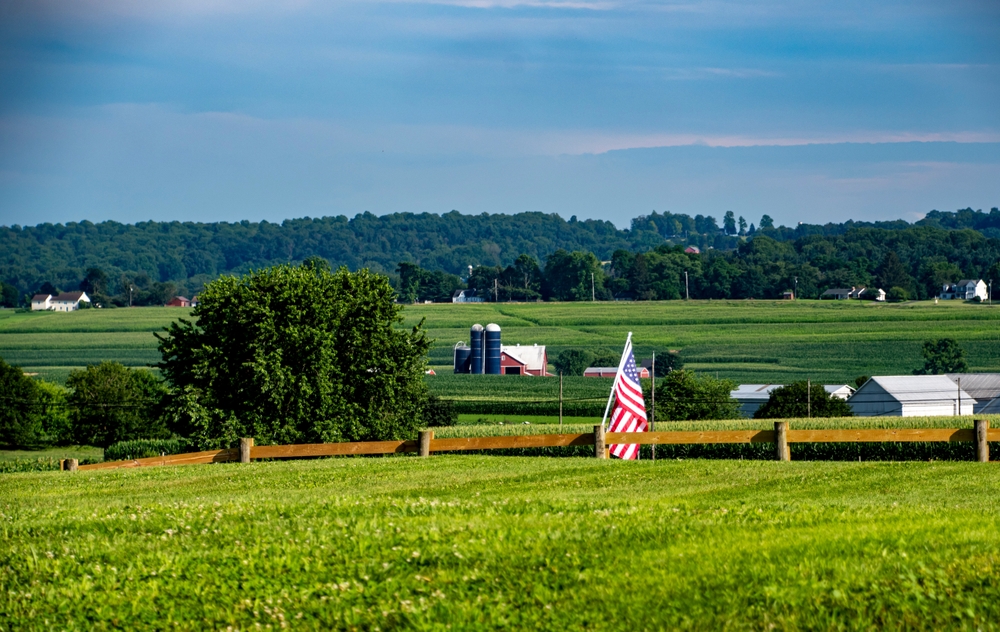
Then, a few years ago, Milbank purchased a home on a bunch of acres in rural Rappahannock County, Virginia, and began writing about his experiences there. He bought a tractor, learned how to hunt deer, explored no-till farming, and expounded on the importance of nature and community. Last year, he began writing a new weekly column about “reclaiming our humanity, restoring our connections and reviving our sense of awe.” Now his columns discuss the glories of fishing, salamanders, and controlled burns. While it’s unclear if any of this has changed Milbank’s politics or character, it certainly has made his writing more interesting and humane.
What Milbank has discovered is the vision of Thomas Jefferson: that a rural, agrarian, yeoman lifestyle offers a strong foundation for republican government, because it cultivates virtue and independence. This, at least, is what John F. Sharpe argues in his foreword to the American Catholic Land Movement: Past, Present, and Future, a collection of essays edited by Jason M. Craig and R. Jared Staudt that describes the homesteading and agriculture movement inspired by the likes of the Southern Agrarians, the National Catholic Rural Life Conference, the Catholic Worker Movement, and author-farmer Wendell Berry. Although they are a welcome reflection on how nature and the land are essential components to realizing the good life, what the essays sometimes lack in practicality, they make up for in presenting an admirable vision of what has appealed to many men and women of faith in an increasingly atomized and deracinated America.
Some of the essays are primarily historical; Staudt’s introductory chapter describes the story of Catholics and agriculture in North America—from the Spanish missions of the West to 19th-century Catholic homesteaders and 20th-century Catholic agrarians. Celebrated author Allan C. Carlson discusses the work of “Green Rising” proponents Fr. Edwin O’Hara and Jesuit John Rawe, who hoped to deindustrialize and depopulate American cities in favor of family farms they believed would best perpetuate human flourishing. William Edmund Fahey in a somewhat rambling and tedious account of his own family genealogy in New England ends well by humbly urging Americans to embrace filial piety for their heritage, whether Catholic or Protestant. “I am humbled by their energy and achievement,” he writes of his ancestors. “I am chastened and anxious when I look upon their flaws, which history preserves for me as their warning—for I recognize their flaws in myself.”
A common theme across the collection is an often-perceptive analysis of the many authentic goods derived from an agricultural and rural life, and, alternatively, the many pathologies that have attended the unequaled economic prosperity of postwar America. Samuel Shephard argues for how hunting and fishing exemplify a stewardship-of-nature model, because it encourages “social-ecological care, local knowledge, and the personal and institutional elements of agency.” Surveying the atomization of contemporary America, Jason M. Craig warns that the breakup of rural communities makes Americans more dependent on government and corporations. “Without mutual dependency, communities and families stay strong only by strained effort. When these bonds no longer ‘hold’—when members of a family and of a community are not intertwined in a living culture and economy—then you end up with individuals alone looking up at the big powers that provide the goods and services we need to survive.”
Alan Harrelson ponders why modern life feels so terrible: “Most people living today come from nowhere, do not care to be from anywhere, and would not know how to be from somewhere if they tried.” Yet while Harrelson is surely right that we often “buy machines that save time, time that is in turn used for nothing,” it doesn’t have to be this way. Those who want to leverage the conveniences of modernity to read, exercise, travel, and pursue hobbies have an unprecedented freedom to do so. Whiling away your evenings and weekends watching streaming programming may be a waste, but that is hardly the fault of your home appliances.
Contributors seem conflicted on the relative necessity of returning to the land. “It’s difficult to leave extended family and friends for the sake of one’s dreams of an agricultural lifestyle,” admits Harrelson. “Relocation is not necessary for everyone, but I think for most, it has to be an option. Indeed, it may be the only option.” Colin Miller, whose essay praises Karl Marx for his often-discerning critiques of capitalism, ends by asserting that “a renewed land-and-craft economy remains the only alternative.” Sharpe provocatively asks if the man not involved in active homesteading can “come authentically to know providence and prudence, or even in their fullness to exercise them” Given Sharpe in the very same paragraph approvingly cites St. Thomas Aquinas, a medieval Italian theologian who spent his days in study and writing (i.e., not farming), I think we have our answer.
Alternatively, Craig admits that in his experience he has seen more failure than success in attempting an agricultural lifestyle. “For us to come together in this type of communal belonging of an agrarian village is nearly impossible, for the simple reason that the economic reality of most households is not what we would call ‘rooted.’” Similarly, Professor John A. Cuddeback acknowledges that homesteading will often require ongoing income from nonagricultural sources. Although persuaded that productive homesteading is a more stable and reliable means of satisfying all the complexities of the human person, he recognizes that a socioeconomic order in which people purchase most everything they need can still be a happy one.
Perhaps the most sensible perspective is Ryan Hanning’s consideration of hypermobility, the idea that our current economy and society encourage an ungrounded, peripatetic life. “There is temptation to oversimplify the issue and wrongly assume the decision is between accepting or rejecting technology or being urban or rural,” he writes. “Rather, our reimagination and reclamation of place should not be based on what we reject as false in our hypermobile age but rather how we seek to live in radical commitment to place.” Returning to the land “can only exist as one option within a broader Catholic vision of place.” Americans need to live “in right relationship with your place, whether rural or urban. … We ought to reject the idol of hypermobility for what it is: a fear of commitment or the hubris of presumption.”
On the other hand, the most confused contribution to the collection is an exhortation for Americans to abandon the moniker “conservative. The author Thomas Storck recapitulates the following tired faux-syllogism popular among a certain brand of traditionalist Catholic (such as D.C. Schindler): Enlightenment thinker John Locke’s philosophy was diabolical, dehumanizing, and anti-God; the American political regime is pure Lockean; therefore the American political system is diabolical, dehumanizing, and anti-God. “Locke’s entire political philosophy is based on his atomistic understanding of human nature, which he held to be essentially solitary and a-social,” writes Storck, who says Locke’s ideology repudiates the concept of the common good and is the foundation of the American regime.
The founders would be mystified by this analysis. As scholars such as Thomas West, Matthew Spalding, and Michael Anton have argued, there is a tendency to simplistically overplay the influence of Locke, who, though the most quoted political thinker among the colonists in the decades leading up to the American Revolution, was not rotely followed by them “like a cake recipe.” To wit, the founding generation routinely cited Locke’s Two Treatises on Government, yet they seem largely ignorant of his problematic An Essay Concerning Human Understanding. Moreover, just as influential, if not more so on the founding, was classical- and Christian-informed natural law theory. Jefferson explained that far from attempting to create a pure Enlightenment regime, “all” the authority of the Declaration derived its reasoning from “the harmonizing sentiments of the day, whether expressed in conversation, in letters, printed essays, or in the elementary books of public right, as Aristotle, Cicero, Locke, Sidney, etc.”
There is a certain temptation that having identified a legitimately good thing, it is the only thing. Such a sentiment is visible among many of this collection’s contributors. Moving from a predominantly agricultural society to a predominantly industrial and now postindustrial society over the course of a single century has undoubtedly been destabilizing for the American people. Communities collapsed, livelihoods were lost, and millions of Americans’ sense of identity linked to particular places, communities, and faith traditions was disrupted, if not destroyed. This is of course to be mourned, and one of the great challenges of the 21st century is determining how to restore and re-create the community, identity, and sense of purpose that Americans desperately need in order to flourish.
Yet it’s unclear whether returning to the land is the best answer, not only for practical reasons—given that approximately 80% of Americans live in urban or suburban areas—but because this movement seems to elide the legitimate goods facilitated by cities. “The greatness of our city means that the produce of all the world comes into it,” declared the great Athenian statesman Pericles, whose city, we should remember, enabled the development of the great philosophical tradition that undergirds Western thought. In the Middle Ages—viewed by many traditionalist Catholic agrarians as the apotheosis of human civilization—it was in cities where worshippers gathered in awe-inspiring cathedrals and students attended universities that became the greatest centers of learning the world has ever known.
The country, agricultural life, and the natural world have tremendous appeal, something even the likes of a Dana Milbank can appreciate. It is restorative, not only in small doses, but as a more holistic means of achieving a rightly ordered life. Yet since even the earliest generations of Christianity, the faithful have also gathered in urban and suburban communities, worshipping, learning trades, gardening, participating in a complex, progressively wider economy, and witnessing to the unchurched around them. Must one of these visions be superior to the other?