When I first began devouring Catholic fiction in college, I couldn’t figure out why J. F. Powers immediately struck a chord with me and Flannery O’Connor (this year is the centenary of her birth) did not. It wasn’t that one was better than the other. Judging from their prose, they are both extraordinary stylists.
What I failed to recognize back then is now obvious to me. I was born in Pittsburgh, raised in Chicago, and educated at the University of Michigan. When I first read O’Connor, I knew much more about trains, factories, and blizzards than I did about heatwaves, fried shrimp, and peacocks. Everything I knew about racial segregation I read from books, including O’Connor’s.
The Midwest is far from an egalitarian utopia, but it certainly lacks the Southern class structure upon which so many of O’Connor’s plots turn. If I had been a more imaginative reader, stories like “Everything That Rises Must Converge” would have taught me something about a culture and a place of which I had absolutely no experience.
Yet I did know a thing or two about alcoholic priests and the affected robustness of many Midwest Catholic institutions, ranging from Notre Dame to the KofC. Powers’ stories made me laugh and showed me the narrative possibilities of an author who can wittily describe Midwest Catholic and clerical culture through the eyes of the rectory cat.
Since moving to Savannah a couple of years ago and working within blocks of O’Connor’s childhood home, all of that has started to change for me. It didn’t take long to meet people like Manley, the conniving Bible salesman in “Good Country People,” and the self-righteous Grandmother in “A Good Man Is Hard to Find.”
I’ve watched peacocks unfurl their plumage on O’Connor’s Andalusia Farm in Milledgeville and knelt in the same pew O’Connor prayed as a girl living a stone’s throw from Saint John the Baptist Cathedral. Even though I’ll always be a Midwesterner, I’m starting to wrap my mind around what it meant for O’Connor to be a Southerner.
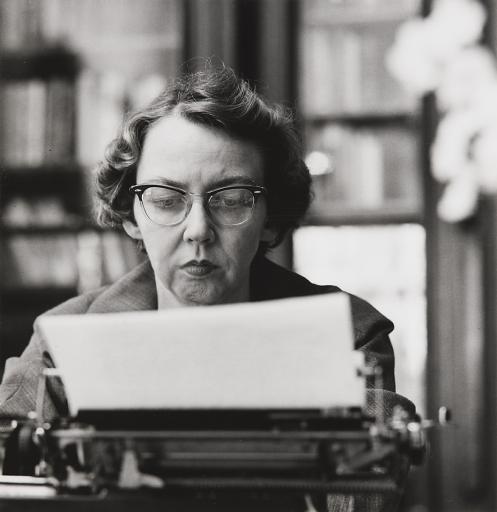
But I don’t think I’ll get very far, and that’s okay. Because if I’ve learned anything from re-reading O’Connor in this centenary of her birth, it’s that I’ll never have to wrap my mind around her Southernness completely to understand her – at least not in the way a Southerner understands her.
Everywhere I go, I can’t help but be a Midwesterner, just as O’Connor couldn’t help being anything but a Southerner, be it in Iowa, New York, or Connecticut. Her one visit to Europe only reinforced her desire to stay put in the South.
While collecting her wits in Rome, she joked that she and her mother Regina – her sole companion on the journey – would “probably end up behind the Iron Curtain asking the way to Lourdes in sign language,” adding that “my will is apparently made out of a feather duster.” Her 14-year battle with lupus would make us think otherwise, but if she simply meant that she lacked the strength not only to put up with the inconveniences of traveling but to adapt to the cultures it took her to, it’s a point well taken.
In O’Connor’s mind, my boyhood home of Chicago – where Powers sets the first part of his great novel Morte d’Urban – is as far away from Milledgeville as Rome. Every detail of her five-day stint at the University of Chicago in 1959 “assisting” young female writers was unbearable. Living in the dormitory, O’Connor was obliged to give a public lecture that no one attended and then sit with the girls “drinking tea every afternoon while they tried to think of something to ask me. The low point was reached when – after a good ten-minute silence – one little girl said, ‘Miss O’Connor, what are the Christmas customs in Georgia?’”
O’Connor found a way to apply this fierce loyalty to home to her soul as well. She would not tolerate a lack of integrity when it came to prayer, be it hers or that of others. Writing to her good friend Janet McKane, she describes an attempt to plow through Karl Rahner’s On the Theology of Death, finding every sentence an immense struggle, persisting nonetheless so that “every now and then,” she would “get the impact.”
She then confesses a truth most of us must acknowledge at some point or another during our spiritual journey: “I am not good at meditating. This doesn’t mean that I get right on with contemplating. I don’t do either. If I attempt to keep my mind on the mysteries of the rosary, I am soon thinking about something else, entirely non-religious in nature. So, I read my prayers out of the book, prime in the morning and compline at night. I like Teilhard’s idea of the Mass upon (sic) the World.”
“Mass on the World” is a breathtaking prayer composed by Teilhard de Chardin in which he imagines the consecration of the entire cosmos – with all its particles, energy, strife, and suffering – upon the altar at Mass. Teilhard’s avant-garde theology may have earned him a warning from the Congregation of the Doctrine of the Faith in 1962, but that didn’t stop Pope Benedict XVI from lauding his “great vision” for a “true cosmic liturgy where the cosmos becomes a living host.”
No matter where you’re from, that’s the one thing you have to understand if you want to understand Flannery O’Connor’s fiction. Indeed, that’s the one thing you have to understand if you want to understand Benedict XVI’s theology.
If the whole cosmos is placed on the altar, it doesn’t matter whether you’re from Chicago or Milledgeville. It doesn’t matter whether you prefer O’Connor or Powers. It only matters that – be it in your social disposition or in your prayer – you are “at home” and you place yourself on that altar too.