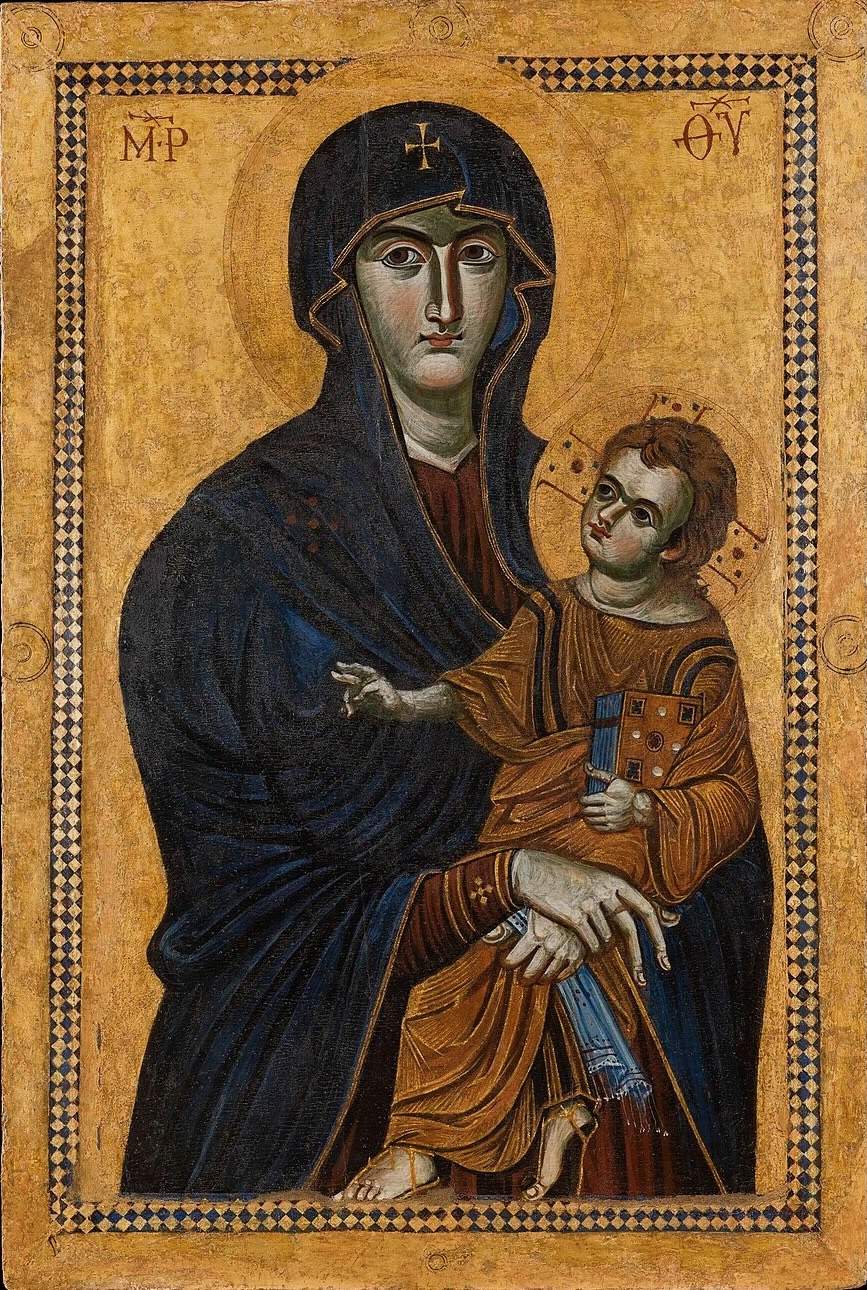
Mary is called the Gate of Heaven, because it was through her that our Lord passed from heaven to earth. The Prophet Ezekiel, prophesying of Mary, says, “The gate shall be closed, it shall not be opened, and no man shall pass through it, since the Lord God of Israel has entered through it – and it shall be closed for the Prince, the Prince Himself shall sit in it.” Now this is fulfilled, not only in our Lord having taken flesh from her, and being her Son, but moreover, in that she had a place in the economy of Redemption; it is fulfilled in her spirit and will, as well as in her body.
Eve had a part in the fall of man, though it was Adam who was our representative, and whose sin made us sinners. It was Eve who began, and who tempted Adam. Scripture says: “The woman saw that the tree was good to eat, and fair to the eyes, and delightful to behold; and she took the fruit thereof, and did eat, and gave to her husband, and he did eat.”
It was fitting then in God’s mercy that, as the woman began the destruction of the world, so woman should also begin its recovery, and that, as Eve opened the way for the fatal deed of the first Adam, so Mary should open the way for the great achievement of the second Adam, even our Lord Jesus Christ, who came to save the world by dying on the Cross for it.
Hence Mary is called by the holy Fathers a second and a better Eve, as having taken that first step in the salvation of mankind which Eve took in its ruin. How, and when, did Mary take part, and the initial part, in the world’s restoration? It was when the Angel Gabriel came to her to announce to her the great dignity which was to be her portion.
St. Paul bids us to “present our bodies to God as a reasonable service.” We must not only pray with our lips, and fast, and do outward penance, and be chaste in our bodies; but we must be obedient, and pure in our minds. And so, as regards the Blessed Virgin, it was God’s will that she should undertake willingly and with full understanding to be the Mother of our Lord, and not to be a mere passive instrument whose maternity would have no merit and no reward.
The higher our gifts, the heavier our duties. It was no light lot to be so intimately near to the Redeemer of men, as she experienced afterwards when she suffered with Him.
Therefore, weighing well the Angel’s words before giving her answer to them – first she asked whether so great an office would be a forfeiture of that Virginity which she had vowed. When the Angel told her no, then, with the full consent of a full heart, full of God’s love to her and her own lowliness, she said, “Behold the handmaid of the Lord, be it done unto me according to thy word.” It was by this consent that she became the Gate of Heaven.

[And “Mother of the Creator.”]
This is a title which, of all others, we should have thought it impossible for any creature to possess. At first sight we might be tempted to say that it throws into confusion our primary ideas of the Creator and the creature, the Eternal and the temporal, the Self-subsisting and the dependent; and yet on further consideration we shall see that we cannot refuse the title to Mary without denying the Divine Incarnation – that is, the great and fundamental truth of revelation, that God became man.
And this was seen from the first age of the Church. Christians were accustomed from the first to call the Blessed Virgin “The Mother of God,” because they saw that it was impossible to deny her that title without denying St. John’s words, “The Word (that is, God the Son) was made flesh.” And in no long time it was found necessary to proclaim this truth by the voice of an Ecumenical Council of the Church.
For, in consequence of the dislike which men have of a mystery, the error sprang up that our Lord was not really God, but a man, differing from us in this merely – that God dwelt in Him, as God dwells in all good men, only in a higher measure; as the Holy Spirit dwelt in Angels and Prophets, as in a sort of Temple; or again, as our Lord now dwells in the Tabernacle in church.
And then the bishops and faithful people found there was no other way of hindering this false, bad view being taught but by declaring distinctly, and making it a point of faith, that Mary was the Mother, not of man only, but of God.
And since that time the title of Mary, as Mother of God, has become what is called a dogma, or article of faith, in the Church. But this leads us to a larger view of the subject. Is this title as given to Mary more wonderful than the doctrine that God, without ceasing to be God, should become man? Is it more mysterious that Mary should be Mother of God, than that God should be man?
Yet the latter, as I have said, is the elementary truth of revelation, witnessed by Prophets, Evangelists, and Apostles all through Scripture. And what can be more consoling and joyful than the wonderful promises which follow from this truth, that Mary is the Mother of God?
The great wonder, namely, that we become the brethren of our God; that, if we live well, and die in the grace of God, we shall all of us hereafter be taken up by our Incarnate God to that place where angels dwell; that our bodies shall be raised from the dust, and be taken to Heaven; that we shall be really united to God; that we shall be partakers of the Divine nature; that each of us, soul and body, shall be plunged into the abyss of glory which surrounds the Almighty; that we shall see Him, and share His blessedness, according to the text, “Whosoever shall do the will of My Father that is in Heaven, the same is My brother, and sister, and mother.”
John M. Grondelski The Next Three January 1’s [Note: Today’s Solemnity of Mary, the Mother of God IS a Holy Day of Obligation.]