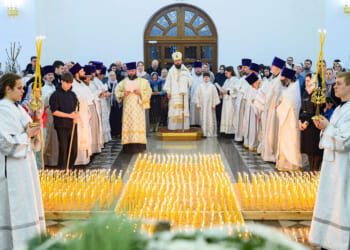
Pope Francis left the Church with multiple controversies, some that he inherited, some that he induced. Indeed, amid the complaints about clericalism and “backwardists,” the considerable presence of LGBT and feminist concerns in recent Church pronouncements, we might ask where to find a more robust, dare one say militant and masculine Catholicism – much needed given the challenges from renascent Islam and Western decline. Much of this might be viewed in light of the late pope’s decision – as a Jesuit! – to take the name of the little poor man of Assisi, St. Francis.
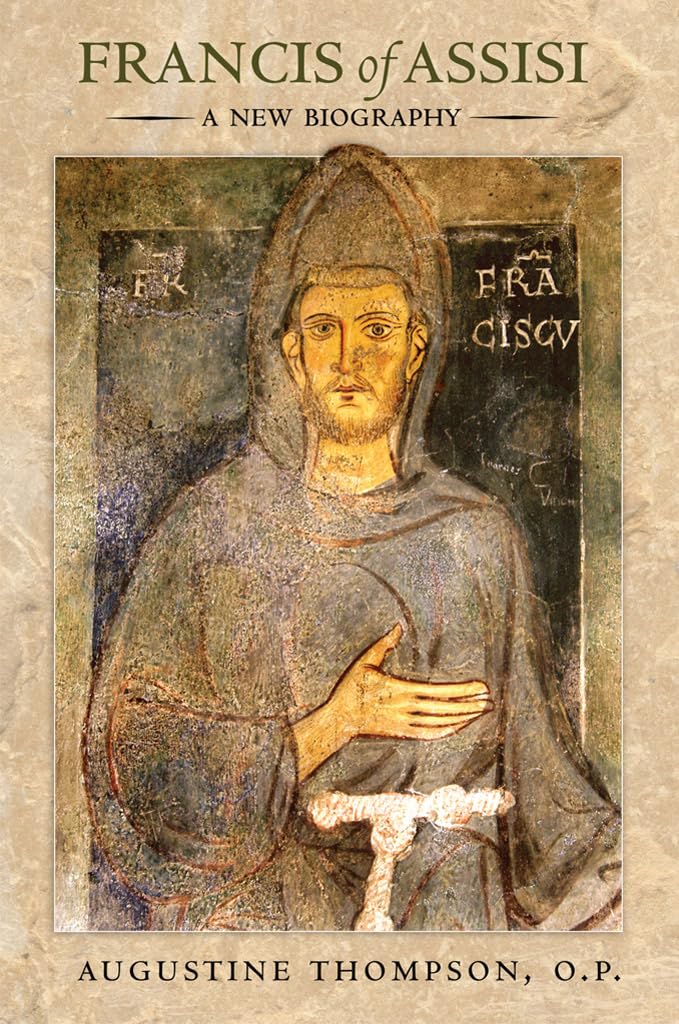
I’ve been thinking about these questions while reading Augustine Thompson O.P.’s Francis of Assisi: A New Biography, which is “new” not only because it’s relatively recent, but in that it takes an interesting path towards identifying the “historical Francis.” Which is to say, insofar as we can reconstruct him from the more reliable sources, amid the traditional myths and recent “Francises”: the hippie Francis, the Francis of a poor stripped-down Church, the environmentalist Francis, etc. And while Thompson doesn’t entirely dismiss the old stories or modern romanticized versions, he offers correctives worth the attention of any reader concerned for historical truth.
To take a prominent instance, most people believe that the saccharine “St. Francis Prayer” (“Make me a channel of your peace”) is by St. Francis. It was actually composed around 1912, in French. And more significantly, “Noble as its sentiments are, Francis would not have written such a piece, focused as it is on the self, with its constant repetition of the pronouns ‘I’ and ‘me,’ the words ‘God’ and ‘Jesus’ never appearing once.” Thompson reports that the discovery of all this is quite often very painful for his students, who have been led to believe otherwise.
As this example shows, Thompson is meticulous about sources and clears up numerous misunderstandings. In fact, this biography is also “new” in that it has a curious form. It’s – nominally – just under 300 pages, but only the first half is biography. The second half consists, not of footnotes, but of brief discussions about questions raised, chapter by chapter, among the scholars. As such, it’s an invaluable guide for anyone who wants to approach the real St. Francis instead of the one often concocted to serve contemporary agendas.
Clearly, it’s not easy to map what Francis did in the thirteenth century onto our current age. But there are multiple interesting points of contact. For instance, as per the “Francis Prayer,” the saint did seek “peace” among the Italians of his day, who were almost perpetually at war, not only among the different city-states (in which Francis had fought himself), but also between highly polarized factions within cities, Assisi among them. Francis focused more on bringing individuals into a condition of peace than on a political program.
As Thompson puts it, “One thing that distinguishes Francis from earlier and later medieval peacemakers was his absolute lack of any program of legal or social reforms.” It may have been for exactly that reason that he exerted such a strong personal magnetism, without much intending to, among the bewildered souls of his age.
He also seems not to have had much of a “religious program” in the sense of some organized effort at reform. His “program” was to live by the plain terms of the Gospel. Here, too, the effect was arguably larger on the medieval world – and beyond – than if he had lived and given birth to a religious order of a more programmatic nature.
Indeed, in Thompson’s account, even the growth of what became the Franciscan Order was more a matter of individuals deciding to follow him than the dedication of the group to some well-worked-out corporate purpose.
Several surprises crop up along the way. For example, Francis was not a precursor of the plain ceramic cup and felt-banner church. He didn’t much concern himself with theological disputes or liturgy wars, but from his earliest days as a penitent, “he linked penance for sin with care for sacred places. He wanted to ensure that the worship of God and the performance of the sacraments had only the finest equipment and preparation.”
Of course, given fallen human nature, even the simple Gospel approach gave rise to tensions within the Franciscans themselves, as factions arose with different ideas of what simplicity meant. But Francis held it all together with the remarkable attractiveness of his depth and sincerity.
Nonetheless, he was controversial even in the Middle Ages. There were some who thought what Francis was doing was something that the highly practical St. Benedict had warned against. In Paradiso, Dante deals with the supposed rivalry between the Franciscans and the Dominicans by having Aquinas praise Francis while deploring the corrupt members of his own order, while Bonaventure lauds the Dominicans while lamenting the fall-off among Franciscans.
The one clear constant in Francis’ life, however, was evangelizing. The Church today talks a lot about ecumenism and peaceful co-existence among religions, with some justness given the state of the world. But Francis, famously, went to Egypt to convert the sultan al-Kamil – and was received graciously, a near miracle given the war then underway and the usual reception of Christians seeking to convert Muslims – death. He didn’t succeed, but clearly impressed the Muslim leader.
Some critics of Thompson’s account have complained that he’s lost the poetry of Francis amid the narrow prose of scholarly rigor. Perhaps so, but the book is still a fascinating read. And we’ve had so many “creative interpretations” – good ones by figures such as Chesterton (though “perhaps more Chesterton than Francis”) and less good ones by writers like Leonardo Boff who transformed the apolitical Francis into a liberation theologian (who “subverts capitalist hierarchies”) – that this volume is good to have handy when you’re going through more freewheeling accounts.
Because the poor man of Assisi is worth any and all attempts to understand him more fully. If there was ever anyone who can be called an alter Christus, it’s him.