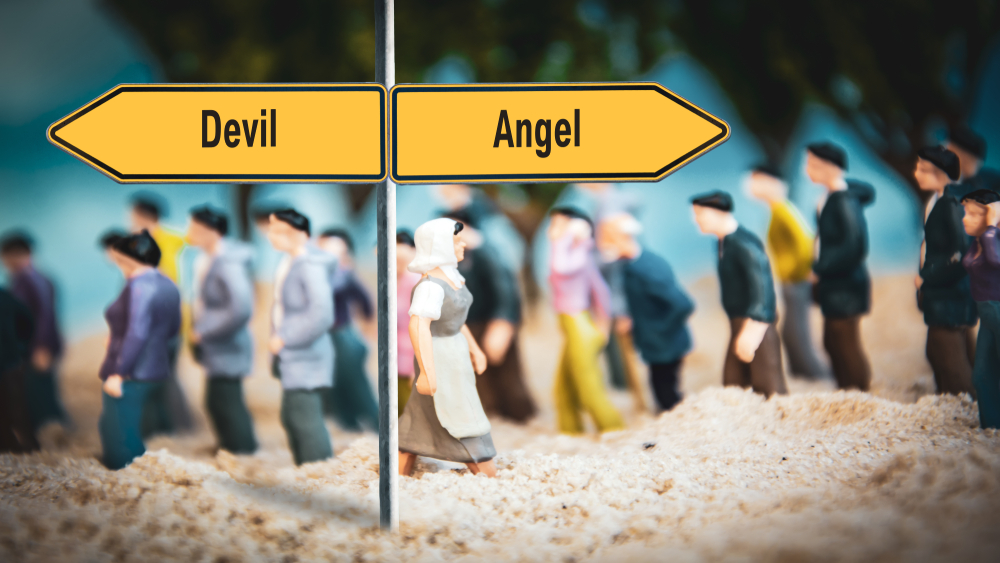
If your dog and a stranger were both drowning, who would you save first? Nationally renowned radio host and bestselling author Dennis Prager often poses this question to his audiences, and he typically gets a pretty depressing answer. Generally, he says, one-third of his respondents choose to save the dog, one-third choose to save the stranger, and one-third are unsure. This profound moral confusion—that only one-third of people choose to save the stranger—is a major reason for his new book, If There Is No God: The Battle Over Who Defines Good and Evil.
Written in question-and-answer style and based on a lecture he gave to a group of teens in the early 1990s, this book is packed with vital discussions concerning morality, religion, atheism, the Bible, human suffering, anti-Semitism, and more.
moralAccording to Prager, moral backwardness reflects the widespread tendency to make moral determinations based on personal feelings rather than objective norms of right and wrong. “The great tragedy of our time,” he says, “is that feelings have replaced values.” If Prager is right, it explains why so many people would choose to save their dog over a stranger.
To press the point, he cites traffic laws. “Imagine,” he urges, “if highways had signs that read ‘Speed Limit: Whatever Speed You Feel Like Driving.’ Would that work?” Nor, then, can such an approach work in the sphere of human action. Moral law is necessary—and, he argues, it must be “rooted in a God who is higher than we are.”
At this point, it is worth noting that thinkers working in the Aristotelian tradition may qualify this claim. They hold that right and wrong are, in a very deep sense, built into the ends of human nature. For example, the purpose of nourishment is to promote bodily health. Eating either too much or too little, therefore, subverts this purpose, whereas eating in moderation enables us to thrive as healthy members of our species. Similarly, the aim of rationality is to pursue truth, so acting contrary to that aim—engaging in or promoting falsehood—undermines our own fulfillment as human beings. Honesty, therefore, is a virtue we are meant to uphold for our own well-being.
In this way, it is possible to discern at least certain fundamental aspects of the moral law without invoking God. Even so, Prager’s central concern remains compelling. While morality may be accessible through human nature, it is far less clear that such an account can sustain itself culturally without the support of religious belief. Prager, then, is right to stress the practical importance of God for morality.
Be that as it may, he goes on to acknowledge that any moral system—even one grounded in God—can be subverted. He recognizes, for instance, many horrendous evils committed by people of faith historically. Granting all this, he nevertheless maintains that “the most moral civilization that has ever existed—Western civilization—was produced by people who believed in the Bible.” There is, of course, real force to this claim. It can indeed be argued that the Judeo-Christian tradition contributed in major ways to advances in women’s rights, human dignity, freedom, medicine, education, science, and even the abolition of slavery. “I know that religion can be abused,” he observes. “I know that values can be abused. But without them … we’re doomed.”
Among the other matters Prager addresses is whether faith needs reason. As he sees it, the two cannot be divorced. “Reason without God,” he exhorts, “has never made a good society, and God without reason easily leads to fanaticism.” This places Prager well within the long line of theologians and philosophers over the centuries who have insisted on the importance of reason, believing as they did that reason leads to rather than away from God. “The idea that everything came about on its own,” says Prager, “is far less rational than belief in a Creator.”
He then goes on to tackle questions about God’s role in daily human life, including whether God needs our prayers, whether he intervenes in our lives, and how people can believe in a good God in the midst of suffering. Take, for instance, the first question. “God,” he suggests, “does not need our prayers.” What, then, is the point? Prayer, he argues, is for us. It is good for us to pray because it connects us with God. “God wants us to love him with all our heart, with all our soul, with all our might. … If you’re closed off to communicating with him, you’re obviously not going to love him.” This is close to the classical theistic tradition, which holds that God is already complete and needs nothing from us. We, however, need God, and prayer is a means by which we attain him. Very well, but why does a loving God let us suffer—and how can one who suffers love God in return?
“When you truly suffer in life,” Prager says, “you come to realize that the only thing left is God. If there is anybody who can tell you about God and faith, it’s people who suffer.” This may be one reason why religious faith ebbed in the late 20th and early 21st centuries, when the country was more prosperous than ever before. When things are going well, people tend to think they do not need God. When times are hard, however, God’s presence often becomes evident. Prager thus flips the question on its head. “I did not learn from Auschwitz not to believe in God. I learned not to believe in man. … How people believe in humanity after knowing about that [the Nazi death camps] is a riddle to me, not how they still believe in God.”
Of course, the unspeakable evils of Nazi Germany lead naturally to the question of anti-Semitism—an attitude that regrettably seems to be on the rise these days. Prager explains a major historical reason for it. Because Jews have long regarded themselves as the “chosen” people of God, many non-Jews have mistakenly taken this to imply superiority. Prager, however, dispels this myth. “There is no hint of that [Jewish superiority] in the Torah or the Hebrew Bible. … ‘Chosen’ means you’re chosen for a task. Period. End of issue. Does that make you a better human being?” Furthermore, despite the troubling persistence of anti-Semitism today, Prager points out that Jews have a duty to God. “Judaism,” he says, “wants Jews to fear God more than they fear man.”
And as this book makes clear, fear of God is vital not merely for Jews but for all of us—and not only for morality but for human flourishing. As an insight often attributed to G.K. Chesterton has it, when people stop believing in God, they don’t believe in nothing; they believe in anything. Likewise, when people think God is not necessary for morality, they do not eliminate moral authority but relocate it, often in themselves. And that, as Prager so aptly diagnoses, is a recipe for moral confusion—and ultimately, for societal disaster.