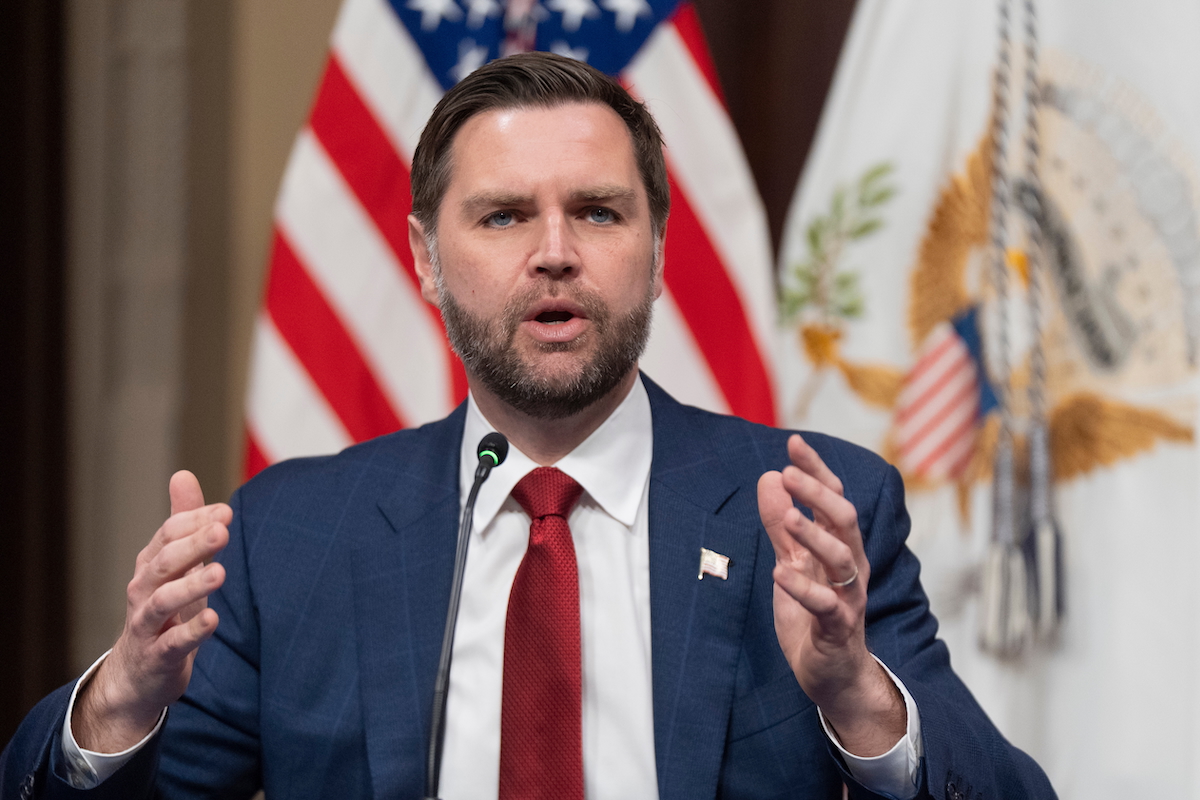
Since going to war against Iran, the only consistency coming out of the White House has been mixed signals and contradictory statements. So it’s difficult to tell if American leadership is serious about wanting to end the war, or if the real purpose of such talk is to manipulate the markets. But for those who want the war to end, it’s a good sign that Vice President JD Vance is involved in peace negotiations, given his longstanding and unwavering derision toward foreign intervention.
President Donald Trump announced on Monday that the United States is negotiating with Iran on a peace deal. The White House sent a 15-point proposal to the Iranians, who reportedly called it unreasonable. Now Trump is telling the Iranians they better make a deal while they still can. Meanwhile, both sides are preparing for escalation.
Vance and Secretary of State Marco Rubio have joined Special Envoy Steve Witkoff and Jared Kushner on the negotiating team. Trump said so in a Cabinet meeting on Thursday when he asked the veep to provide an update on Iran.
Back Stabbers
According to multiple reports, the Iranians want nothing to do with Witkoff or Kushner, who acted as negotiators when the war broke out. Gulf sources said the Iranians view Witkoff and Kushner as having “stabbed them in the back,” per reports. Other reports suggest Witkoff and Kushner are viewed as “Israeli assets that dragged a president into a war he wants to get out of.”
The New York Post corroborated Vance’s emerging leading role in negotiations. Per the Post:
The behind-the-scenes insight positions Vance — long seen as a skeptic of foreign military entanglements — as a possible lead negotiator, reflecting both his growing clout inside the administration and a belief among Iranian officials that he represents a different kind of American interlocutor.
The Iranians’ likely distrust toward the Americans is understandable, given that the United States has attacked them in the middle of negotiations twice over the last year. The U.S. defense, however, is that the Iranians were using the negotiations to stall and that they were not serious about reaching a deal.
Vance Acceptable
But when it comes to Vance, they’re more open to talking to him, if such reports are accurate. According to the Guardian:
Pakistani sources said [Vance] was being put forward as a probable chief negotiator from the US side if talks went ahead. Iranian sources have said they would refuse to sit down with Trump’s Middle East envoy, Steve Witkoff, or Trump’s son-in-law Jared Kushner, who led the nuclear negotiations with Iran before the war.
The Guardian also reported that the Iranians “viewed Vance as a more acceptable interlocutor” because they see him “as a sceptic of the decision to entangle the US in a Middle East war and has largely kept quiet on the conflict.” Pakistani officials said the two sides may soon meet in Islamabad.
CNN has made the same claim, that the Iranians would rather deal with Vance.
Propaganda?
But Vance advisor Andrew Surabian said on Tuesday in a social-media post that narrative is “utter fiction” — part “a coordinated foreign propaganda op meant to undermine President Trump, VP Vance and the entire Admin, as they engage in negotiations.”
Axios reported that some White House officials believe the “op” Surabian may be referring to is being carried out by the Israeli government as retaliation for “a difficult phone call on Monday between [Israeli Prime Minister Benjamin ] Netanyahu and Vance.” During that call, Vance supposedly told Netanyahu that his “predictions about the war had proved far too optimistic, particularly when it came to the prospects of a popular uprising to topple the regime. Before the war, Bibi really sold it to the president as being easy, as regime change being a lot likelier than it was.” Axios cites an Israeli and U.S. source for its reporting.
Not a Quick War
Mossad Director David Barnea recently predicted that regime change would most likely take a year. That’s a far cry from the expectations Trump probably had. During his February 28 middle-of-the-night announcement of the war, the president encouraged the Iranian people to rise up and take over their government. Netanyahu had made similar calls. Obviously, that hasn’t happened.
A couple of weeks ago, Trump indicated he was open to ending the war without an uprising and without regime change. That may indicate budding desperation within the White House to find an off-ramp. This war is taking a toll on Americans’ pocketbooks and Republicans’ political stature. If recent polls are to be believed, Trump’s approval rating is diving quickly, and the war is the main reason for this.
Unacceptable Demands
Nevertheless, the forecast for peace, as of now, is not looking promising. Both sides are making demands unacceptable to the other. The U.S. wants Iran to stop all uranium enrichment on Iranian soil; to completely dismantle the Natanz, Isfahan, and Fordow nuclear facilities; to hand over all enriched uranium stockpiles to the IAEA; and to commit to never pursue nuclear weapons. The Americans also insist on major range restrictions on Iran’s ballistic missiles; an immediate end to funding, arming, and supporting its various proxies; and to reopen the Strait of Hormuz.
Iran is asking that Israel and the US halt all attacks and assassinations, guarantee that the war will not resume once it’s over, war reparations for damages, an end to the war against Iran’s proxies, and international recognition of Iran’s “natural and legal right” to exercise sovereignty over the Strait of Hormuz.
Escalation Likely
If the current talks break down, major military escalation is likely. Over the last few weeks, the Pentagon has deployed thousands more soldiers to the region, indicating it’s preparing for a ground invasion. A major point of speculation is that the thousands of Marines and paratroopers are being sent to the region to capture Kharg Island, which handles about 90 percent of Iran’s crude oil exports. The Middle East Monitor reported Friday that Iran said it mobilized one million fighters to counter a possible ground invasion, with a particular focus on defending Kharg Island. It’s unlikely that Iran has a standing army of one million fighters, but between its active duty personnel, its reserves, and its volunteer militiamen, it may be able to field one million fighters.