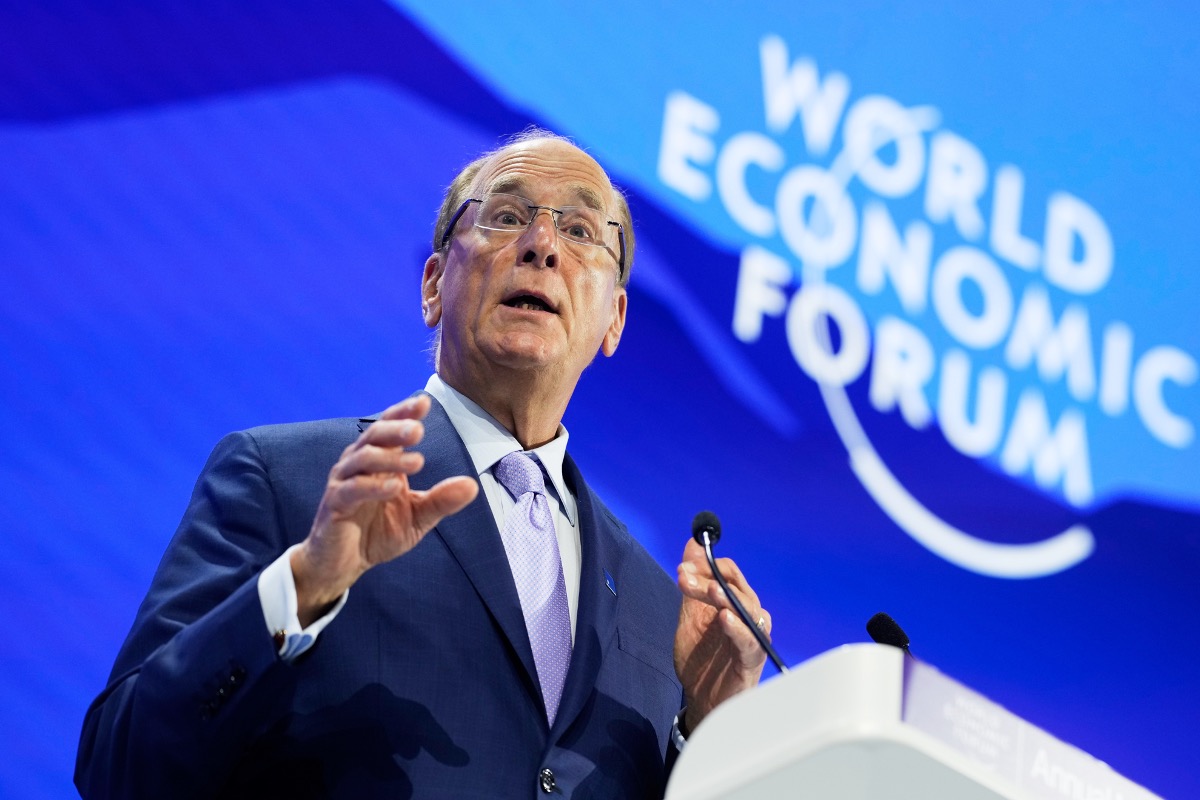
Larry Fink opened the annual meeting of the World Economic Forum (WEF) by stating the obvious. Trust in Davos is collapsing. “Will anyone outside this room care” about what happens here anymore? he asked. The question carried weight because it came from the top chief executive of BlackRock — the world’s largest asset manager pointedly dubbed “Masters of the Universe” for its unparalleled influence over markets and corporate governance.
As co-chair of the forum, Fink described Davos as “elites meeting in an age of populism.” He admitted it now operates under “deep mistrust” that, however, can be overcome by establishing a better “dialogue.”
What Fink did not say mattered more. The erosion of trust followed decades of policy shaped by global corporate finance, asset managers, and “public-private partnerships,” with Fink and the forum playing instrumental roles in setting priorities and producing outcomes.
Some commentators treated Fink’s remarks as an obituary for globalism. That reading is as naive as it is dangerous, since it invites people to lower their guard. There is little reason to believe the world’s wealthiest and most powerful interests would retreat when they can adapt, recalibrate their messaging, and advance their agenda through aligned “populist” cabinets. By all indications, the next phase of globalism, forged in response to populist revolt, isn’t likely to soften. On the contrary — it will be more technocratic, more centralized, and increasingly reliant on tools such as artificial intelligence to suppress social and economic dissent rather than resolve its causes.
“Age of Populism”
Fink began by challenging Davos itself. Greeting nearly 1,000 CEOs and 65 heads of state and government, he noted that “outside of the United Nations, this is the largest gathering of global leadership of the post-Covid period.” Despite the scale, and echoing the last year’s topic, “Restoring Trust,” he asked, “Will anyone outside this room care what we’re doing here?” Fink stressed:
For many people, this meeting feels out of step with the moment. We hear all about the elites. And how does it play out in the age of populism? How does an established institution make a difference in the era of deep institutional mistrust?
He warned that without “regaining trust,” Davos risks irrelevance.
The language was unusually blunt. Fink admitted that legitimacy is no longer assumed. Yet the critique stopped short. He did not address why trust was lost. He did not mention policy failures, massive wealth transfers, or corporate capture of governments.
Instead, he framed distrust as a perception problem. Davos, he suggested, must listen better, explain itself more clearly, and perhaps redefine “economic success.” The crisis was identified; responsibility was not.
“Capitalism” and Prosperity
Fink then turned to capitalism, or rather to his version of it:
Prosperity isn’t just growth in the aggregate…. It can’t be measured by GDP or market caps of companies. It has to be judged by many people who can see it, can touch it, can feel it and can build their future on it.
He called this “the strongest critique of the last economic era,” stressing later in his speech:
This is going to be a test: [Whether] capitalism can evolve to turn more people into owners of growth, instead of spectators watching it happen.
The formulation sounded humane. It also remained safely abstract.
Fink acknowledged that enormous wealth was created after the Cold War. But in developed countries, that wealth “accrued to a far narrower share of people than any healthy society can ultimately sustain.” The observation was accurate. The explanation was absent.
He did not mention central banks inflating asset prices while wages stagnated. He did not mention decades of corporate lobbying that reshaped tax codes, labor law, and regulation. Fink also did not talk about trade frameworks such as NAFTA that offshored industry and hollowed out domestic economies. Yet, all of it was designed, negotiated, and promoted through elite consensus, often inside institutions like the forum itself.
The problem, therefore, is not free-market capitalism. Properly understood, that remains one of the most effective systems for generating prosperity, innovation, and upward mobility. What failed was something else entirely. A narrow, unaccountable elite fused market power with state authority to manage outcomes, suppress competition, and consolidate control. In this model, wealth creation gave way to wealth extraction. What remains of economic freedom is now being increasingly displaced by technocratic governance.
AI and the Management of Displacement
Fink warned that artificial intelligence could repeat the same pattern of concentration. “Early gains flow to owners of models, data, and infrastructure,” he said. “If AI does to white-collar work what globalization did to blue-collar, we need to confront that directly.”
The warning understated the scale of what is already unfolding. AI reshapes control over labor, capital, and decision-making. Ownership of computing and data remains tightly concentrated. Most people encounter AI as users, subjects, or redundancies.
Yet elite institutions move in the opposite direction. The forum, a key partner of the United Nations on Agenda 2030, emphasizes scale and “global cooperation.” The UN calls AI a “powerful tool to accelerate progress across all 17 Sustainable Development Goals.”
To that end, the WEF launched AI Global Alliance. The initiative aligns governments, corporations, and regulators, including the U.S. Department of the Treasury and the Federal Reserve. In other words, AI governance is being embedded directly into financial and state power.
Expecting these institutions to govern AI for white- or blue-collar workers borders on fiction. Power rarely regulates itself against its own interests. Speaking on one of the Davos panels, Liz Shuler of the AFL-CIO (the largest union federation in the United States) warned that tech giants heavily betting on AI were “looking to just deskill, dehumanize, [and] replace workers.” When that happens, “then absolutely you’re gonna have a revolution,” she said.
“Spirit of Dialogue”
Fink’s remedy was dialogue. “This forum can’t remain an echo chamber,” he said. He cited the need to “listen” to people in places like Detroit, Dublin, Jakarta, and Buenos Aires. Davos, he acknowledged, is “an elite gathering trying to shape a world that belongs to everyone.” He then concluded, “Dialogue is the only way a room like this earns legitimacy.”
But “dialogue” does not change who holds power. It merely manages perception.
Fink’s allusion to “post-Covid” times also underscored how the call for better communication rings hollow without accountability. In early 2020, at the invitation of then-President Donald Trump, Fink himself helped shape “emergency” financial policy that resulted in the “greatest transfer of wealth in human history.” Fink and his BlackRock continue to play a prominent role in U.S. policy (see here and here) — which may expand further into the Fed. At the same time, the forum continues to platform figures like Pfizer’s CEO Albert Bourla, Bill Gates, Democratic governors such Gavin Newsom and Gretchen Whitmer, and many others complicit in the pandemic “response” as problem solvers.
In other words, trust did not erode because the elites did not listen to people. It eroded because the WEF helped build a system of elite coordination that delivered losses to the many, and gains and protections to the few.