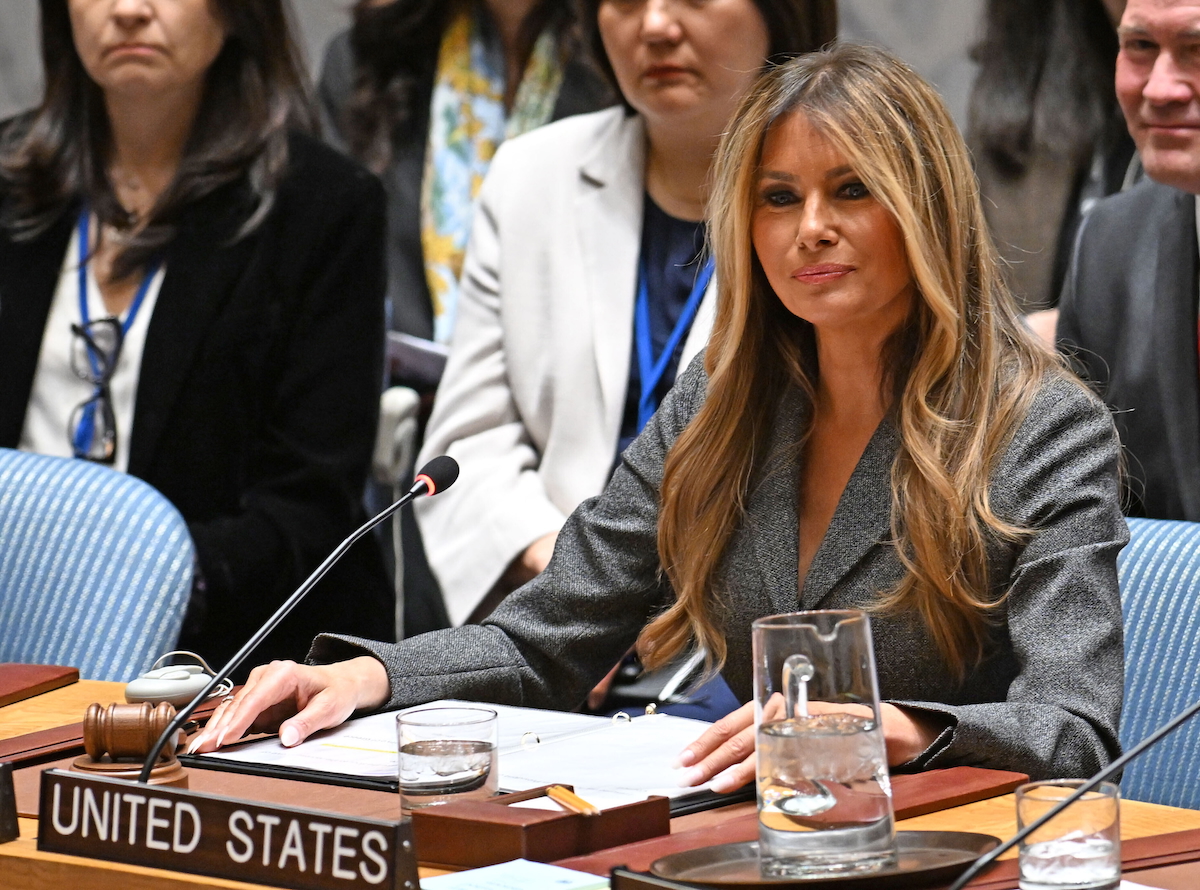
On Monday, First Lady Melania Trump presided over a United Nations Security Council meeting in New York. The session focused on children, technology, and education in conflict and beyond.
The optics added to the frustration among the Americans weary of global engagements. President Donald Trump often rails against globalism, both rhetorically and through policies he touts as “America First.” Yet his administration maintains deep financial and institutional commitments to global bodies. Now, with the United States holding the rotating presidency of the Security Council, his wife sat at the head of the chamber. The image was unmistakable: Even as the White House denounces globalist ideology, it remains fully engaged in the growing architecture of global governance.
The meeting also unfolded amid the military operations against Iran. The timing was stark: Days earlier, U.S. strikes reportedly hit civilian sites, including a girls’ school. UNESCO cited reports of children killed in an elementary school in Minab, calling it a “grave violation of humanitarian law.” Mrs. Trump did not address the incident. Yet she spoke of peace, knowledge, and a digitally connected future.
“Infrastructure of Understanding”
It marked the first time a sitting first lady formally presided over the Security Council.
Mrs. Trump’s prepared remarks pushed a single theme: “peace through education.” “Peace does not need to be fragile,” she declared. She urged member states,
Security Council members, I encourage you to pledge to safeguard learning in our communities and promote access to heightened education for all. I implore you to build a future generation of leaders who embrace peace through education.
The first lady thanked representatives from the United Kingdom, France, the Russian Federation, China, and others by name. She cast the mission as universal and binding: “The U.S. stands with all of the children throughout the world. I hope soon — peace will be yours.”
She also framed education as “a fundamental human right,” adding, “We must cultivate a just, moral imagination for the next generation, for our children — building an infrastructure of understanding.”
Yet beneath the polished language lay a sharper reality. The United States continues to use the world’s most powerful global body to promote an education agenda rooted in UN doctrine. Universal education stands at the center of Agenda 2030, specifically Sustainable Development Goal 4. It calls on governments to “ensure inclusive and equitable quality education and promote lifelong learning opportunities for all.”
As this magazine has documented extensively, this is not a neutral aspiration. It operates within a framework that pressures nations to “harmonize” standards, data systems, curricula priorities, and accountability metrics across borders. The result is centralization that shifts authority away from parents, local communities, and sovereign legislatures toward transnational benchmarks and bureaucratic oversight. For children, that can mean indoctrination shaped by transnational agendas rather than local cultural context. For nations, it means surrender of control over one of the most formative pillars of civil society.
Toward a “Single Digital Nation-state”
In her speech, the first lady focused heavily on technology. She called AI a force that “democratizes knowledge” and declared that we live in an “age of imagination.”
Then came the line that stripped the varnish:
Is a single digital nation-state inevitable? Perhaps this idea isn’t so farfetched since digital currency and payment systems via blockchain, plus AI’s massive factual database is already revolutionizing media and financial markets. We are in the age of imagination — a period when technology can be free and unrestricted by land borders.
This did not sound like modest policy refinement. It sounded like high-tech globalism declared plainly: Networks over nations, systems over sovereignty. In this vision, borders are obstacles, and code becomes governance.
She followed with another telling claim:
AI is redefining who gets to participate in the global economy of ideas.
But redefining who gets to take part means redefining power. Entry into this “economy of ideas” — and thus ability to provide for oneself — does not occur in a vacuum. It now flows through platforms, algorithms, payment systems, and data infrastructures designed and controlled by a narrow circle of corporate and political actors. The language of “democratization,” then, is hard to read as anything but an empty marketing slogan.
Trump closed the arc with a sweeping formula: “The path to peace depends on us taking responsibility to empower our children through education and technology.”
In this telling, technology plus education equals peace. This equation is dubious, at best. Digital systems do not automatically cultivate virtue. They amplify whatever “values” animate them. When governance shifts from territory to networks, and from constitutions to code, the question is no longer who participates. It is who sets the terms of participation.
Mrs. Trump at Home
The global vision Mrs. Trump outlined at the United Nations does not remain confined to diplomatic chambers. It is unfolding at home.
As previously reported by The New American, Melania champions the integration of AI into American schools. To that end, she convenes meetings with senior administration officials and major Big Tech executives under President Trump’s Executive Order, “Advancing Artificial Intelligence Education for American Youth.” The order established a White House Task Force on AI Education. It mandates AI-focused curricula, expands teacher training, and launches a Presidential AI Challenge. The stated goal is to “equip our students with the foundational knowledge and skills necessary to adapt to and thrive in an increasingly digital society.”
The language sounds practical, but it is also ideological.
If AI is “redefining who gets to participate” globally, embedding it into classrooms becomes more than job training. It becomes formation. Students are not merely learning how to use tools. They are being socialized into a system where algorithms mediate information, assessment, and opportunity.
The constitutional tension is unavoidable. Education has long been a state and local responsibility, emphasizing civic literacy and local accountability. Yet federal directives tied to funding, standards, and technology partnerships expand Washington’s reach, and that of global corporations constructing a borderless digital order. When these initiatives mirror international agendas, the boundary between national sovereignty and global alignment narrows.
The shift is quiet. It does not require sweeping legislation. It moves through executive fiat, curriculum standards, grants, pilot programs, public-private partnerships and continued global “cooperation.”