As Donald Trump’s administration claims to have hit 9,000 targets in Iran during the nearly month-old bombing campaign, and U.S. Central Command avers that the Iranian Navy is in “irreversible decline” because its top commander has been killed, The New York Times reports that many of the 13 American military bases in the region are “uninhabitable” because of Iran’s retaliatory drone and missile strikes.
The claims are not mutually exclusive. But the Times report dulls the shine that the administration is putting on the war it launched because Israeli Prime Minister Benjamin Netanyahu — former CIA agent John Kiriakou has said — threatened to nuke Iran if the United States didn’t begin bombing.
That aside, U.S. personnel in the region are working remotely from multiple locations because Iran’s strikes have rendered U.S. military bases worthless.
As recent developments go, President Trump has extended the deadline for Iran to open the Strait of Hormuz or face the destruction of its energy plants.
Rosy Picture
While Defense Secretary Pete Hegseth said the U.S. has clobbered 7,000 targets, White House spokesman Karoline Leavitt added 2,000 more during a news briefing on March 25.
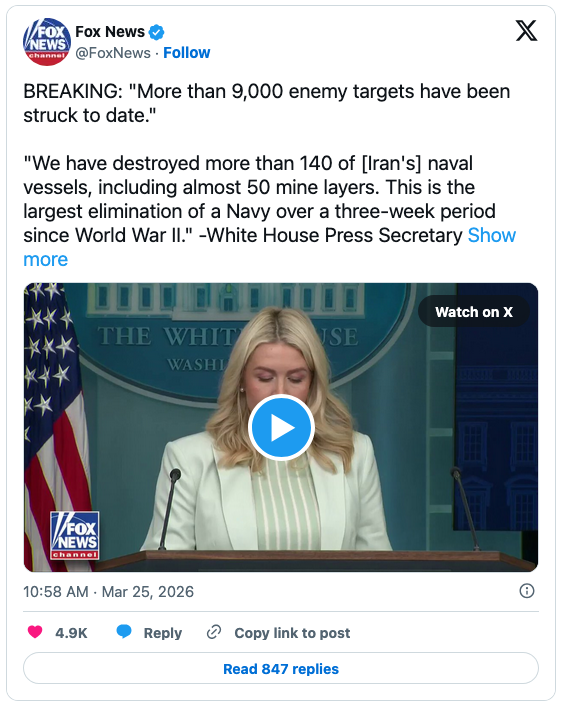
“More than 9,000 enemy targets have been struck to date,” Leavitt said:
Compared to the start of the operation, Iran’s ballistic missile attacks and drone attacks are down by roughly 90 percent.
The United States is also annihilating the Iranian regime’s Navy.
We have destroyed more than 140 of their naval vessels, including almost 50 mine layers. This is the largest elimination of a navy over a three-week period since World War II.
Early yesterday, Admiral Brad Cooper, chief of U.S. Central Command, announced that an Israeli airstrike had killed Alireza Tangsiri, leader of the Islamic Revolutionary Guard Corps Navy. Tangsiri, 64, was a specially designated terrorist.
Cooper said the United States has destroyed 92 percent of the Iranian Navy’s large ships, which means it can no longer “project power in the Middle East or around the world.” He called on Iranian naval personnel to abandon their posts and go home to avoid being killed.
Those reports are all well and good, but they neglect to disclose what has happened to U.S. bases in the region.
Baker’s Dozen Gone
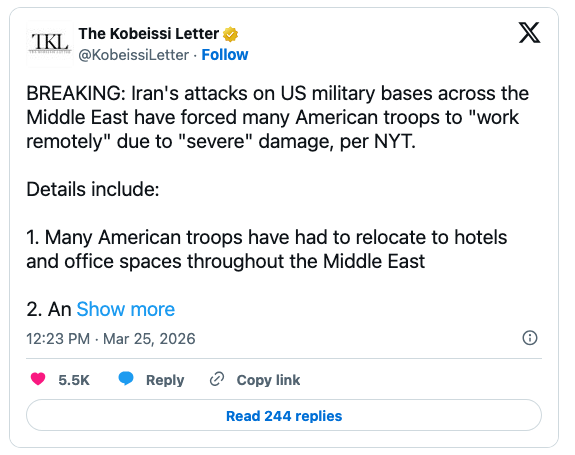
Iran’s retaliatory bombing campaign has forced “many American troops to relocate to hotels and office spaces throughout the region,” U.S. officials told the Times:
So now much of the land-based military is, in essence, fighting the war while working remotely, with the exception of fighter pilots and crews operating and maintaining warplanes and conducting strikes.
Because of that, waging the war will be harder. Master Sgt. Wes J. Bryant, a retired Air Force Special Operations targeting specialist, told the Times: “We have the ability to set up expedient operation centers, but you’re absolutely going to lose capability. You can’t just put all that equipment on the top of a hotel, for example. Some of it is unwieldy.”
“Many of the 13 military bases in the region used by American troops are all but uninhabitable, with the ones in Kuwait, which is next door to Iran, suffering perhaps the most damage,” the Times reported:
Six U.S. service members were killed in a strike on Port Shuaiba that destroyed an Army tactical operations center. Iranian drones and missiles also targeted Ali Al Salem Air Base, damaging aircraft structures and injuring personnel, and Camp Buehring, damaging maintenance and fuel facilities.
In Qatar, Iran struck Al Udeid Air Base, the regional air headquarters of U.S. Central Command, damaging an early-warning radar system. In Bahrain, a one-way Iranian attack drone struck communications equipment at the headquarters of the U.S. Fifth Fleet. At Prince Sultan Air Base in Saudi Arabia, Iranian missiles and drones damaged communications equipment and several refueling tankers.
For its part, Iran says U.S. forces that occupy hotels are using civilians as human shields, the Times reported. A message on Telegram told civilians that “it is your Islamic duty to accurately report the hiding places of American terrorists and send the information to us on Telegram.”
Deadline Extended
Land bases aside, a key objective for the United States, particularly given that the price per barrel of oil has rocketed past $100, is reopening the Strait of Hormuz. Some 20 percent of the world’s oil supply — 20 million barrels per day — traverses the strait daily.
Iran closed it to all but its allies, which provoked President Trump to threaten the nation’s energy infrastructure.
On Saturday, Trump gave Iran 48 hours to open the seaway; he then extended the deadline to Friday. Yesterday, he extended that deadline, supposedly at the Iranian regime’s request.
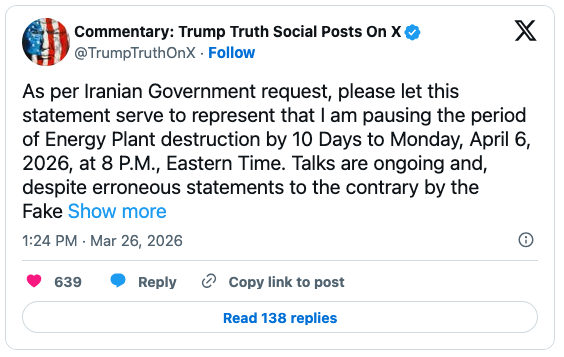
“As per Iranian Government request, please let this statement serve to represent that I am pausing the period of Energy Plant destruction by 10 Days to Monday, April 6, 2026, at 8 P.M., Eastern Time,” Trump wrote on Truth Social:
Talks are ongoing and, despite erroneous statements to the contrary by the Fake News Media, and others, they are going very well.
At yesterday’s Cabinet meeting, Trump said that Iran had permitted 10 ships through the strait as a goodwill gesture, the Times reported:
“They’ll tell you, ‘We’re not negotiating,’” Mr. Trump said of Iran. “Of course, they’re negotiating. They’ve been obliterated.”