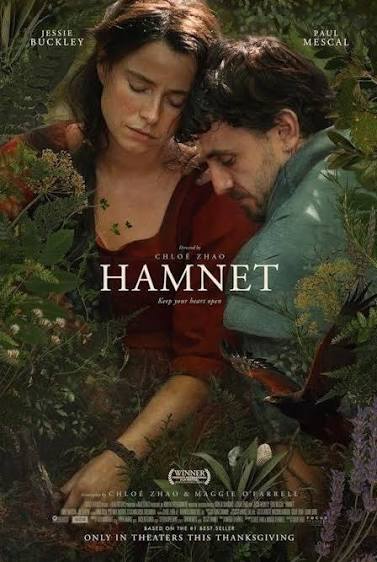
Hamnet, the 2025 film that has already won a slew of awards and is a favorite to win Oscar “Bests” for Picture, Director (Chloé Zhao), and Actress (Jessie Buckley), deserves its accolades. Based on Maggie O’Farrell’s novel, it reimagines the genesis of The World’s Most Famous Play. (Spoiler alert ahead, although at the very end.)
Hamnet begins with the meeting and mating of William Shakespeare and Anne Hathaway, called Agnes in the book and film, because her father’s will refers to her by that name. O’Farrell, who came across Richard Hathaway’s will, sees “Agnes” as a kind of revelation about the way, historically, the fame of fathers, sons, and husbands has subsumed female identities.
There’s truth in that, although probably not in this case. In O’Farrell’s novel, the playwright’s surname never appears. He’s just “Will.” So, in a fair exchange for “history’s” marginalization of Anne Hathaway, Farrell and Zhao place William Shakespeare in the margins of the book and the film.
And, twee as I think that is, it doesn’t diminish the movie’s power. Besides, we know perfectly well who’s wooing Agnes.
Hamnet moves slowly through their courtship: a kind of midsummer-night’s-dream of wonder in what’s probably the Forest of Arden. Agnes is an almost pagan figure, gathering medicinal plants and cavorting with her falcon. Is she a witch? Will, his father being a glover, presents her with a hawking gauntlet. He tells her the story of the ill-fated love between Orpheus and Eurydice. Will and Agnes have sexual intercourse. They marry and have three children. By and by, Will leaves for London.
At the heart of Hamnet, of course, is the boy, Hamnet, the Shakespeares’ only son, born with his twin sister, Judith, in 1585. (Their oldest, Susanna, had come two years earlier.) The real Hamnet would die of bubonic plague at age 11, and is buried (as are his father and mother) at the Church of the Holy Trinity in Stratford-upon-Avon.
The loss of a child is devastating. It was even in the 16th century when infant and childhood deaths were commonplace. The film does not explicitly suggest that Will retreated to London out of grief, but it seems that way, especially because we are given no hint that this young, grieving father will dominate the literature of the English-speaking world as no one ever had, or has since.
Perhaps his success, his fortune, and his work don’t justify “abandonment.” But, perhaps, there was no abandonment.
After all, Agnes was no poor child. When they married, Will was 18, and she was 26. We don’t know when Shakespeare left Warwickshire for London, but it was certainly after the births of the twins and may have been after Hamnet’s death. Anne would then have been in her early to mid 30s.
Coincidentally, Hamnet has appeared within months of the release of scholarly work by Prof. Matthew Steggle that refutes the premise of Hamnet, which is that Shakespeare abandoned his family for London and fame. Steggle has found (and not he alone) that Mrs. Shakespeare likely visited and even lived with Will in London, and that their connection was strong.
Of course, that’s history, not drama – and new history at that. And it does not matter, in a way, since O’Farrell and Zhao are not engaged in fact but fiction, placed in a historical setting. That said, the premise that Hamlet was inspired by the death of Hamnet is also dismissed by scholars. And it matters not that they don’t address the “authorship” or “recussant Catholic” questions.
But in a brilliant bit of casting, perfectly aligned with the film’s premise, the Prince of Denmark is played by Noah Jupe, the real-life older brother of Jacobi Jupe, who plays Hamnet. Thus, when Agnes travels to London with her brother and they join the groundlings to see a performance of Hamlet, she is doubly shocked to hear a name and a face so like that of her dead son.
More about the performance of Jessie Buckley in a moment, but I pause to praise Jacobi Jupe’s portrayal of Hamnet.
He resembles no one so much as a 10-year-old Orson Welles. (I can only hope he has career success like Welles, although without the serial wives and lovers or the frequent and outrageous dissembling.) I have never seen a better performance from so young an actor: charming, intelligent, and emotionally pitch-perfect.
I could say the same about Jessie Buckley, except that Agnes’ emotions, raw and roaring in grief, twice border on the histrionic. Whether that was Buckley’s decision or the otherwise restrained Chloé Zhao’s, I don’t know.
The 1998 Best Picture Oscar winner, Shakespeare in Love, suggested that the playwright kicked the provincial dust from his boots and carried on serial sexual affairs in sophisticated London. It was a comedy of misadventures worthy of the Bard. Twenty years later, Kenneth Branagh starred in and directed All Is True, the story of Shakespeare’s return from London to Stratford-upon-Avon, a rather dour tale of sublimated homosexuality and family bitterness – with the outrageous suggestion that Hamnet committed suicide.
O, what fools these mortals be!
Of the three, Hamnet is the best film. Because just when you think you’re sitting through a neo-feminist attack on Shakespeare, and that Agnes is going to disrupt the premiere of Hamlet with fist-shaking accusations of Will’s desertion, she watches the play and is captivated by it.
It’s very much like the climactic scenes of Shakespeare in Love, when all the bawdy craziness of the film’s convoluted plot dissolves into the thrall of Romeo and Juliet.
Hamnet ends with one of the most moving scenes I’ve seen in years. Prince Hamlet, dying from the prick of the poisoned sword, collapses at the stage’s apron, arm outstretched, “The rest is silence.” The groundlings push forward, as doubtless they would have at the Globe in 1601, extending their hands to the actor. Agness/Anne is among them. Will, offstage, weeps.
So, perhaps not abandonment but redemption, because, unlike Orpheus, Will never looked back.
Hamnet is rated PG-13. Also in the cast are Paul Mescal as Will and Joe Alwyn as the brother of Agnes