’Tis the season to…use the Christmas story for political gain?
We’ve heard the line repeatedly. Somehow, we’re not supposed to secure our borders in 2025 and deport invaders because 2,000 years ago the Holy Family were “refugees.” Just today, for example, Newspeak Newsweek wrote that “it’s worth remembering that Jesus began life as a refugee.” (And, apparently then, it’s worth forgetting that we have immigration laws.)
Another example is Minneapolis Police Chief Brian O’Hara. Bothered that Immigration and Customs Enforcement (ICE) is enforcing immigration law in the Mini Apple, he likened Somali criminals’ plight to the Holy Family’s. Whether or not the chief believes that President Donald Trump is now a Herod targeting all Minneapolis Somali boys two years old and younger was not reported.
A Stable for Mohamed?
What is certain is that this is true to form for O’Hara. For example, on November 20, he apologized for talking about crime by “groups of East African kids” (itself a euphemism). This isn’t because the criminality is imaginary, but because of the Third Woke Commandment. To wit: “Thou shalt not speak of crime when thy perpetrators be swarthily complected.”
As for the current story, The Western Journal wrote Sunday:
ICE surged dozens of agents into the Minneapolis area to target illegal immigrants from Somalia after revelations of at least $1 billion in welfare fraud emerged, with the Treasury Department investigating allegations that proceeds from the scheme went to the radical Islamic terrorist group Al-Shabaab.
Not to worry, though, O’Hara assured us at a recent press conference. His police won’t ask about immigration status. Whether or not laws are only meant for citizens, the chief did not say.
The Journal continued:
“We know this has been a very, very difficult time for our communities here in the city. The fear that people are experiencing is real,” O’Hara said.
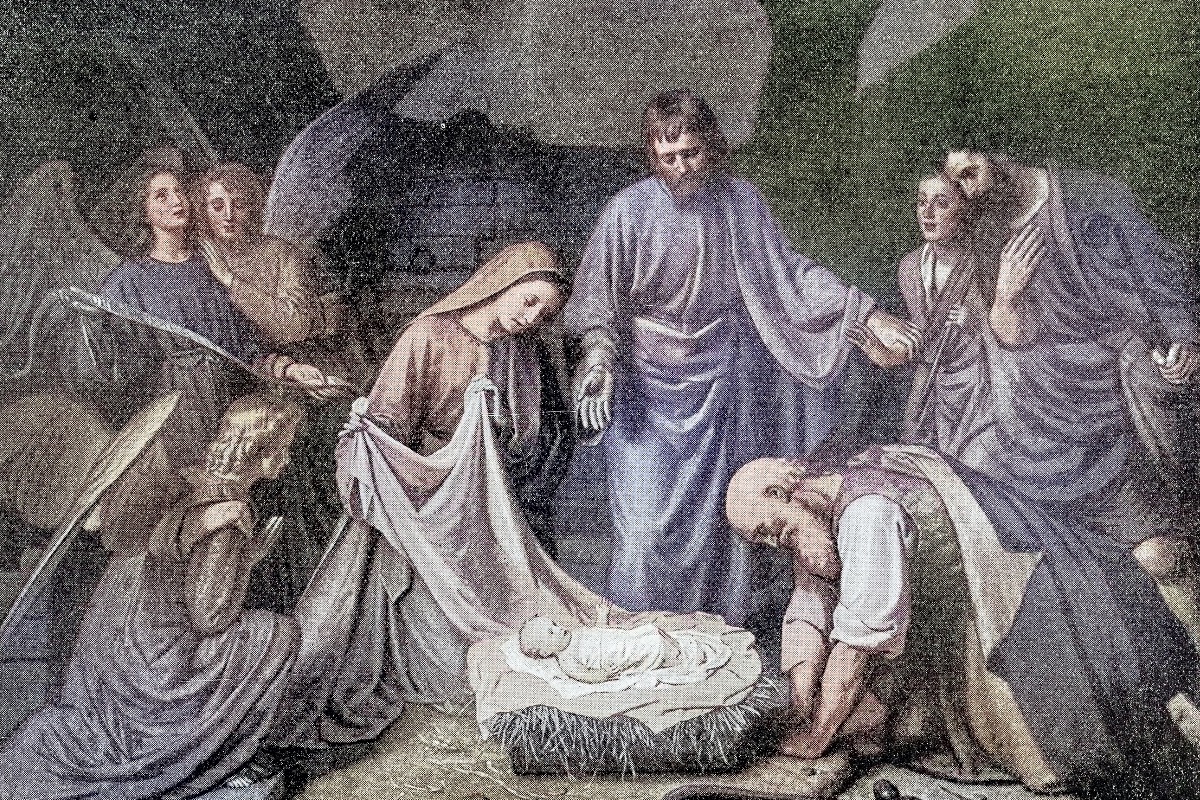
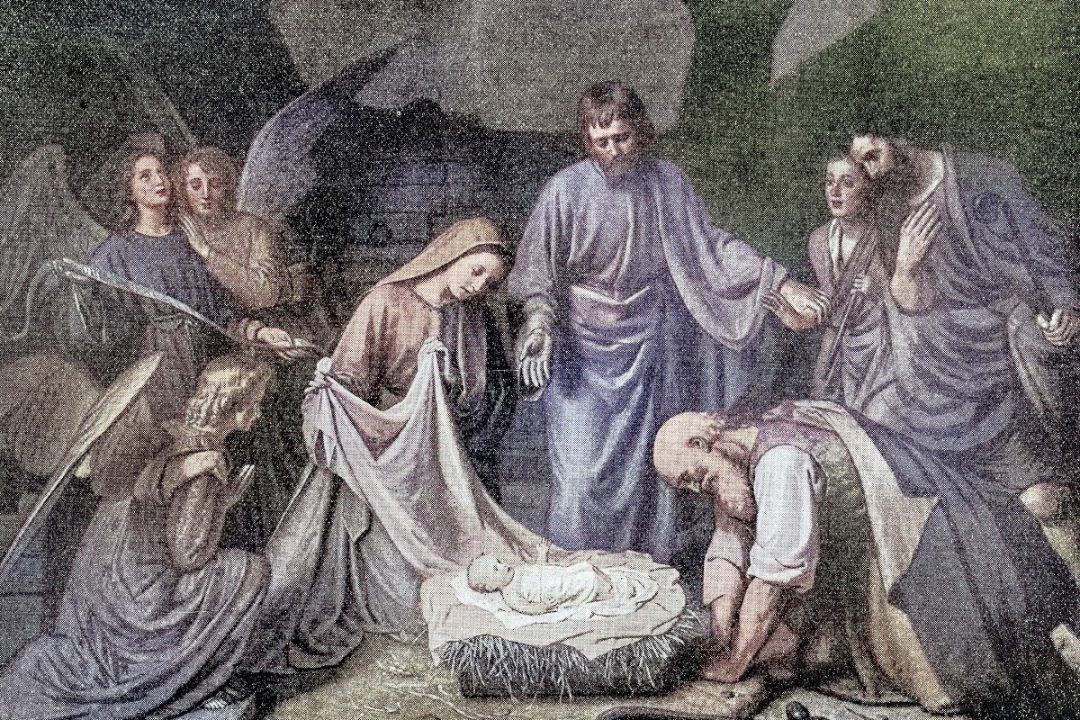
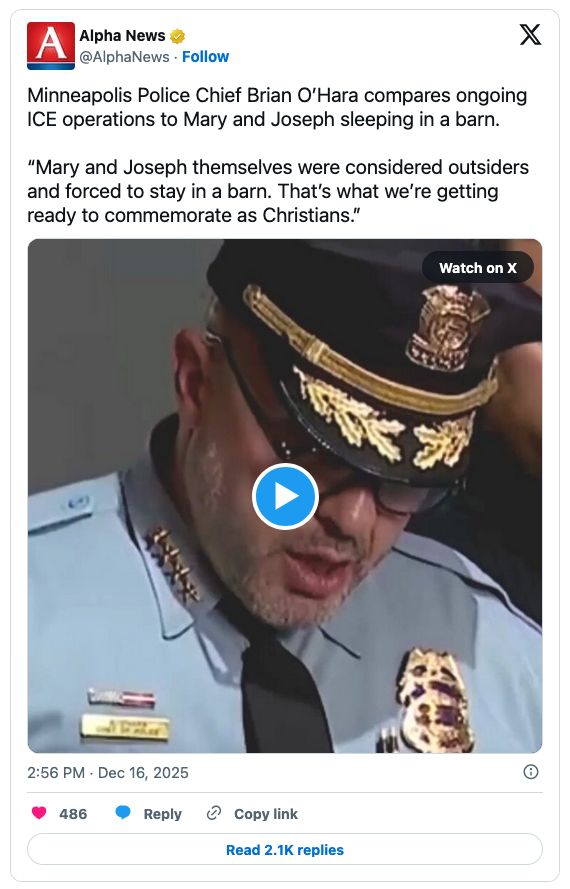
… “It’s especially personal to me, having been raised a Catholic, to be in a Christian church this morning as we are approaching Christmas,” O’Hara continued. “And I cannot help but think of what is happening in our city today and how that echoes with how outsiders have been treated for thousands of years, how Mary and Joseph themselves were considered outsiders and forced to stay in a barn. That’s what we’re getting ready to commemorate as Christians around the world while all of this fear is happening right here in our town.”
The chief can be seen on X making his remarks.
A Theologian He’s Not
A simple point here is that O’Hara speaks of ICE creating “fear” in his community. Surely it does. Bank robbers may experience fear, too, when the cops are on their heels. The law is supposed to induce fear in lawbreakers — that’s the whole point.
As for the deeper issue, O’Hara is (whether he realizes it or not) referencing the Holy Family’s trip to Bethlehem. They were not, however, there as “refugees,” but to answer a Roman census call. In other words, they were conducting government business.
Moreover, they weren’t staying in a “barn” because they were outsiders, but because the inn was full. (Perhaps other outsiders, also there for the census, had already taken the rooms.)
Were O’Hara better informed, he would’ve instead referenced the Holy Family’s later flight to Egypt to escape King Herod’s tyranny. They had to leave the king’s jurisdiction because he aimed to kill baby Jesus. Even in this, though, was their plight truly comparable to what’s occurring today?
Theologian Alex Kocman addressed this recently. Among other things, he points out that the Holy Family were refugees — but real ones. And today?
Kocman relates that the Office of Homeland Security reported that in 2024 there were a total of 100,050 refugee admissions. He then points out that this constitutes a minuscule percentage of the tens of millions of illegals in our country. Most illegals simply aren’t refugees in any sense.
Seeking Refuge, Not Riches
But the dissimilarities don’t end there. While Jesus and his parents were refugees, Kocman writes, first and notably, they
remained within the political boundaries of the Roman empire before, during, and after their flight to Egypt. Rather than escape one oppressive regime to flee to a transnational empire a world away, they fled to another jurisdiction a relatively short distance away from their homeland. This fact stands in contrast to the many migrants who pass by numerous other free nations (or, freer nations) in which they could take refuge on their way to the United States. Both geographically and politically, the flight of Joseph and Mary from Judea to Egypt was more comparable to a trek from Manhattan to Pittsburgh than from Haiti to Ohio. Of course, this is not to minimize the plight faced by the holy family…; rather, it is simply to demonstrate that the text of Matthew 2 simply cannot be used to justify the dissolution of modern geopolitical borders.
To cement this point, just consider a migrant from Venezuela. Traveling overland to the U.S. requires that he pass through eight different nations. These are Colombia, Panama, Costa Rica, Nicaragua, Honduras, El Salvador, Guatemala, and Mexico. El Salvador, do note, has become quite safe, too.
(It’s likewise in Europe. Syrian migrants, for example, would not flee to neighboring Turkey or go to a wealthy, sparsely populated Arab nation. Instead, they’d travel 2,000 miles into the heart of what once was Christendom and is now Offering-handouts-dom.)
Not There to Increase Diversity
Kocman then points out another significant difference:
Second, and importantly, Joseph, Mary, and the Lord Jesus retained their national identity and returned home when the threat was gone. Joseph was not a “paperwork Egyptian.” Mary did not campaign about North Africa proclaiming that Egypt was now “just an idea.” Jesus did not become Egyptian simply by touching its magic sands. And as soon as they learned that Herod was dead, they returned to Israel (Matt. 2:19-21). Far from arguing for the fluidity of national identity or belonging, the case of Jesus’s flight to Egypt demonstrates, if anything, that asylum by its nature is ordinarily meant to be temporary and provisional.
Relevant here is something Jordanian Palestinian academic, and practicing Muslim, Dr. Mudar Zahran said a decade ago. Warning against mass Muslim migration into the West, he stated, “I am completely against making this situation permanent.” The “refugees,” he emphasized, should eventually “be sent home.”
Question: Why must this even be said? Imagine your 15-year-old son’s friend is having some trouble at home and is, consequently, spending the night at your place. Is the default assumption that he’s going to stay permanently and become a member of the family? No, rather, assumed is that you’ll grant him “safe haven” until the home-front problems resolve — and no longer.
“Refugee” Has a Meaning
The reality is that our current “refugee” standard is not a refugee standard at all. It’s a replacement-immigration-by-another-name standard. The idea isn’t providing safety for temporary asylees, but permanent power for the party they, upon naturalization, generally support.
Kocman makes other good points in his essay as well, such as theological, prophetic, and political ones relating to the Holy Family’s flight to Egypt. The bottom line, however, is that the world’s O’Haras are not engaging in exegesis, but eisegesis. They like stating that those disagreeing with their (mis)interpretation are sinners, too. But perhaps they should consider what the Bible says about people who, cynically, twist Scripture to achieve their own ends.