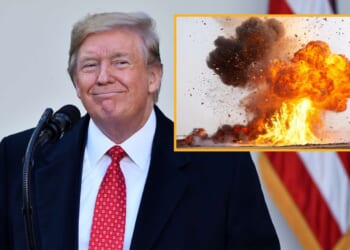
“When you’re a star, they let you do it. You can do anything… Grab ‘em by the p**sy. You can do anything.” — Donald J. Trump on seizing women, Access Hollywood (2005)
“I think I can do anything I want with it. Whether I free it, take it, I think I can do anything I want with it.” — Donald Trump on seizing Cuba (2026)
It’s been 20 years since Donald Trump bragged that, as a star, he could do anything — even assault women — and get away with it.
Two decades later, what once sounded like crude bravado has become a governing philosophy: might makes right, power excuses everything, and accountability is for other people — not this president.
Despite the Access Hollywood recording — and everything it revealed about his character — Trump was elected to the White House twice. And ever since, he has governed exactly as he promised: as a man who believes he is unaccountable, entitled, and free to act without limits.
The same mindset that once bragged about being able to “stand in the middle of Fifth Avenue and shoot somebody, and I wouldn’t lose any voters” has now been scaled up and weaponized through the presidency.
With a core MAGA following that seems unwilling to hold him accountable for any wrongdoing, Trump has justifiably earned his nickname as “Teflon Don.”
He can be accused of sexually assaulting young girls, and he won’t lose any voters. He can, as commander-in-chief, sanction the bombing of a girls’ school in Iran — killing young girls, their mothers and teachers — and he won’t lose any voters. He can torpedo a thriving economy, sending inflation and gas prices soaring, and he won’t lose any voters. He can dismantle a government structure that has been in place for over 200 years, and he won’t lose any voters. He can be a walking — talking — living contradiction of everything Christians claim to stand for, and he won’t lose any voters. He can send Americans servicemen and women to die in wars that the U.S. had no business starting, and he won’t lose any voters.
This is the mindset now shaping American policy.
Trump’s acts of aggression against other nations — Venezuela. Iran. Greenland. Canada. Now Cuba — are expansions of the same worldview, only this time backed by the full force of the U.S. military and funded by American taxpayers.
It is the logic of the schoolyard bully: Take what you want. Dare others to stop you. Punish anyone who resists.
Trump wanted Venezuela’s oil, so he used the military to get it — and then bullied the country’s leaders into letting him keep it and its profits.
The tactics — swaggering, arrogant, and always prepared to browbeat and mow over anyone and anything in his way — have become all too familiar.
Trump wants a new ballroom? Tear down the old one and build another.
Trump wants to be in charge of global peace? Seize the U.S. Institute of Peace and rename it.
Trump wants to prove his economic prowess? Levy tariffs against any nations who refuse to fall in line.
Trump wants to be seen as the one who solved Iran? Launch a preemptive war that kills civilians, destabilizes regions, and threatens the global economy — then turn to the same allies he once disparaged to bail him out.
The pattern is unmistakable: Power without restraint. Action without accountability. Force without principle.
This is not constitutional governance. This is how a bully operates: rules are for other people, constitutional prohibitions are inconveniences, and the law becomes whatever the one in power says it is.
The same egomaniacal traits are evident in how Trump treats dissent.
Criticism is not tolerated — it is punished.
Media outlets that report unfavorably are threatened with government retaliation. The FCC is weaponized to intimidate broadcasters. “Fake news” is redefined to mean anything that challenges the narrative.
Truth, in Trump’s America, is whatever serves power.
And those who challenge that power are ridiculed, demeaned, and dehumanized.
This is not behavior that should be brushed off as a personality quirk.
It is a reflection of character.
And when that character is paired with unchecked power, it becomes dangerous.
In a constitutional republic, no one is supposed to be above the law.
A bully — an autocrat — a dictator — believes he is the law.
“Peace through strength” has become the Trump administration’s rhetorical cover for preemptive violence, military incursions, and acts of aggression that bypass Congress and ignore constitutional limits.
Yet abuse of power is not leadership.
America deserves better.
Because in the end, this is what it comes down to: we have put a schoolyard bully on the world stage, and we are pretending it is leadership.
A man who measures strength by how much he can dominate others. A man who confuses cruelty with leadership. A man who believes that power means never having to say no — to himself.
The bully doesn’t follow rules — he rewrites or ignores them. And like all bullies, this particular bully thrives not just on aggression, but on silence, fear, and complicity.
The bully’s code — might makes right — has replaced the Constitution’s promise of equal justice under law. But history warns us that power without restraint is just another name for a King.
This nation was born in defiance of a bully.
Two hundred and fifty years ago, a king who believed himself untouchable used force, intimidation, and unchecked power to bend a people to his will.
The colonists refused.
They stood their ground — not because they were the strongest, but because they believed they were right.
They understood something we seem to be forgetting: Power without principle is tyranny. And tyranny, no matter how loud or forceful, is not invincible.
The question now is whether we still believe that. Whether we will continue to reward the bully — or finally refuse to be ruled by one.
Because the example we tolerate is the example we become.
And right now, the lesson we are teaching our children, our country, and the world is this: the bully wins — unless someone finally refuses to play by his rules.
We’ve seen this script before.
As I’ve warned in Battlefield America: The War on the American People and in its fictional counterpart The Erik Blair Diaries, the collapse of a country starts the moment we decide that the bully is the hero.
We may already be in the final act of that story. But we can still change the ending — if we remember that in America, the law is king, and the citizenry are supposed to be the masters, not the servants.
About John & Nisha Whitehead:
Constitutional attorney and author John W. Whitehead is founder and president of The Rutherford Institute. His latest books The Erik Blair Diaries and Battlefield America: The War on the American People are available at www.amazon.com. Whitehead can be contacted at [email protected]. Nisha Whitehead is the Executive Director of The Rutherford Institute. Information about The Rutherford Institute is available at www.rutherford.org.