Two new reports strongly suggest that U.S. President Donald Trump has knuckled under to Israeli demands not to discuss a ceasefire in the war with Iran that the U.S. and Israel started on Saturday.
On Wednesday, The New York Times disclosed that Iranian intelligence officials secretly contacted the CIA about ending the war. The same day, Axios reported that Israeli Prime Minister Benjamin Netanyahu called Trump about reports that Iranian and U.S. officials were secretly negotiating without Israel’s knowledge.
The reports surfaced after Secretary of State Marco Rubio revealed that Israel pulled the U.S. into the war by planning an attack regardless of the Trump administration’s approval. Trump then claimed he forced Israel’s hand.
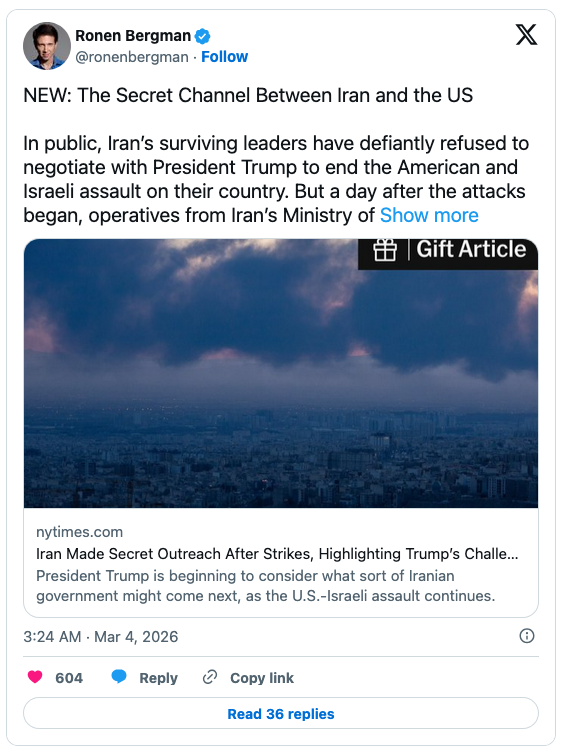
NYT: Iran Wanted to Talk
The comprehensive Times report suggests that Iranian officials — despite claims from U.S. and Israeli officials that they were planning for war — wanted a sit-down for peace talks.
“A day after the attacks began, operatives from Iran’s Ministry of Intelligence reached out indirectly to the C.I.A. with an offer to discuss terms for ending the conflict, according to officials briefed on the outreach,” the newspaper reported:
U.S. officials are skeptical — at least in the short term — that either the Trump administration or Iran is really ready for an offramp, the officials briefed on the outreach said.
Still, the offer, which was made through another country’s spy agency, raises critical questions about whether any Iranian officials could put into place a cease-fire agreement with the Tehran government in chaos as its leaders are methodically picked off by Israeli strikes.
Of course, Israeli officials, notably Netanyahu, want to crush Iran and “have urged the United States to ignore the approach,” the newspaper continued. “For now, the offer is not considered serious in Washington.”
Trump, the newspaper noted, said the time had passed for talks. As well, “Trump officials will expect any agreement to stop the bombing to include a pledge from Tehran to abandon or drastically curtail its ballistic missile and nuclear programs, and its support for foreign proxy groups like Hezbollah,” the newspaper continued:
In return, Mr. Trump has suggested that he would allow Iran’s surviving leaders to maintain their economic and political power.
Mr. Trump suggested again on Tuesday that his model would be Venezuela after the U.S. capture in January of the country’s leader, Nicolás Maduro. Under threat of additional force, Mr. Trump has compelled Mr. Maduro’s successor to grant the United States control over Venezuela’s oil exports while making few demands for political reform.
“What we did in Venezuela, I think, is the perfect scenario,” Mr. Trump said in a Sunday interview with The New York Times. “Leaders can be picked.”
Axios: Bibi Called Trump — “No, You’re Not Talking to Iran”
Those possible discussions with Iran, and others, are off the table, however, because Netanyahu ordered Trump to stop them, Axios reported.
“Israeli Prime Minister Benjamin Netanyahu asked the White House for clarifications earlier this week after learning Trump administration officials might be communicating with the Iranian regime, two sources with knowledge of the issue said,” the website’s Barak Ravid disclosed.
Netanyahu apparently panicked, the sources said, because Israeli intelligence learned that Iran and the Trump administration had “some kind of communications … to discuss a ceasefire.”
“On Monday, Netanyahu called White House officials and asked if such talks or exchange of messages happened,” the website continued:
“The White House told Bibi that the Trump administration wasn’t talking to the Iranians behind his back,” one source said.
A U.S. official said special envoy Steve Witkoff and Trump’s adviser and son-in-law Jared Kushner talk almost every day to Netanyahu, to the director of Mossad David Barnea, and to other Israeli officials — and that regardless of ups and downs in the past, the coordination over the last month was very close.
“They know we are not talking to the Iranians,” the U.S. official said.
Messages went from Iran to the administration through other nations in the region, but the administration didn’t answer them. “We treated these messages as bulls**t,” a U.S. official told Axios.
Axios writer Ravid, it turns out, worked for Israeli military intelligence, his Wikipedia biography shows.
Rubio Contradicted
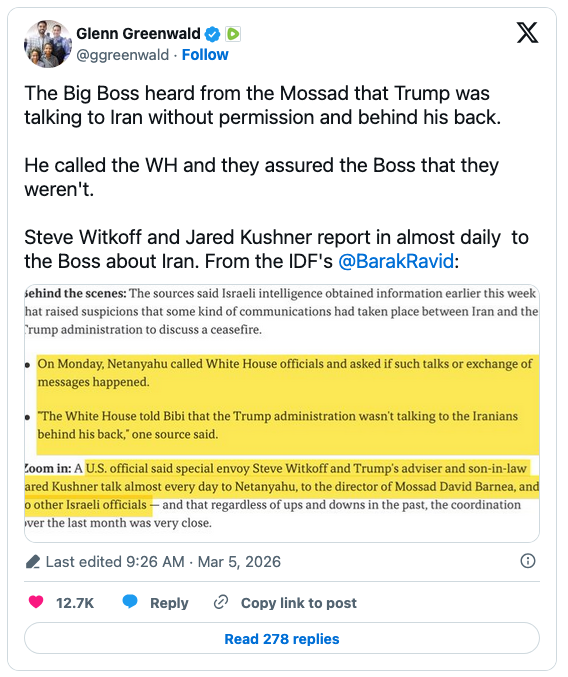
Independent journalist Glenn Greenwald, a fierce critic of Israel and its influence over U.S. Middle East policy, ridiculed Netanyahu, Witkoff, and Kushner on X.
“The Big Boss heard from the Mossad that Trump was talking to Iran without permission and behind his back,” Greenwald wrote:
He called the WH and they assured the Boss that they weren’t.
Steve Witkoff and Jared Kushner report in almost daily to the Boss about Iran.
The “Big Boss” is Netanyahu.
As The New American reported on March 2, Rubio admitted that Israel forced the U.S. to attack Iran.
An assessment “was made that if we stood and waited for that attack to come first before we hit them, we would suffer much higher casualties, and so the president made the very wise decision,” the secretary of state said:
We knew that there was going to be an Israeli action, we knew that that would precipitate an attack against American forces, and we knew that if we didn’t preemptively go after them before they launched those attacks, we would suffer higher casualties, and perhaps even higher [numbers] killed. And we would all be here answering questions about why we knew that and didn’t act.
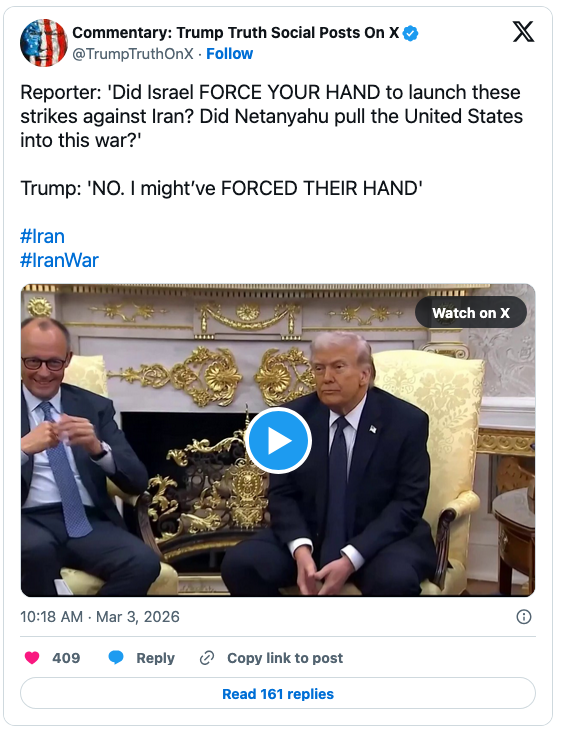
Trump contradicted Rubio during an Oval Office meeting with German Chancellor Friedrich Merz.
Asked directly whether Israel forced his hand, Trump said, “No, I might have forced their hand.”
“You see, we were having negotiations with these lunatics, and it was my opinion that they were going to attack first,” Trump continued:
They were going to attack if we didn’t do it. They were going to attack first; I felt strongly about that. … Based on the way the negotiation was going, I think they were going to attack first, and I didn’t want that to happen. So if anything, I might have forced Israel’s hand.