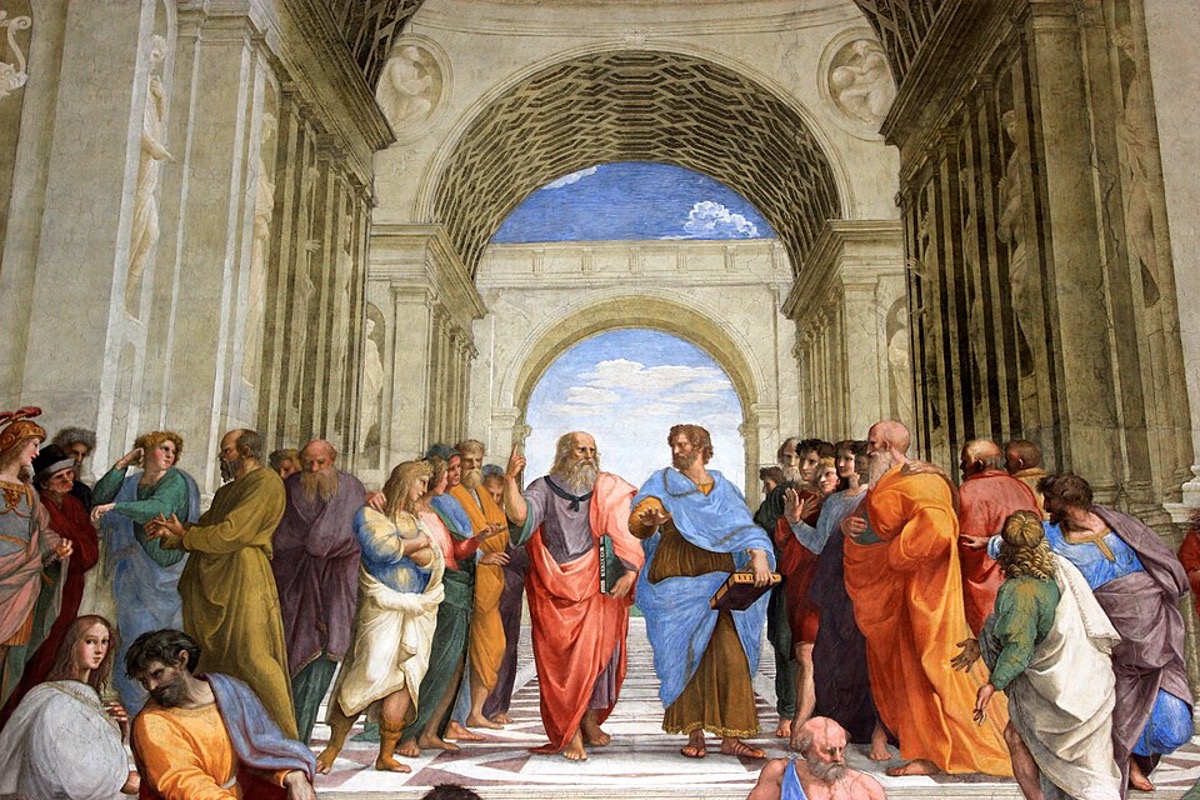
It is interesting to note that both ancient Greece, the “cradle of Western civilization,” and the Roman Empire, which spread Western civilization, declined and “fell” due partially to internal divisions. Another point to ponder is something Salvian of Marseilles, a Christian priest, observed in the mid fifth century:
[T]he name of Roman citizen, once not only much valued but dearly bought, is now voluntarily repudiated and shunned, and is thought not merely valueless but almost abhorrent.
Does such loathing (though perhaps not the citizenship part — yet) sound vaguely familiar?
“History doesn’t repeat itself, but it often rhymes,” the famous saying goes. And one man who might say we’re rhyming right now is commentator J.B. Shurk. In fact, bemoaning the West’s internal divisions, he warns of our “domestic enemies.” He doesn’t think it’s inevitable that the West must fall due to those divisions (and decadence), as Rome did. But he certainly appears to believe it’s the 11th hour.
Writing Monday, Shurk laid out well our current state of affairs:
In broad strokes, we know what’s happening. Open borders policies in North America and Europe are sabotaging social cohesion. Christianity is under attack. Reason, rationality, and scientific inquiry have been abandoned. Our shared history is continuously rewritten in ways that turn our ancestors into villains. … [I]deals fostering individual sovereignty, personal freedom, and maximum liberty have been eroded by the pernicious encroachments of collectivism, Marxism, socialism, and communism. Virtue is mocked, while sin is celebrated. Unchecked desire, envy, and instant gratification have supplanted temperance, humility, and self-restraint. The indulgence of personal fantasy has superseded the pursuit of eternal truth. Schools, governments, and cultural institutions preach a false and destructive religion requiring Westerners to repent for their “climate change sins” and embrace the doctrines of “multiculturalism” and “diversity” as tenets of leftism’s “faith.”
And where’s this going? As Shurk states, relating an ever-more-common prediction:
Last week, a European Parliament conference concluded that the whole continent is headed for civil war. One professor argued that “the foundations of Western self-belief, prosperity, and competency” are now broken and that Europe is “on a track for a peasant revolt.” In response to Western governments’ betrayal of Western civilization, there will be an “uprising in which the ruled seek to punish their rulers for violating their obligations under the social contract, and for changing the rules of the game against their wishes.” Most of the politicians and academics who participated in the conference do not believe that Europe will survive this century. Although they expressed various opinions about how the coming chaos will unfold, they reached a common conclusion: “It will be bloody.”
Some predict the same for the United States, too. We’ll descend into civil war, they say, and perhaps dissolve into two or more nations. The question now arising, of course, is: How can we remedy this state of affairs? Let’s examine solutions.
“Only a Virtuous People Are Capable of Freedom. As Nations Become More Corrupt and Vicious, They Have More Need of Masters.” — Benjamin Franklin
It is common, as Shurk does, to complain about government sins (which are many). Yet the state doesn’t exist in a vacuum. Shurk writes that “Western citizens desperately seek civilizational renewal.” But is this true? Some do. But even they often don’t know how to effect such a renewal — or are not morally capable of being part of it.
As the above Franklin quotation reflects, too, the Founders well understood this problem. They knew that for the government to be better, we must be better. How can we become so?
Well, we can begin with an analogy. Imagine we discover that mathematical ability has become universally horrid in our nation. (This is analogous to our moral breakdown.) We then realize how bad it is: People don’t even believe the “laws of math” exist. Instead, they fancy that 2+2 can equal 5, 7 — or “whatever works for you.” (This is analogous to the moral relativism, which boils down to moral nihilism, that has swept the West.) So the first step in renewal is obvious:
People must accept that math’s laws are real. (This is analogous to acknowledging the existence of Truth, objective by definition.)
Upon doing this, the next step is grasping the principles of math and inculcating knowledge of them in others, especially the young.
Is this easy? No — only necessary.
The Eternal Principles
So what is that second step analogous to regarding civilizational renewal? Well, many often complain about our aforementioned moral breakdown, aka the demoralization process. But the remedy for demoralization is moralization. And what does the Truth dictate are the principles of morality?
The virtues (i.e., objectively good moral habits).
Yes, I’ve often mentioned them (and I will again in the future!). A comprehensive list: Faith, Courage, Hope, Honesty, Charity, Fortitude, Justice, Temperance, Prudence, Chastity, Diligence, Patience, Kindness, Forgiveness, Humility, and Love.
It’s as with the mathematical principles, too. Learning the above, cultivating them in ourselves, and inculcating them in our children can foster Western civilization’s renewal.
Is this easy? No — only necessary.
Again, too, the Founders knew this. To quote John Adams, our second president, “Public virtue cannot exist in a nation without private [virtue].” We can complain about monetary and ideological corruption in government, sure. But why should we expect any better if the citizens themselves wallow in moral corruption?
And people can talk about this or that revolution, hot or cold, or secession, and forging a better country. But what would be the point if we stayed on the same cultural trajectory? Without fundamental, virtue-directed change, the process of civilizational degradation would just resume.
“You Never Change Things by Fighting the Existing Reality. To Change Something, Build a New Model That Makes the Old Model Obsolete.” — Buckminster Fuller
Moreover, we should ask: How can we ultimately defeat the toxic spirit of our age, currently called “wokeness”? (It is, do note, just an intensification of political correctness.) Merely railing against it and shaking our fists at the heavens won’t suffice. As famed late architect Fuller pointed out above, you supplant something by providing a better alternative. The good news is that we don’t need a new model, just the eternal Truth/virtue one already outlined.
How to proceed? Well, a change in speech can inspire a change in thinking. Use the words “perspectives” and “opinions” less and “Truth” more. Don’t talk of “values”; that’s part of the secular/relativistic speaking style — talk about virtue. Make sure you know what the virtues are, too. And what about when someone tries to cow you with relativistic mantras such as “That’s your truth; someone else’s may be different” or “There are only shades of gray”?
Double down and talk of Truth and virtue all the more.
Speaking of which, it also wouldn’t hurt to read my 2023 essay “A World Without the West.” It isn’t about defending the West — it concerns going on the offense for the West.
More could be explored, of course, about this book-worthy subject. Suffice it to say, however, that if we don’t right the moral ship, we may end up echoing something else Salvian of Marseilles said.
“Be ashamed, ye Roman people everywhere,” he lamented. “[I]t is our vicious lives alone that have conquered us.”