This is a free post. If you would like to receive my newsletter for subscribers you can upgrade.
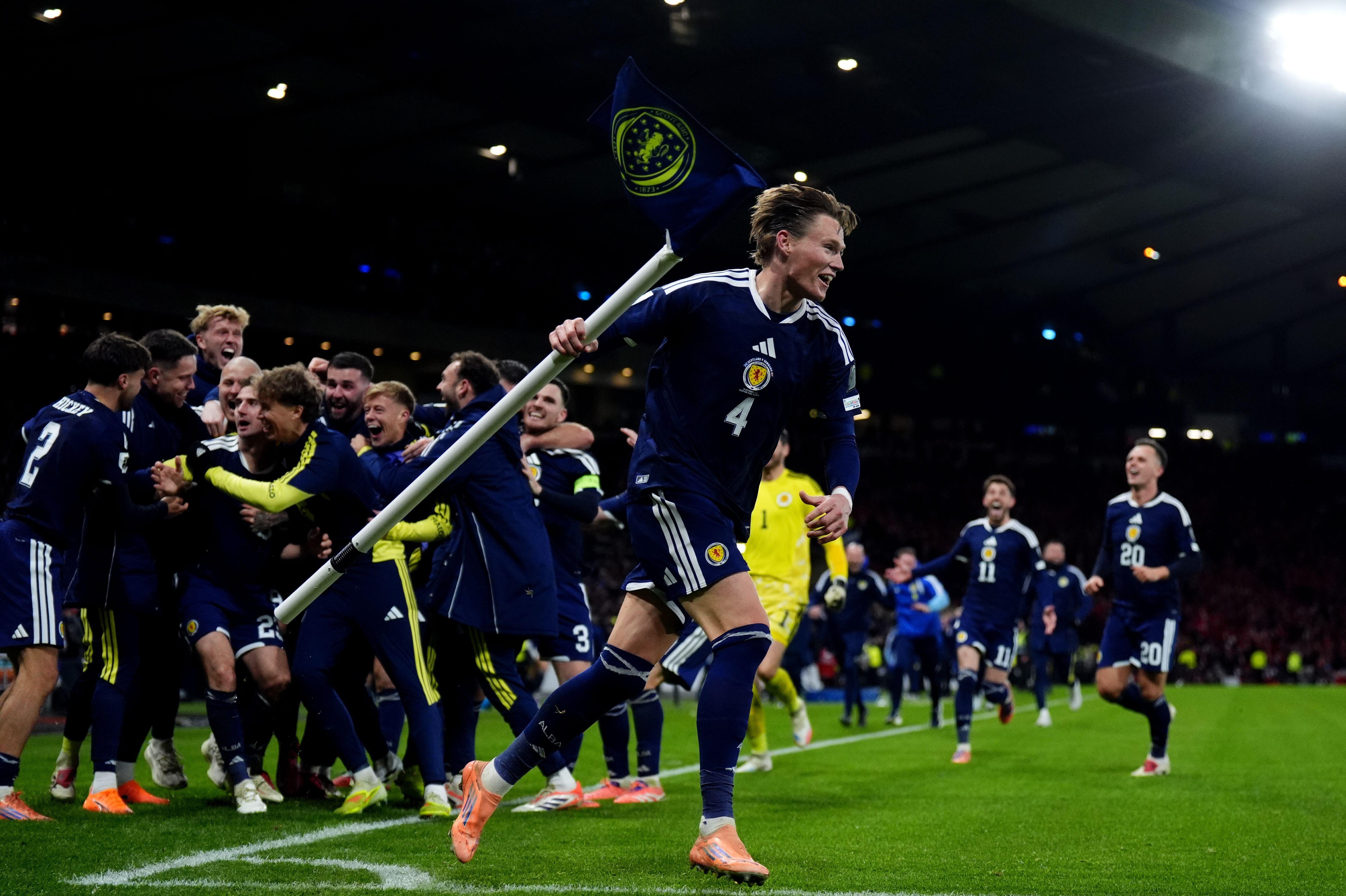
These things do not happen. Scotland’s football team does not qualify for the World Cup, with three of the best goals ever scored in one night by Scotsmen and the first of those goals being an overhead “bicycle” kick only three minutes into a do or die (sort of) fixture. There are not wild celebrations. This great victory does not then lead the UK national news the next day. I repeat – these things do not happen.
Only, these things did happen this week and like most Scotland fans, I imagine, I still cannot quite believe that after all these years it was real.
Against Denmark at Hampden on Tuesday this was the kind of night Scotland fans dream of, or dreamt of back when we were naive children, knew no better and had still to be confronted with endless Scottish footballing disappointment and falling short. This – Tuesday – was the night of dreams when, finally, the nightmare ended (for now) and everything worked perfectly as though it had been scripted by the sporting gods or as a fairytale concocted by the great sport writer Hugh McIlvanney during a magical night in the pub with Billy Connolly in 1977.
Let’s face it, Scottish football as a national team endeavour has been largely comical in character for more than thirty years now, perhaps even since the late 1970s. That is not to knock the talent or effort of a wide range of players who tried in those decades since and sometimes came close to defying our downward dive to the status of joke minnow status. This could not disguise the truth, though. Our role was to go out on goal difference or to be hammered by Morocco, as we were in 1998 the last time we made it to a World Cup final.
It was not ever thus. Scotland used to be a major force in European football because its best players dominated England’s clubs, filling many of the leading managerial and playing roles at Liverpool, Manchester United, Leeds and beyond in the old Division One, then the equivalent of the Premier League. Since then Scotland has lost its knack for producing true footballing greats, as the game changed and other countries advanced. Changing training techniques, diet, a fading of interest among young Scots and the internationalisation of English football meant there just weren’t as many top flight Scottish players to make up a serious national team once we got into the 2000s.
In the 1970s Scotland was no footballing joke. Our failure was tragic. Yes, Scotland’s exit from the 1978 World Cup was one of the most inherently amusing incidents in football, because our team went to Argentina with the nation convinced that we would return with the Cup. Alas, hubris was followed by nemesis.
It was funny, but it was also a tragic missed opportunity because the players in that 1978 squad were of such high quality that we should have won it, or at least got out of the group stages and come close to winning it. Instead, inept management meant we were humiliated by Peru and Iran before we beat the wonderful Holland side, but by one goal too few to proceed.
Since then, we’ve been on the slide.
If you are English and reading this with a smirk on your face it is worth remembering that if Scottish football has become comical, English football – the national team – has since Italia ‘90 become inherently tragic. Having failed narrowly to win the World Cup in 1990 – the campaign England should have won – England has been one near miss after another. The psychological damage gets worse every time. Who will beat England on penalties next? Surely one of the greatest footballing nations – inventor of the game – should be able to bring it home again? The last time England did so, the Beatles had just released their masterpiece album Revolver.
Which is worse? Scottish comedy or English tragedy? At least it is amusing being a Scotland fan. To follow England it increasingly seems you need a degree in psychology to make sense of the serial disasters and tragic near misses.
An English friend messaged me this morning to say he is pleased Scotland have qualified because World Cups are “funnier” when Scotland qualify. I responded that we are happy to provide light relief and amusement in the early stages, before a traumatised England are ejected – again – in the semi-finals.
But of course we are not happy to provide light relief and amusement. We – the Scots, Unionists and Nationalists alike – are a warrior nation desperately seeking greatness and vindication, to win something and really show everyone, particularly our large neighbour next door.
Could it happen? I doubt it, but in this Scotland team are a small group of really serious talents who are coalescing at the right time.
There is Scott McTominay, the brilliant young man rejected, sold, by Manchester United who has since become a hero in Naples as the key figure in a league winning Napoli side. Alongside him, also of Napoli, is the industrious playmaker Billy Gilmour, although not last night as he is out injured for a few weeks. Then the dynamo John McGinn, who whirrs away at the heart of the Aston Villa side, and the captain Andy Robertson, of Liverpool, who hoped to top a highly successful club career with his first trip to a World Cup. His ambition will be achieved – fitness permitting. Others deserve their trip too.
It is McTominay’s story that is most compelling, however. It was his balletic bicycle kick that opened the scoring against Denmark. Born in England, and qualifying for Scotland because his father was born in Scotland, there is something inspiring about his can do attitude. His great love was Man Utd and it was a very mixed experience being at the club, coinciding as it did with a calamitous slide in their fortunes. He took quite a lot of criticism and at times his form was erratic. Even his basic ball control seemed off at times. Would his confidence be destroyed? No. When the Napoli opportunity came up he didn’t whinge or melt in the glare of attention in a city that takes its football as seriously as Manchester or Glasgow. McTominay calmly got on with it, worked hard and became a star who scores wonder goals – as he did against Denmark.
I do not for a second think any of this means that Scotland will really shake them up and win the World Cup, or even get out of the group stages. I am familiar with the script.
There will be no final against England in which McTominay scores the winning goal, or a semifinal shootout in which England lose to an Andy Robertson perfect penalty and the Scots go on to beat Brazil 5-1 in the final.
These things do not happen. But sometimes they do.