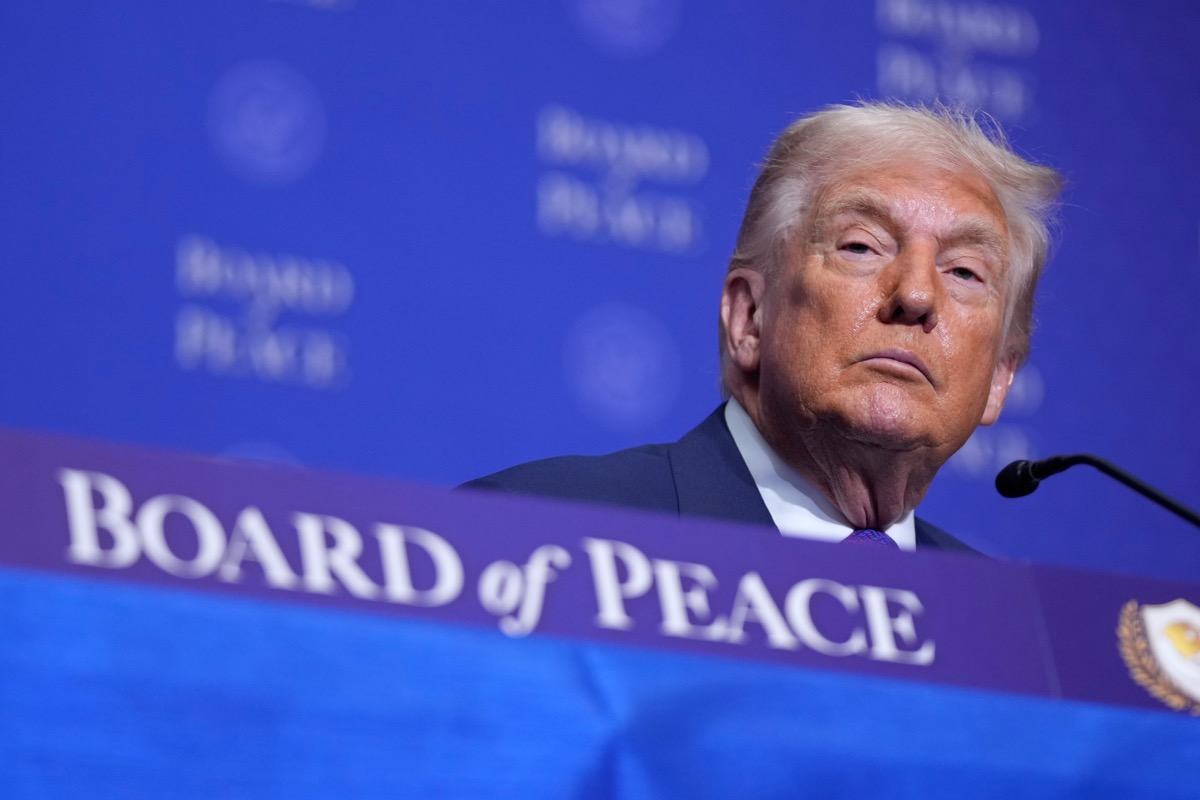
The State Department is transferring $1.25 billion to the “Board of Peace,” an international organization launched by President Donald Trump earlier this year at the World Economic Forum’s (WEF) annual gathering in Davos, Switzerland. The organization was authorized last November by the UN Security Council to oversee elements of a Gaza “peace plan” and reconstruction effort. The latter is co-led by Trump’s son-in-law Jared Kushner.
Earlier, the president had pledged to send $10 billion for Gaza reconstruction. Per the Gaza plan’s numbers, Israel dropped over 90,000 tons of munitions on the enclave in response to October 7, 2023 Hamas attacks. That reduced most of its buildings to 60 million tons of rubble and took “tens of thousands” of lives. Much of that death and destruction was enabled by generous U.S. military and financial backing under both the Joe Biden and Trump administrations — in other words, made possible by U.S. taxpayers. Now, those same taxpayers are expected to foot the bill to rebuild.
Congress has not passed legislation approving such funding. Nor has the Senate ratified any treaty recognizing the board as a legitimate international organization.
The Funds
Semafor reported the development on Thursday, noting that the funds for Trump’s board are being drawn from other federal programs:
Of the State Department money, officials pulled $1 billion from international disaster assistance; $200 million from peacekeeping operations; and $50 million from international organizations and programs.
Such missions would typically fall under the United States Agency for International Development (USAID). A notorious arm of the CIA, it primarily served as a vehicle for regime change, destabilization, and political interference. Despite early pressure to audit and dismantle it in Trump’s second term, the State Department instead absorbed its functions, with Secretary of State Marco Rubio now serving as its acting administrator.
Rubio had previously announced that 83 percent of USAID programs would be cut. He did not specify which programs would remain, who would benefit, or on what basis those decisions were made.
The transfer raises immediate legal and constitutional questions. Congress controls federal spending. Redirecting funds to a new international entity, especially one without formal authorization, places the executive branch on uncertain ground.
The State Department has offered little clarity. “We have nothing to announce at this time,” a spokesperson told Semafor. The White House did not respond to requests for comment.
Political Backlash
The move has already triggered a legislative response. Democratic Senator Catherine Cortez Masto of Nevada plans to introduce a bill to claw back a large portion of the funds. Her proposal would redirect $1 billion toward domestic energy assistance. Per Semafor:
“Instead of giving President Trump a $1 billion blank check to fund a ‘Board of Peace’ that has offered no transparency about how it is investing its money, let’s focus on helping American families afford their monthly power bill,” Cortez Masto said.
According to the text of the bill shared with the outlet, the money would go to yet another unconstitutional entity, “the Secretary of Health and Human Services[,] to carry out the Low-Income Home Energy Assistance Act of 1981.” The program enables states, territories, and tribes to assist low-income households with heating and cooling costs, with the stated aim of reducing health risks tied to unsafe temperatures. Under the Constitution, however, such responsibilities fall to states and localities themselves, not Washington.
Still, the bill serves as an indirect confirmation that the funds are either already being transferred or are about to be.
The timing is not accidental. Energy prices have surged amid the escalating U.S.-Israel war on Iran. Lawmakers face growing pressure to focus on domestic priorities over highly opaque foreign initiatives.
$10 Billion Pledge and Promise of Peace
The $1.25 billion transfer is only part of a larger financial commitment. At the board’s inaugural meeting on February 19, Trump publicly pledged that the United States would contribute $10 billion. Despite having no constitutional authority to assume such a role, Trump is serving as the board’s chairman. He framed the body as one of his most important and consequential missions, saying:
I want to let you know that the United States is going to make a contribution of $10 billion to the Board of Peace … and we’ve had great support for that number.
He acknowledged the scale of the pledge, but downplayed it. The contribution, said Trump, “sounds like a lot, but it’s a very small number” compared to the cost of war. He estimated it equals roughly two weeks’ of fighting. The president added:
Together, we can achieve the dream of bringing lasting harmony to a region tortured by centuries of war, suffering and carnage.
The rhetoric, however, did not last. Just days later — without congressional approval — Trump ordered strikes on Iran, including multiple reported hits on civilian infrastructure. That included a strike on an elementary school in Minab, Iran, carried out on the first day of the war and killing at least 175 people, most of them children. Official preliminary findings place the responsibility on the U.S. military. That underscores the gap between the language of “peace” and the reality of policy.
Meanwhile, Israel, America’s “closest ally” and another member of the board, has escalated its military campaign against Lebanon, resulting in widespread destruction across southern regions and Beirut’s southern suburbs. Reports indicate significant civilian casualties, large-scale displacement, and extensive damage to residential infrastructure, further escalating tensions across the region.
Other Funds for the Gaza “Master Plan”
Beyond the U.S. pledge, other countries, primarily Gulf states such as Saudi Arabia, the United Arab Emirates, Qatar, and Kuwait, have collectively committed about $7 billion. The funds are expected to move through a World Bank-administered mechanism tied to the Board of Peace.
Trump also pointed to additional funding streams. He said the United Nations would seek to raise another $2 billion for humanitarian aid, and Japan would convene an Asian donors conference. Even the International Association Football Federation (FIFA), he said, would contribute $75 million for soccer projects in Gaza.
Despite these pledges, the scale of need remains great. The United Nations estimates that roughly $70 billion will be required to rebuild Gaza.
The president’s diplomatic envoys, including real-estate developer Steve Witkoff and real-estate investor Jared Kushner, along with other parties, co-developed a “Master Plan” for Gaza reconstruction. Both have acknowledged the plan had been in development since 2023. Its presentation by Kushner coincided with the launch of the Board of Peace, tying the reconstruction agenda directly to the new body.
According to the plan, Gaza would be transformed, as Trump previously promoted, into the “Riviera of the Middle East,” complete with high-rise developments, tourism zones, luxury waterfront projects, and large-scale commercial infrastructure.