One of the great paradoxes of the modern world is that as living has become easier, believing in God has become more difficult. This lack of belief stems from, among other things, the many choices of religion on offer. The world today is largely pluralistic and individualistic, and people now pick their religion like they pick out an outfit at a department store.
Naturally, this results in a kind of spiritual paralysis and malaise. With so many choices, the ordinary person might despair that any of them is the right one and might assume choice itself is an illusion. Moreover, this problem becomes all the worse when most educational institutions regularly deride religious faith and discourage its practice.
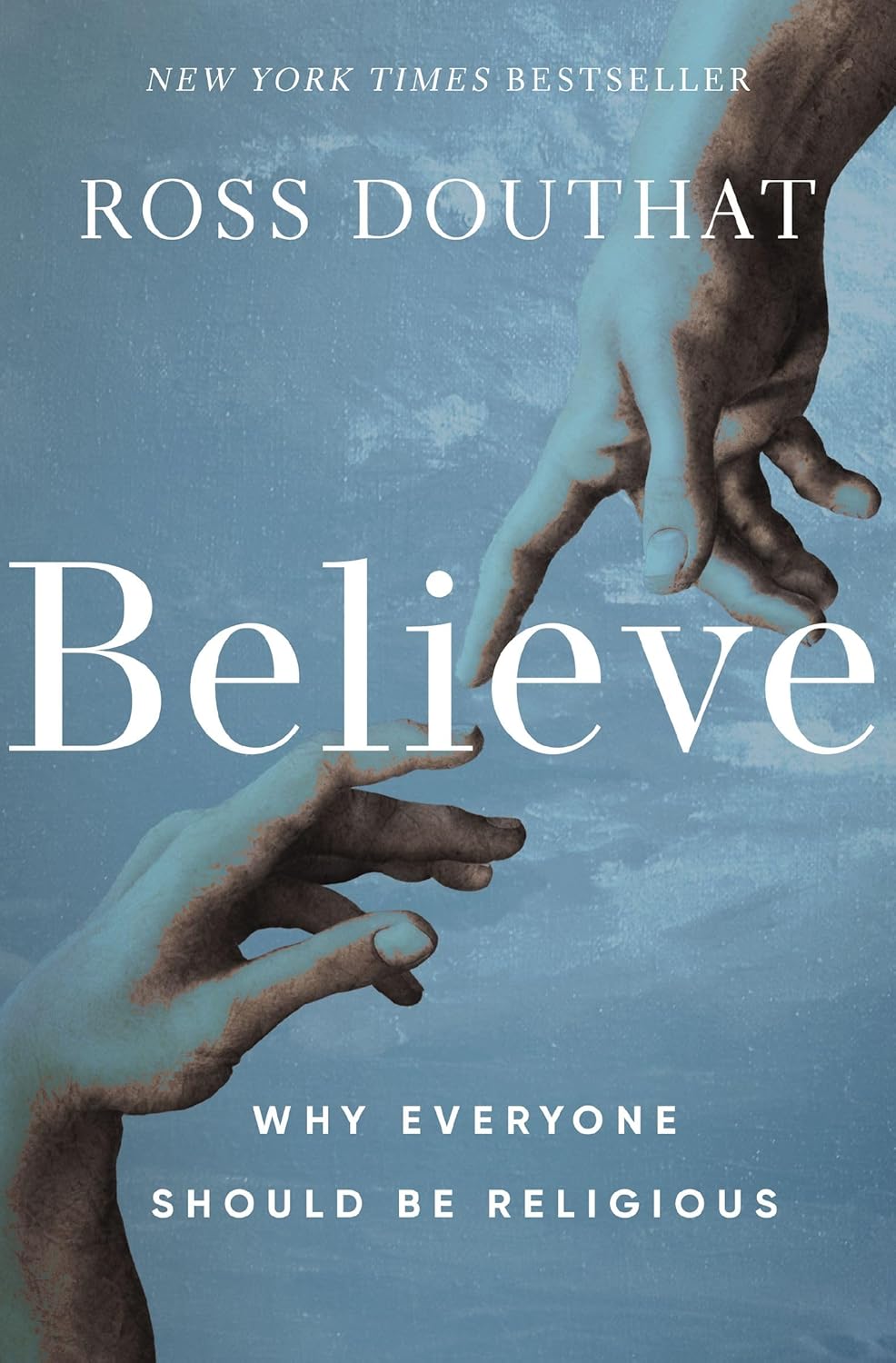
So, apologists not only need to argue for belief in God, but also for the act of belief itself. This is the challenge that New York Times columnist Ross Douthat – and a conservative Catholic – takes up in his recent book Believe: Why Everyone Should Be Religious. Douthat is well situated to appreciate the moods and prejudices of modern readers, and makes the case that they should reconsider their indifference to church and commit to a religion.
On one hand, Douthat’s broad approach relieves him of having to account for obscure theological differences and speak as a reasonable layman who can identify with his audience. On the other hand, he is forced to attempt reconciliation between religions that are often opposed to one another.
Instead of assuming a great leap of faith from doubt into belief, Douthat works off the premise that people make many little hops from a qualified skepticism to full religious participation. His analogy usually works, but it can also mistake certain hops backward as progress.
That said, Douthat deserves praise for his eloquent defense of theism. He avoids the dry syllogisms explaining causation and contingency, but uses them as a means of dismantling the popular idea that science disproves God’s existence.
While not exactly debunking religious faith, the momentous theories of heliocentrism and evolution have effectively disrupted and destabilized traditional faith: “Two hinge points, the Copernican and Darwinian revolutions, are understood to have shifted the reasonable default to purposelessness and accident, materialism and atheism.”
Douthat explains, however, that these theories mainly speak to the complexity of the cosmos, not to the absence of God. Moreover, as one surveys more recent scientific discoveries, it even appears more likely that God designed the universe.
Douthat presses on and explores the mystery of the soul. Similar to scientific breakthroughs in physics, new discoveries in neuroscience seem to challenge the existence of souls. And yet, such advances also may be seen as offering more evidence for the existence of an immaterial soul: “Whatever consciousness may be, soul or mind, dream or spell, it self-evidently has its own integrity, its own being, which is intertwined with physical reality without being reducible to physical substances and their interactions.”
In expounding upon these points, Douthat gradually presses materialists into an untenable corner. In order to explain the soul and the universe, they must conjure up implausible theories of an infinite multiverse and of consciousness inexplicably “emerging” from complex neural networks in the brain. He makes it clear that today’s materialists are desperately grasping at straws and, consequently, do not occupy the intellectual high ground.
After an interesting chapter on miracles and ghosts, Douthat moves on to the trickier case for religious adherence. After all, most people these days can at least be brought to a point of being “spiritual but not religious” – and leave it at that. It is quite another matter to coax them to the next step of committing to a religion.
Douthat’s reasoning here is solid and dispels much of the do-it-yourself attitudes about religious practice. He explains the need for community as well as practical guidance when traversing the metaphysical plane, and this can only happen when attending an actual church with actual people.
Problems arise when Douthat discusses choosing a particular religion. Based on his mode of reasoning, the answer should be fairly obvious: pick the church that comes closest to the truth. Nevertheless, Douthat instead opts for an awkward syncretism that appears to make all the major religions morally equivalent. Sure, one might pick a religion that misrepresents the fundamental nature of God and His Creation and is fraught with contradictions, but in the end, Douthat insists it will still lead that person to ultimate truth.
Perhaps he believes that saying something different will exclude a portion of his audience and seem intolerant. But to claim that all religions are valid in some way undermines the rest of the argument. He insists that one can argue for Islam, Buddhism, or Hinduism in the same way one can argue for one particular form of Christianity over another. Even a cursory glance at history, along with the state of the world today, offers ample evidence that not all faiths are remotely alike, nor do they point in the same direction.
Fortunately, in addition to addressing the common stumbling blocks to religion, Douthat relates his own faith journey. As he makes clear, the usual rebuttals to belief – the problem of evil, the scandals in religious institutions, the demanding rules on chastity – do not disprove religion. There are good potential reasons God has made the world as He has, but human beings must accept their limitations and work with what they are given instead of withholding their faith in God in protest.
Finally, Douthat shares his experience, growing up as a charismatic Protestant and converting to Catholicism. Evidently, the “sheer weirdness” of his childhood faith was “matched, exceeded, and enfolded into orthodoxy,” and the “capaciousness of Catholicism, its antiquity and global sprawl” made it more satisfying for someone of his intellectual scope.
Throughout, Douthat is eloquent and avoids the usual longueurs of religious arguments. He can be humble and accommodating to a fault, but also brilliantly assertive as to the necessity and rewards of belief. Anyone considering the value of religious belief in good faith should at least be persuaded of its reasonableness. And, God willing, can begin the journey towards experiencing the joys of religious truth firsthand.