It’s Lent, when our mortifications and the Church’s readings give us a sharper opportunity to think about what we love, and whether we are loving the right things.
James Patrick was a wise man and a good friend. I met him after he had founded a tiny post-secondary educational institution, St. Thomas More College in Fort Worth. I say “institution” because even aside from its size and situation in a few residential houses near Texas Christian University, it bore little resemblance to anything we’d recognize as a university today.
He had previously taught at the University of Dallas, the University of the South at Sewanee, and the University of Tennessee. He had studied architecture, theology, philosophy and just about everything else. He was an Episcopal priest before entering the Catholic Church.
Jim was one of the many wise people who have shared with me much of their time and goodness. He was a man of letters, an exemplar of Western civilization. You might say in many ways he was another Fr. Jim Schall.

He knew of my interest in philosophy and provided one of the greatest gifts I received as I began formal studies. He warned me, gently but clearly, that when philosophy gets off its knees, it gets into trouble.
That’s a pithy way of saying that when philosophy, the use of human reason to know the whole truth of “what is,” divorces itself from faith, bad things happen.
While failure to love God above all throws any life awry, the intellectual life seems particularly vulnerable to losing one’s way. Perhaps this is because many intellectuals are very smart and can indeed make considerable progress in knowing reality, so they become overambitious and proud.
A paradigmatic modern case was Martin Heidegger, a truly brilliant mind who produced much great philosophical work, jettisoned his Catholic faith, and became a Nazi (the degree of his cooperation with Hitler’s regime is disputed).
The original case study, though, must be the geniuses who came up with the idea for the Tower of Babel. I’m always struck that God did not say, “Look at those fools, trying to do something impossible.” He stopped them because they might have succeeded. He disrupted their logos, confusing their reasoned speech so that such collective endeavors would be less likely thereafter.
Reason as used by the Babel builders might have accomplished something that, presumably, God knew would not be their true good. They sought Heaven without depending on God.
What does it profit us to gain the world and lose our souls?
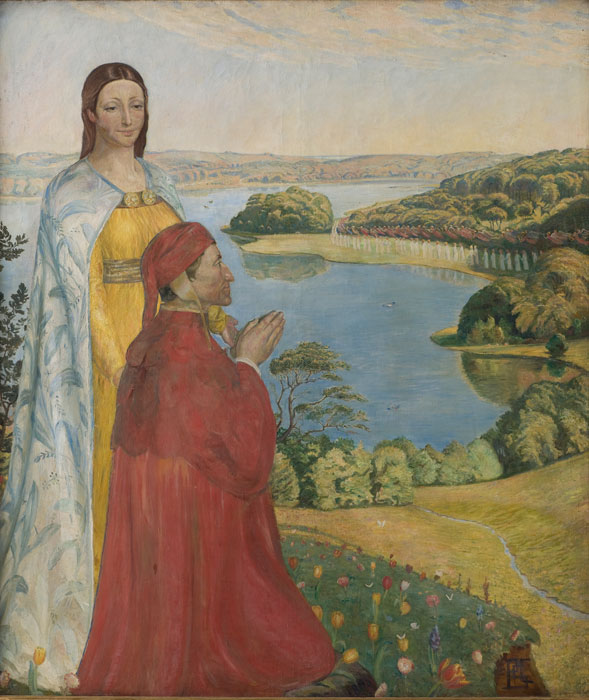
“Philosophy” is derived from the Greek for “love of wisdom.” It’s very easy for philosophers to focus on the “wisdom” – the truth of things – and forget about the “love” part. St. Augustine and other Christian philosophers knew this danger and accepted the notion of “I believe in order to understand.” I am given faith as my first love – love of God – then I use my reason to seek truth within that love.
Jim Patrick and Fr. Jim Schall understood that approach.
Some philosophers, including Leo Strauss, who helped revive the study of ancient philosophical wisdom in recent decades, would disagree. He thought it was impossible for a man of faith to be a true philosopher, as faith would constrain the search for the truth, which is itself unconstrained.
I wonder whether that kind of thinking brought the poet-philosopher Dante to the point where he begins his Divine Comedy. The beginning of Inferno is one of the most famous starts to any journey in Western literature:
Midway in the journey of our life
I came to myself in a dark wood,
for the straight way was lost.
Ah, how hard it is to tell
The nature of that wood, savage, dense and harsh –
the very thought of it renews my fear!
It is so bitter death is hardly more so.…
How I came there I cannot really tell,
I was so full of sleep
When I forsook the one true way.
– Inferno I.1-12 (Hollander trans.)
Dante knew philosophy well, including St. Thomas Aquinas and St. Augustine, and bits of Aristotle and Plato. But did philosophy get Dante lost in that dark wood, off the straight way, unable to recover?
It takes much of the Comedy to find out. After his fellow poet Virgil has guided him through Hell and Purgatory, his beloved Beatrice takes over to lead him through Paradiso.
In earthly life, Beatrice had been for Dante the paragon of beauty and purity, though he rarely encountered her. She was the human embodiment of the divine, and Dante loved her.
In the first few cantos of Paradiso, Beatrice sharply rebukes Dante for his philosophical errors in misunderstanding the truth of “what is.” Drawing on elements of classical and scholastic philosophy, she wipes the floor with him. She and the other saints are moved by the “true light that brings them peace [and] does not allow their steps to stray.” (Paradiso 3.32-33)
Dante is mortified to learn of his mistakes. His misguided study of philosophy had taken him far from wisdom. Robert Hollander sees in Dante’s report of this dressing down the possibility that Dante is embarrassed by his betrayal of Beatrice on earth. He had failed in “not making good the vow he had made to honor her” in his Vita Nuova, turning instead to devote himself to “Lady Philosophy.”
That failure was a diversion from Dante’s love of divinely inspired wisdom to favoring merely human efforts to understand reality. So he winds up in his famous dark wood, in need of Beatrice’s aid and that of several other saints to find his way.
It’s a comedy, so Dante’s fault ends in his happy correction. He is put back on his knees with a fuller understanding of true wisdom thanks to Beatrice.
Blessedly, Dante is forgiven his mistake. But it’s not a mistake Jim Patrick would have made, and it’s one that should help philosophers remember what to love.
The post The ‘Dark Wood’ of Philosophy? appeared first on The Catholic Thing.