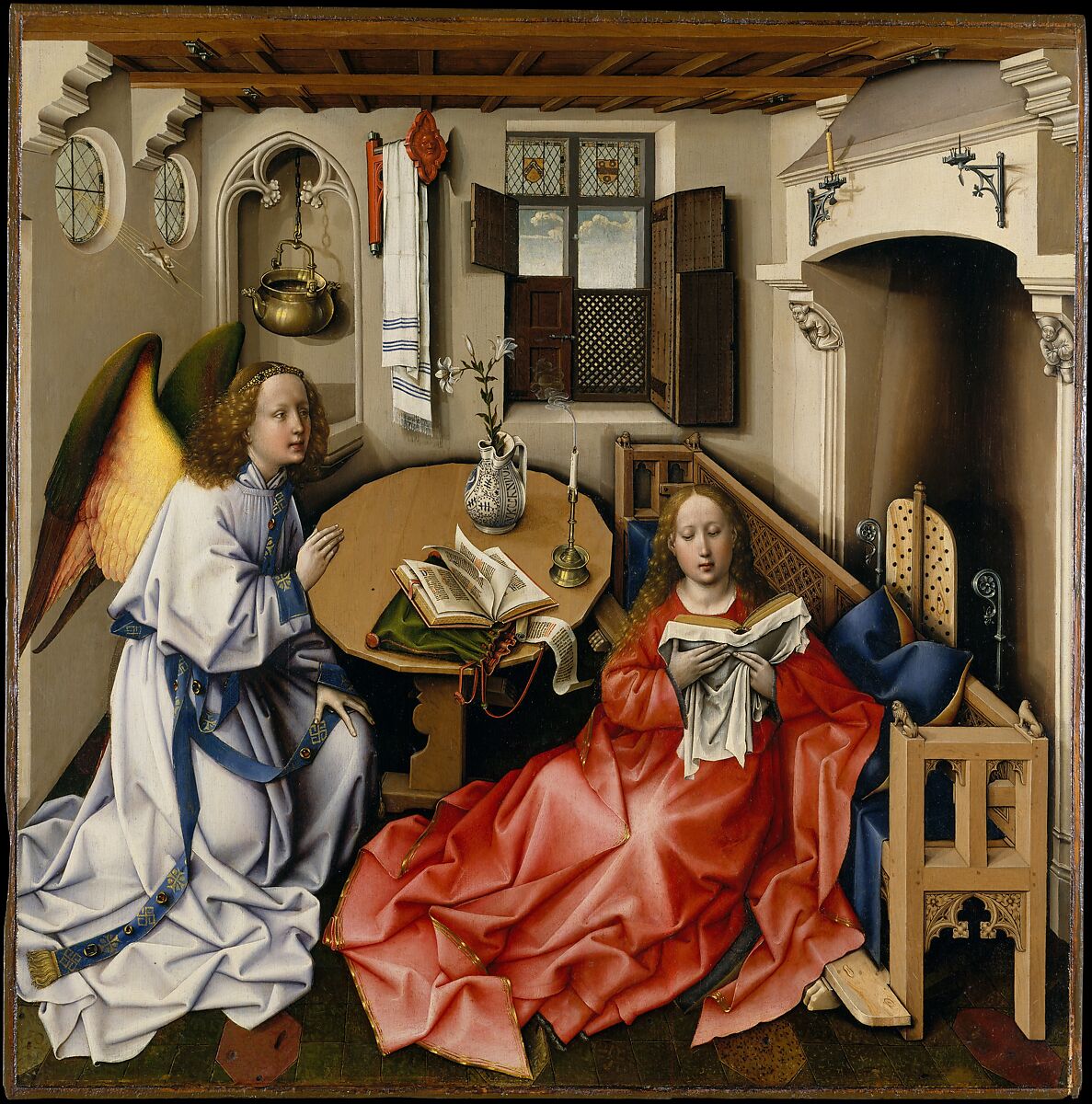
For Lent this year, I resolved to pray the Angelus in the morning, at midday, and in the evening – a practice, of course, long a part of Catholic piety. In my adult life, I’ve been up and down in adhering to this practice, and this year I wanted to fix that. (Please don’t ask how I’ve done thus far!)
I was inspired to make this resolution by a passage in St. John Paul II’s Gift and Mystery, which he published on the 50th anniversary of his ordination. This dense little book tells JPII’s “vocation story.”
For a man who chose “Totus Tuus” as his episcopal motto, it’s no surprise that Mary played an influential role in that story. From early on in life, it appears Karol Wojtyla prayed the Angelus three times a day. Indeed, while working in the stone quarry as a young man, Karol would pause at midday, put down what he was carrying, and silently pray the Angelus – a sight that his fellow workers found admirable, but also somewhat amusing. Such is the fate of a fool for Mary!
By learning more about Mary and then consecrating himself to her (under the guidance of St. Louis de Montfort), young Karol “came to understand why the Church says the Angelus three times a day.” The “powerful words” of this prayer, he writes, “express the deepest reality of the greatest event ever to take place in all of history.”
That’s a mouthful, to be sure, and yet what a potent assertion! Especially on this Solemnity of the Annunciation, a feast that we might nickname “Angelus Day.” His description of the Angelus highlights what’s so meaningful, and yet so hidden, about the event that we celebrate today.
Today we celebrate Gabriel’s announcement to Mary that she will conceive in her womb and bear a son, whom she shall call Jesus. (Luke 1:31). Gabriel’s announcement is, in fact, a proposal, since Mary remains free to accept Gabriel’s future-tense statement as her own future. . .or not.

In a well-known homily, St. Bernard of Clairvaux, another devotee of Mary, captures the drama of that moment so beautifully:
You have heard, O Virgin, that you will conceive and bear a son; you have heard that it will not be by man but by the Holy Spirit. The angel awaits an answer; it is time for him to return to God who sent him. We too are waiting, O Lady, for your word of compassion; the sentence of condemnation weighs heavily upon us.
Bernard draws us into the magnitude of this moment. He intuits in this Angelus moment what John Paul himself describes: “the deepest reality of the greatest event ever to take place in all of history.” It is the turning point, and we who place ourselves there with Gabriel also await Mary’s reply.
Indeed, my own Lenten attempts at a thrice-daily recitation of the Angelus have driven home John Paul’s description of this moment, which makes two implicit, foundational assertions that ought to suffuse the minds of every Christian believer daily — and especially today.
The first assertion is that the moment of the Annunciation is, in fact, the greatest event in all of history. The whole of history pivots around this event, around Mary’s decision and what results from it, namely, the absolutely hidden and mysterious conception of Jesus Christ in her womb.
This is the world-transforming moment of Incarnation, of the Becoming-Flesh of the Word of God. Et Verbum caro factum est, et habitavit in nobis. All of history up to that moment had been anticipating it, and all of history afterward has unfolded and will continue to unfold its reality and significance. And at the center of it all stands Gabriel’s Annunciation and Mary’s reception of it.
The second assertion is in some ways even more mysterious: that the Angelus captures the deepest reality of this greatest event in history. The ultimate drama of the Annunciation lies hidden within Mary’s personal interiority, within her heart, within her deliberate self-present exercise of freedom in response to God’s proposal.

Indeed, when we peel away all that led up to this moment as well as all that unfolded thereafter, at the core stands a young woman in conversation with God in the depths of her conscience, and within that inner sanctuary she freely decides to undertake what God has proposed – and to participate thereby in His re-creation of all things.
Most fittingly, then, does she answer: “Fiat!” This most interior of exchanges between a creature and her God gives birth to the greatest event in all of history: the Incarnation; such is the “deepest reality,” the most hidden actuality, of that world-transforming event.
We must remind ourselves of this daily. We must remind ourselves that the deepest reality of history does not lie in the noisy events and clamorous actions that constitute all the news, real or fake, that’s fit to print. The deepest reality of history lies, on a daily basis, in the movements of the hearts of unique human persons who stand before God in the sanctuary of their consciences, choosing freely to collaborate with his proposals. . .or not.
In this way, then, we too can participate in the Annunciation, in the willingness to give flesh to Christ in the world, in every conscientious decision we make, no matter how big or small. Such is the lesson of the Angelus; such is the lesson of today’s solemnity.
The true drama of each of our lives dwells within us, and it concerns whether we freely and conscientiously accept to conceive in our hearts the reality of Jesus Christ. . .or not.
It seems so fitting, then, that almost every year the Solemnity of the Annunciation (“Angelus Day”) comes upon us during Lent, during that at first dreaded, but eventually welcomed season of the year when, by fasting, prayer, and almsgiving, we are reminded of what’s most essential in all of history and of the deepest reality of our own lives.