Anyone who prays the Divine Office will say the Benedictus each morning, as it is the closing hymn of Lauds (Morning Prayer). It’s also called “The Canticle of Zechariah,” the father of John the Baptist, who sang the Benedictus (“Blessed be God”) when his infant son was circumcised, on the eighth day.
More precisely, he sang it after the ceremony of naming. If the ancient Jewish practice was like current practice: first, the baby was circumcised, which act was understood to place him within the covenant of Abraham. Then, his father would declare the baby’s name, which the parents would have kept secret until then.
A circumcision ceremony was a festive gathering of friends and relatives. Apparently, it was so obvious to the crowd there that the baby was to be called “Zechariah” after his dad, that they started saying that name spontaneously, as if it were a settled fact. (Luke 1:59) Zechariah was still mute: therefore, it was left to the mother, Elizabeth, to contradict them: “Not so; but he shall be called John.” (v. 60, Douay-Rheims) It was a fitting role for her to assume anyway, because she was the one who had believed the words of the angel.
And yet it was the father who had final authority over the name (as when Joseph would later name Jesus). Therefore, they turned to Zechariah.
About this, Luke writes, curiously, “They made signs to his father, how he would have him called,” which has puzzled the commentators. After all, it was Zechariah who was mute: why did they need to make signs? And the best answers are that Zechariah was punished with deafness as well as muteness; or that the crowd made the very human mistake of supposing that they needed to communicate with him “in his language.” If the latter, then how endearing that Luke passes on this little detail, which would have been recalled by everyone there, clearly, as a silly misapprehension!
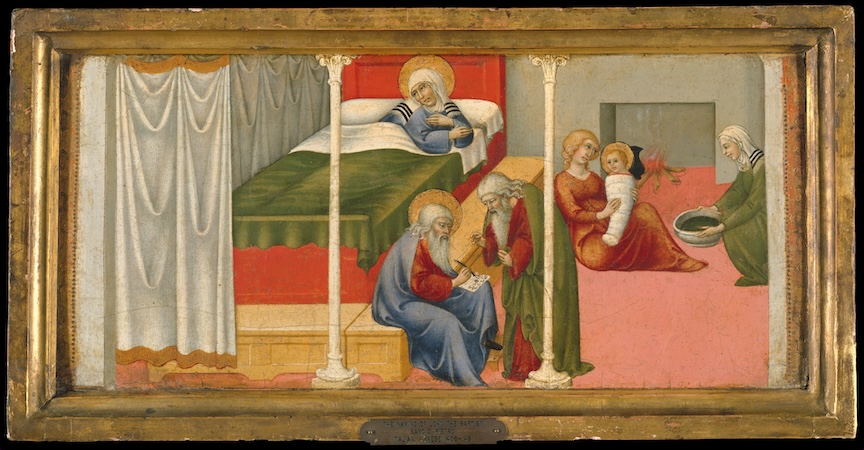
A writing tablet was at hand. And in this, there is a lesson, because writing tablets then were like scratch pads now. They were always at hand, and therefore apostles such as Matthew, a recorder by trade, would have been writing things down on them all the time. But these tablets of wax and thin wood were frail and have not survived from classical times except under unusual circumstances, e.g., if they were left in cool, dry caves.
So, Zechariah takes the tablet and writes, “John is his name.” Luke says the crowd “wondered” at it. They marveled; they were puzzled; they were amazed. In the gospels, amazement is the typical reaction of a crowd, superficial and unthinking, when they encounter something strange.
Just then, however, John regains his ability to speak. Tellingly, his first words are not “John is his name,” but rather he blesses God! And now the crowd responds, rather, with fear, because they recognize that some numinous power is at work, right there, among them.
This newfound fear has instilled some sense in them, because they see that the miracle was worked not as much for the father, as to point towards the newly-named son: “What do you suppose this child will be?” they ask one another.
Zechariah answers their question, and this is his Canticle or Hymn. He spoke those words as prophecy, being “filled with the Holy Spirit,” as Luke writes.
One might think that he composed the Hymn in advance, during his long months of silence, out of faith that he would someday be able to sing it. But Luke’s words preclude that interpretation. What the Spirit inspires someone to say is precisely not prepared in advance (“the Holy Spirit will teach you at that time what you should say,” Luke 12:12). And yet, if inspired on the spot, could those words have been recovered later, with accuracy? Even without the Spirit’s assistance, in an oral culture, with an entire crowd working at it (“all these things were noised abroad over all the hill country of Judea”), yes.
For the Hymn itself, I recommend the Douay-Rheims translation (here), which tracks closely the Greek and the Vulgate, and which preserves all of its startling imagery:
He hath raised up an horn of salvation to us. (v. 69)
Yes, that’s like the virile power of a strong ram with its horns. The Savior is a warrior, mighty in battle. “Lift up your heads, O gates! And be lifted up, O ancient doors! That the King of glory may come in. Who is the King of glory? The Lord, strong and mighty, the Lord mighty in battle!” (Psalm 24:7-8, RSVCE).
And then:
Through the bowels of the mercy of our God
The “bowels” are where the passion of mercy is felt among us. A pure spirit has no bowels, and no similar passions. The phrase can be a metaphor, of course, and yet it does point to the Incarnation: “And seeing the multitudes, he had compassion on them [literally, he felt mercy in his bowels], because they were distressed, and lying like sheep that have no shepherd.” (Matthew 9:36) After all, Zechariah says “Blessed be the Lord God of Israel,” “because he hath visited his people.” He dwelt among us. (John 1:14)
From this divine mercy,
The Orient from on high hath visited us: To enlighten them that sit in darkness and in the shadow of death.
The Orient is the morning star, preceding the rising sun. The phrase might just signify Mary, who had visited Zechariah, and whom everyone will later call Stella Matutina, the Morning Star. (Remember, it is the Spirit speaking through him.) Or “The Orient” can mean the rising dawn, as in the antiphon, “O Oriens –splendor of eternal light, sun of justice.” And then it signifies a time of Advent.
We search our streaming services for an Advent hymn equal to our beloved Christmas hymns: the Spirit has given us the very best one.