Exactly eighty years ago yesterday, the War Crimes Tribunal convened a trial to prosecute twenty-four Nazi leaders – a legal procedure with continued relevance for us today. The driving force behind the creation of the tribunal was American President Franklin D. Roosevelt. Shortly after America entered the war, he said, “It is our intention that just and sure punishment shall be meted out to the ringleaders responsible for the organized murders of thousands of innocent persons in the commission of atrocities which have violated every tenet of the Christian faith.”
The November 20, 1945 indictment of the 24 Nazi ringleaders consisted of three parts. Part one accused the defendants of conspiracy to wage a war of aggression and violation of international treaties; these were “crimes against peace.” Part two charged the defendants with violations of the laws and customs of war as embodied in the Hague and Geneva conventions and as recognized by the military forces of all civilized nations; these were “war crimes against peace.” And finally, part three accused the Nazis of the extermination of racial, ethnic, and religious groups and with other atrocities against civilians; these were “crimes against humanity.”
The arguments of the defense were essentially two. First, it was claimed that at the time the various acts were alleged to have been committed, the “crimes,” which the defendants were now being charged, had no statutory basis: either in German law or international law; that the legal basis of indictments had been created after the fact. Since “ex post facto” laws are constitutionally prohibited by each of the Allied Powers, they could hardly have validity in a court convened by those nations.
The defense’s second argument was that the accused ought not to be charged with the consequences of following the orders of Germany’s lawful leaders. Hitler’s supreme authority had been confirmed equally by appointed judges and elected legislators, and he was able to boast of the Nazi Party: “We stand absolutely as hard as granite on the ground of legality.”
It was, however, perverse legality. Beginning with the decree for the Protection of the People of the State (1933), which obliterated the personal freedoms formally protected by the Weimar Constitution, the Nazis promulgated a series of legal outrages. There were “Racial Purity” laws that forbade marriage between Jews and non-Jews. There were laws that forced the registration of “alien races” and genetically “less valuable” individuals; and laws that expelled Jews from government employment and permitted the “Aryanization” of Jewish assets. From such “hard as granite” laws, Hitler and the German leadership fashioned the Final Solution.
Yet, despite the enormity of these Nazi atrocities, the legal dilemma at Nuremberg was very real. In establishing a case against the defendants, especially on charges of “crimes against humanity,” the prosecution had no pre-existing statutes sufficient to the task. But the prosecutors did not hesitate to invoke the law – the natural law – that supersedes all civil statutes and abrogates the kind of perverted legal order such as existed in Nazi Germany. Philosopher Peter Kreeft has written that “the Nuremberg Trial assumed that such universal moral law really existed.”
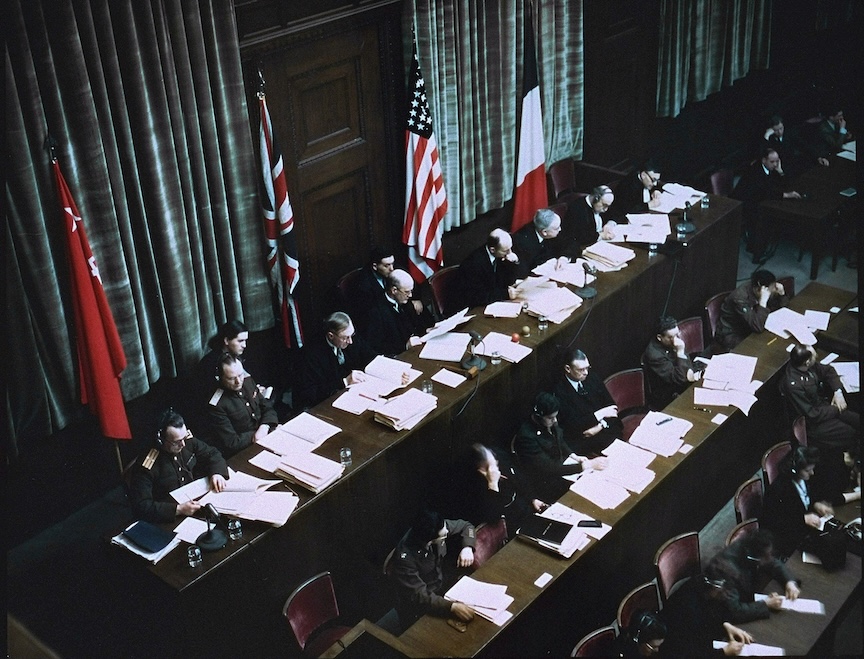
The Nuremberg defendants and their attorneys argued that theirs “was not guilt before a human criminal court but a crime before God.” It was assumed that although they might be morally guilty, they remain legally innocent; the defeated German state bore the guilt, not its people or its leaders.
To this, Robert H. Jackson, an associate justice of the U. S. Supreme Court who served as America’s chief counsel at Nuremberg, flatly stated: “We do not accept the paradox that legal responsibility should be least where the power is greatest.” Justice Jackson recalled English jurist Edward Coke’s rebuke of James I’s assertion of royal authority: “A king is still under God and law.” Jackson added, “If you were to say of these men that they are not guilty, it would be as true to say there has been no war, there are no slain, there has been no crime.”
Jackson’s natural law reasoning was summarized by Ann and John Tusa, authors of The Nuremberg Trial:
The very idea that states commit crimes, he said, “is a fiction. Crimes are always committed only by persons. Men who exercise great power cannot be allowed to shift their responsibility onto the fictional being, the state “which cannot be produced for trial, cannot testify, and cannot be sentenced.” He berated those who had sworn an oath of inviolable fidelity and absolute obedience to Hitler, he called it “an abdication of personal intelligence and moral responsibility.”. . . .Then came the cry from Jackson’s heart, as characteristically honest as it was passionate. “I cannot subscribe to the perverted reasoning that society may advance and strengthen the rule of law by the expenditure of morally innocent lives, but that progress and law may never be made at the price of morally guilty lives.”
Unable to convict the Nazis through civil laws, that is, man-made law, they were convicted by a higher law – divine law.
The verdict at the Nuremberg Trials proved that without natural law, there is no case against the enfranchisement of evil. The natural law tradition not only assumes and assures the dignity of the human person but is often the only counter to injustice and inequity. That’s a lesson we very much need to relearn in all the historic Christian nations today.