In my memories, December 31 in Leningrad, Russia, was always cold. Of course, the city has been called St. Petersburg, its pre-Revolutionary name, for much of my life, but for the almost decade that I lived there, it was Leningrad. So in my mind, the outdated name, commemorating a man whose views and policies destroyed millions of lives over the seven decades of the USSR’s existence, persists. In her ode to the city’s famous white nights, the pop star Edita Piekha crooned,
If you, since your childhood years, live in Leningrad,
You will understand me, friend, you will understand.
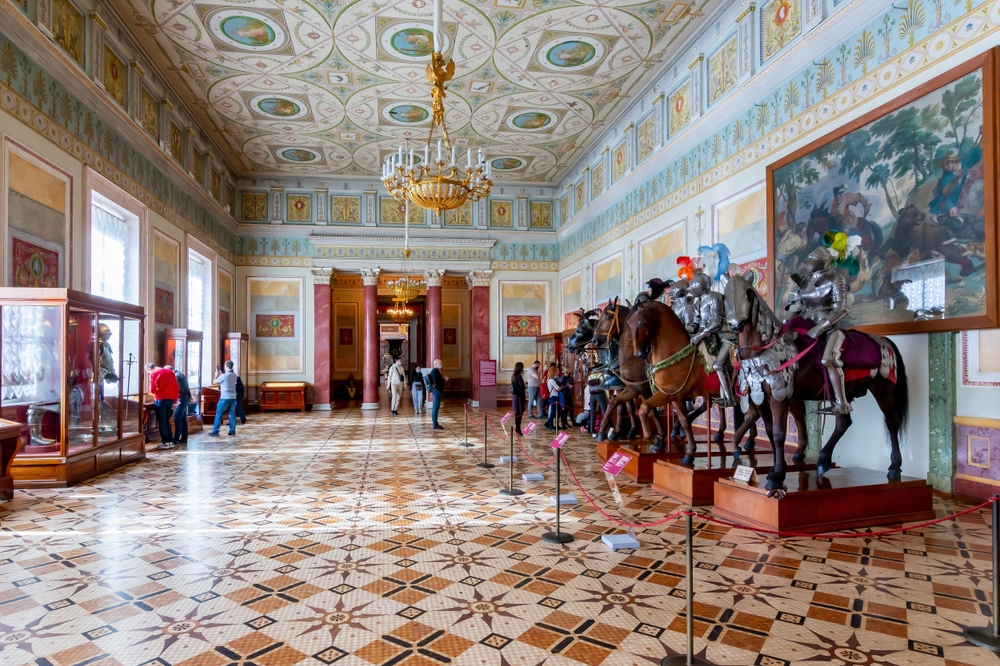
Those white nights were in August. By December, the dark fell early, waging nightly battle with the city lights, like those at the top of the Admiralty building, visible from afar. And reliably, every December 31 during my childhood, my family took an outing in the afternoon to the Hermitage museum, located a brisk two-kilometer walk from our apartment building. The tsars had lived in the Hermitage once, but by the time of my childhood, 1917 seemed very far in the past. This former Winter Palace of the tsars had been a museum for the people by then for nearly 70 years. My feet have trod the same marble staircases as Catherine the Great—a thought rendered significantly less remarkable by the reality that millions of other perfectly ordinary Soviet citizens have done likewise since 1917. World War II (known as the Great Patriotic War), however, was still very much in cultural memory—and especially the suffering Leningrad had endured in that war. War, after all, affects all places, even the most beautiful ones. War cares not for beauty, art, or people.
During the war, Leningrad had been under a complete German blockade for nearly 300 days, and close to a million civilians died of starvation and related causes. In the brief autobiographical notes of my grandmother, who had lived through it as a young woman, the blockade earned merely a single sentence—“Of this horror, I cannot speak.”
In his new novel, The Prodigal of Leningrad, writer and literary scholar Daniel Taylor attempts to do what witnesses to the events could not. He tells the story of the Siege of Leningrad through the eyes of one ordinary man—a volunteer docent at the Hermitage museum. As Taylor states matter-of-factly in the novel’s chilling opening sentence, “Starvation was the most natural of all the many ways to die in Leningrad in the winters of 1941 and ’42.” What does it mean to stay human at a time of profound atrocities all around, when death could come dramatically at any moment, whether from the sky above or the banality of brutal cold and the absence of food?
For the novel’s protagonist, Daniil, it means to care for the museum he so dearly loves: the Hermitage. Once Hitler’s Operation Barbarossa was underway, during those stunning white nights of summertime, the museum’s director knew it was necessary to pack the greatest treasures of the Hermitage and send them away for safety: “To save time and space, the paintings were removed from their frames, which were left hanging in place on the walls.” Without the bulk of the frames, paintings could then be packed gently by experts into crates or, in the case of the largest canvases, wound on rollers. One painting alone, Rembrandt’s larger-than-life-size masterpiece The Return of the Prodigal Son, got its own crate. Taylor muses about the recognition of its grandeur even by the atheists packing it away:
Even in the God-mocking, priest-murdering, church-razing center of scientific materialism, this transcendent rendering of a story from the Bible was deemed too important to share space with any other masterpiece.
A young man in rags, kneeling at the feet of his father, whose hands are placed tenderly on the son’s shoulders, with a surrounding audience of a judgmental older brother, a family friend and possible counselor, a servant girl, and, barely visible in the dark shadows, perhaps an emotion-filled mother. A painting of Rembrandt’s old age, maybe even his last, maybe even unfinished, painted by a man who knew what needing forgiveness was all about.
As the novel unfolds we discover that this moving painting has been a key part of Daniil’s life ever since he saw a small print of it in his grandfather’s office as a child. Physically absent for the rest of the novel, this painting and the memories associated with it will continue to play a role in the protagonist’s reflections as he tries to retain his humanity and love for others in the midst of a struggle for survival. Yes, survival is the most basic of human instincts, as we desire to preserve our life in times of danger. And yet life is about so much more than mere survival—Jesus’s exhortation readily comes to mind: “Whoever would save his life will lose it, but whoever loses his life for my sake will find it” (Matt. 16:25).
Forgiveness of the sort Rembrandt depicts in his masterwork is something Daniil truly needs, for complicated reasons that we also learn over the course of a narrative that toggles between the past and the present. People, after all, are complicated, Taylor gently reminds us. To understand the present, we must always go back to the past. And in the past, Daniil, who is a quiet widower now, was once a beloved son, a favorite grandson, as well as a cherished husband and father. What happened to these people whose love and company once filled his life with joy and laughter? Perhaps, in a nutshell, we could say, Soviet life happened: “The mistake was being alive in Russia in the twentieth century. All other mistakes flowed from that one.”
The weight of the national and individual trauma experienced since the Revolution and through the years of the purges and into the Great Patriotic War that forms Daniil’s present is heavy. But art heals, because art points to something transcendent. This is true for Daniil. This is true for his friend, a gifted painter. And this is true for another friend, a musician. Their stories intertwine as we get glimpses of ordinary lives rendered tragic by the Siege of Leningrad. And yet, into every tragedy and devastating loss, art speaks.
Officially, the office of the docents at the museum is closed early on during the blockade. But unofficially, visitors still come—and Daniil keeps going to the museum each day just to have a purpose. And over time he falls into an unusual routine: For visitors, such as soldiers passing through who had never visited the legendary museum before, Daniil begins giving tours of the empty museum, taking them to each empty painting frame where once a world-renowned painting was housed and telling the story of that painting, effectively painting it all over again with his words for the listeners. He concludes each tour with The Return of the Prodigal Son.
The tours delight Daniil but also troubles him. They remind him that he once had a deep faith but has lost it. The novel is in many ways, therefore, a tale of God’s pursuit of this one man, a prodigal in an unbelieving land. But in addition to Rembrandt’s prodigal and Daniil, there is another prodigal in the book: a starving cat Daniil encounters in the museum well into the siege. By then most people had been pressed into eating pets. Daniil, however, moved by pity for this living thing, takes the cat home and adopts him as a friend: “There we are, little prodigal. Yes, that shall be your name—Prodigal—for once you were lost, but now you are found.”
Author Daniel Taylor’s previous work includes contributions to two Bible translations—the New Living Translation and The Expanded Bible. Taylor wears his faith confidently in his fiction but without imposing it unnaturally on his characters. Biblical references, some subtle and others less so, permeate this novel. Yes, he wants us to know that what happened to Leningrad during the siege is a tragedy. Yet through the story of this one man, he wants also to answer the question that so many have asked about every tragedy in human history: Where is God in this? His answer, involving great art and presented in the form of a work of art—a novel—is a beautiful example of the value of distinctly Christian art and literature in this day and age.
“Can Christians Write?” mused poet, writer, and editor Paul J. Pastor in an essay a year ago, considering the well-worn adage that when it comes to great art or writing, all that matters is whether it is good. Ah, but good Christian writing is still distinct and powerful, Pastor insists. In reading Taylor’s novel, I was reminded of the same. The heavenly virtues of faith, hope, and love come through in Christian writing about the most tragic and seemingly hopeless of subjects in a way secular writers cannot even fathom. For instance, I recently read Julia Ioffe’s Motherland: A Feminist History of Modern Russia, from Revolution to Autocracy. Ioffe’s writing is exquisitely beautiful. And yet it is laced with despair. Ioffe is not looking for God—her quest is for an earthly justice, one that seems as unlikely to become a reality for Russia and its residents as it was for the people who lived through the Siege of Leningrad.
But then again, the story of the Bible is one of a people walking in darkness who at long last see a great light. It is this quest that Christian writers pursue. It makes their work not only beautiful but true in a cosmic sense, reminding that there is always hope for all who are lost but who yearn to be found.