This is the week when we contemplate, more than any other week, how much we are loved.
This is the week when the words of John’s Gospel, that we are “given power to become children of God,” are brought to fulfillment.
This is the week when we are restored to the possibility of having a great soul.
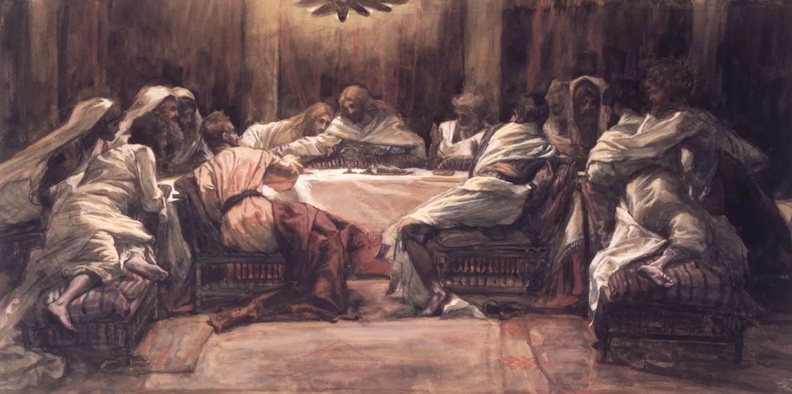
God is love, claims St. John. At the Last Supper, Christ tells us repeatedly to love Him by knowing His commandments and keeping them. Such is the person who “loves me, and he who loves me will be loved by my Father, and I will love him and manifest myself to him. . . .This is my commandment, that you love one another as I have loved you.”
That emphatic call for love as Christ prepares to suffer follows His teaching after His entry into Jerusalem. Asked which is the greatest commandment, He replies, “You shall love the Lord your God with all your heart, and with all your soul, and with all your mind. This is the greatest and first commandment. And a second is like it, You shall love your neighbor as yourself. On these two commandments depend all the law and the prophets.”
Christ has come to fulfill the law in its every detail, the law that is love.
Of the three theological virtues that we must be given by grace – faith, hope and love – St. Paul tells us that love is the greatest.
If God is love, and the foundational commandments are love for God and each other, then all sin must be a failure to love well, an absent or misdirected love that shrivels our soul.
The crucified Christ saw every sinner in all of history, and He became every sin, every failure of all time to love our neighbors properly – acts of theft, murder, adultery, lies, injustice against parents – and every failure to love God as we are created to love Him.
All of those failures follow from the original sin that divided the divine and supernatural from the human and natural, splitting our human logos or reason from Logos itself.
After that catastrophe, but without divine revelation, philosophers reasoned about what an excellent human life would entail. Socrates, Plato, and Aristotle identified the excellences of prudence, justice, fortitude, and temperance.
These habits permit a good life in human or natural terms, and they result from rightly ordered reason. Failures in these virtues derive from failures of reason or prudence, failures either to know reality or to act according to it. Prudence, writes Josef Pieper, is the mother and guide of the other three virtues. Without prudence, a person cannot be just or brave or moderate.
Aristotle also described the virtue of magnanimity, or great-souledness. The magnanimous man is dissatisfied with modest achievements. He is concerned not with money but especially with “matters of honor and dishonor.” He wants the highest honors his community can offer – because he rightly deserves them for his great action.
He knows he is built to be great.
Philosophers have puzzled over what Aristotle meant, or whether he was serious, or even whether he actually wrote these passages. And Aristotle himself is puzzled. “For we blame the ambitious person, on the grounds that he aims at getting more than he ought.” We see some people as overly ambitious when they seek honors that are greater than their souls merit. “We blame the unambitious person, on the grounds that he chooses not to be honored [even for] what is noble.” He is wrongly self-effacing.
Yet “sometimes we praise the ambitious person as manly and a lover of what is noble, and praise the unambitious person as measured and moderate.” Aristotle seems to conclude that our speech and opinion about ambition are confused. We are to want great things in the right proportion to the greatness of our souls, but we can’t get our praise and blame about this greatness consistent and clear.
My pastor, Fr. Paul Scalia, preached recently about “holy ambition,” two words whose association we might find as confusing as Aristotle would. He meant, I think, that we are supposed to be ambitious for real greatness of soul.
The truly great-souled person, claims Aristotle, “would be the best. . .and worthy of the greatest things. He. . . .must be good, and what is great in each virtue would seem to belong to the great-souled man.” The magnanimous man has all the human excellences of prudence, justice, fortitude, and temperance. But that’s not enough for holy ambition.
The confusion about ambition is resolved this week, when the supernatural and natural virtues – divine love and human prudence understood by reason – are reconciled as God and man. That only happens with an act of love, an act of such great love that only God could accomplish it.
Josef Pieper writes that Christianity clarifies the “preeminence of charity over prudence. . . .It is an event unfathomable in any natural way. . . .All our works are elevated by charity to a plane which is otherwise unattainable and utterly inaccessible.” So we might forgive Aristotle for his confusion.
The suffering of Christ opens the way for us to exercise our power to become children of God, through love. His suffering makes it conceivable for us to live on that higher plane, to live as St. Charles de Foucauld says, “only in the thought of God’s love. . .on the heights.” To live the hopes of the Beatitudes, where humility is the key to greatness.
This is the week for greatness of soul, for our deification (theosis) that the Eastern churches speak of, to be as divine as we are meant to be. A time, as St. John Henry Newman says of the nobility of our faith, to have the heart to dare something.
Holy Week is the week of holy and high ambition.