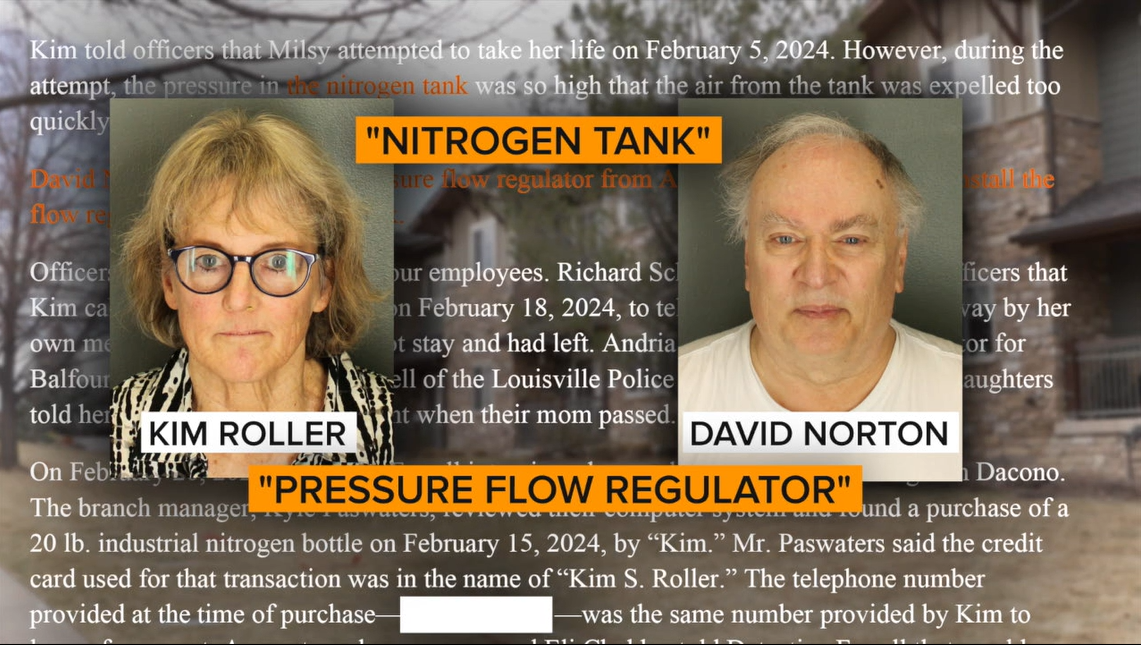
The death of 91-year-old Mildred “Milsy” Roller should end the lazy claim that assisted-suicide laws are safe because they are regulated. Colorado lawmakers and activists sold the public a tightly controlled system. They promised narrow eligibility, medical supervision, and meaningful safeguards.
Yet prosecutors now say Roller died outside that legal framework, with a plastic bag over her head, tubing attached to a nitrogen tank, and family members allegedly involved in planning and carrying out the act. Boulder County District Attorney Michael Dougherty has called it “a sad and tragic case” and has made clear that this was not a lawful assisted death under Colorado law.
It was, he says, a crime.
That fact matters far beyond one Colorado courtroom. This case strips away the public relations language that often surrounds assisted suicide. Once a state declares that some lives may be deliberately ended, the culture changes. The old moral boundary weakens. The question shifts from “Should we kill?” to “Under what conditions may we kill, and who gets to help?” That shift invites abuse, pressure, and rationalization. It teaches people to see death as a service, a solution, and eventually a duty.
Please follow LifeNews.com on Gab for the latest pro-life news and info, free from social media censorship.
According to the publicly reported facts, Roller did not have the terminal diagnosis required by Colorado’s End-of-Life Options Act. Autopsy findings confirmed that point. The law requires a terminal illness with six months or less to live, physician involvement, competency safeguards, and a non-beneficiary witness. None of that happened here. Instead, prosecutors allege that family members bought equipment, assembled it, discussed details by text, and were present when Roller died.
The defendants deny criminal wrongdoing and remain presumed innocent. Still, the indictment itself tells us something important: when the state normalizes suicide as an answer to suffering, people will find ways to imitate the act outside the law’s formal structure.
Supporters of assisted suicide insist that this proves the system worked because the law drew a line and prosecutors enforced it. That argument fails on moral and practical grounds.
It fails morally because the law itself already accepts the principle that some human lives may be intentionally ended. Once that principle takes hold, the legal distinctions begin to look arbitrary.
Why should a person with six months to live qualify for a lethal prescription, but a person who is elderly, despairing, costly to care for, and tired of life must wait?
Why should a doctor be allowed to facilitate death in one case while a relative faces prison in another if both insist they are honoring the same wish? Assisted-suicide advocates created this confusion. They cannot pretend to be surprised when people act on the logic they promoted.
It fails in practice because the so-called safeguards depend on a fiction. They assume that coercion is easy to detect, that motives are transparent, and that vulnerable people act in a vacuum. Real life does not work that way.
Older people know when they are expensive. They know when others feel burdened. They hear the sighs, the talk about bills, the concern over savings, the subtle push toward “dignity.” In Roller’s case, public reporting notes that she lived in a facility costing about $6,980 a month and had substantial savings that would pass to surviving children and other beneficiaries.
Her defenders say this was about her wishes, not money. Perhaps a jury will weigh the facts. But the existence of inheritance interests in a death like this shows why these cases are so dangerous. The pressure does not need to be spoken aloud to shape a decision.
This case also exposes the role of advocacy groups that push death as a legitimate response to suffering. Final Exit Network reportedly held a public workshop at Roller’s facility, and one of the defendants allegedly obtained information there about nitrogen asphyxiation. Final Exit Network was not charged, and it says it did not provide formal guide services in this case.
But after the investigation, the Boulder District Attorney’s office secured changes in the group’s Colorado practices, including an end to public nitrogen demonstrations and step-by-step equipment instruction. That alone is revealing. Authorities clearly saw a serious risk that this information could help people evade the law and hasten death outside medical oversight.
A movement that claims deep concern for autonomy should answer for the trail it leaves behind.
Proponents of assisted suicide often speak in soft tones about compassion. They present hard cases. They invoke pain, fear, and personal choice. What they rarely confront is the social meaning of the policy they defend. A society that authorizes intentional killing in the name of mercy teaches the weak to question whether they should go on living. It teaches families to weigh care against convenience. It teaches institutions that some deaths are easier to facilitate than some lives are to protect.
That danger grows as the numbers rise. Colorado’s reported use of assisted suicide has increased sharply since legalization, from 69 prescriptions in 2017 to 510 in 2024. Advocates treat that increase as evidence of acceptance. A civilized society should see it as a warning. When a lethal practice expands year after year, the burden falls on supporters to prove that the vulnerable remain safe. They have not met that burden. Cases like this one show why they never will.
The right response is stronger than better paperwork. It is stronger than the revised workshop policies. It is stronger than a promise to explain the law more clearly next time.
We need a moral recovery. We need to reject the lie that killing can become care if enough forms are signed first. We need laws that protect the elderly, the disabled, the depressed, and the dependent from every scheme that presents death as treatment. We need families, churches, physicians, and lawmakers to say without apology that a person’s worth does not shrink with age, illness, fear, or need.
Mildred Roller is gone. District Attorney Dougherty said she no longer has a voice in this process. That is true in more ways than one.
The duty now falls to the living. Colorado should prosecute this case fairly and fully. The country should learn from it. When the culture accepts planned killing as a solution, the weak pay first.
A decent society draws the line earlier. It protects life before the bag, the tank, the tubing, and the silence.
LifeNews.com Note: Raimundo Rojas is the director of Outreach Director for the National Right to Life Committee. He is a former president of Florida Right to Life and has presented the pro-life message to millions in Spanish-language media outlets. He represents NRLC at the United Nations as an NGO. Rojas was born in Santiago de las Vegas, Havana, Cuba and he and his family escaped to the United States in 1968.